

• HOME
  • NEWS
  • EXPLORE
    • CAREER
      • Companies
      • Jobs
    • EVENTS
    • iGEM
      • News
      • Team
    • PHOTOS
    • VIDEO
    • WIKI
  • BLOG
  • COMMUNITY
    • FACEBOOK
    • INSTAGRAM
    • TWITTER
Friday, January 9, 2026
BIOENGINEER.ORG
No Result
View All Result
  • Login
  • HOME
  • NEWS
  • EXPLORE
    • CAREER
      • Companies
      • Jobs
        • Lecturer
        • PhD Studentship
        • Postdoc
        • Research Assistant
    • EVENTS
    • iGEM
      • News
      • Team
    • PHOTOS
    • VIDEO
    • WIKI
  • BLOG
  • COMMUNITY
    • FACEBOOK
    • INSTAGRAM
    • TWITTER
  • HOME
  • NEWS
  • EXPLORE
    • CAREER
      • Companies
      • Jobs
        • Lecturer
        • PhD Studentship
        • Postdoc
        • Research Assistant
    • EVENTS
    • iGEM
      • News
      • Team
    • PHOTOS
    • VIDEO
    • WIKI
  • BLOG
  • COMMUNITY
    • FACEBOOK
    • INSTAGRAM
    • TWITTER
No Result
View All Result
Bioengineer.org
No Result
View All Result
Home NEWS Science News Health

Discovery of a drug to rescue winter depression-like behavior

Bioengineer by Bioengineer
April 13, 2020
in Health
Reading Time: 2 mins read
0
IMAGE
Share on FacebookShare on TwitterShare on LinkedinShare on RedditShare on Telegram

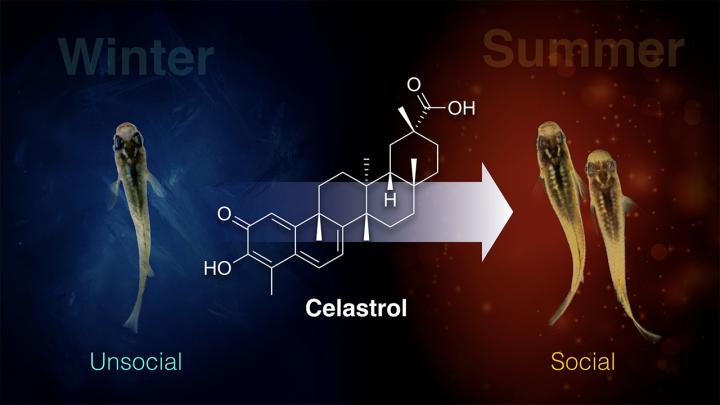
Celastrol treats SAD-like symptoms in medaka fish
IMAGE

Credit: Issey Takahashi | Nagoya University ITbM

A group of animal biologists and chemists at the Institute of Transformative Bio-Molecules (WPI-ITbM), Nagoya University, has used a chemical genomics approach to explore the underlying mechanism of winter depression-like behavior and identified a drug that rescues winter depression-like behavior in medaka fish.

Seasonal changes in the environment can lead to depression- and anxiety-like behavior in humans as well as animals. At high latitudes, including northern regions of the United States and Nordic countries, about 10% of the population suffers from winter depression (Seasonal Affective Disorder: SAD), with typical symptoms including low mood, sleep problems, disrupted circadian rhythms, social withdrawal, decreased libido, and changes in appetite and body weight, and related suicide and social withdrawal becoming a serious public health issue.

Animal models play an essential role in understanding the mechanistic nature of biological and behavioral processes, as well as in the discovery of new drugs. Small fish such as medaka have emerged as powerful models for the study of complex brain disorders and have become valuable pharmacogenetic tools. Medaka were found to be an excellent animal model for winter depression, with decreased sociability and increased anxiety-like behavior in medaka exposed to winter conditions.

To understand the underlying mechanisms of winter depression, the research group employed a chemical genomics approach. An in vivo broad-spectrum chemical screen identified the traditional Chinese medicine, celastrol, as rescuing winter behavior. NRF2 is a celastrol target expressed in the habenula, known to play a critical role in the pathophysiology of depression. Although fish do not have a defined prefrontal cortex (PFC), the habenula is evolutionarily highly conserved and connects the limbic forebrain and monoaminergic system. Depression is considered an adaptation to a harsh environment. Given the striking parallels between patients with SAD and medaka kept under winter-like conditions, the present findings provide important insights into the mechanism of winter depression and offer new potential therapeutic targets for its treatment involving NRF2.

###

Media Contact
Takashi Yoshimura
[email protected]

Original Source

http://www.pnas.org/content/early/2020/04/09/2000278117

Related Journal Article

http://dx.doi.org/10.1073/pnas.2000278117

Tags: BiochemistryBiologyCircadian RhythmDepression/AngerGeneticsMarine/Freshwater BiologyMolecular Biologyneurobiology
Share12Tweet8Share2ShareShareShare2

Related Posts

New Cholinesterase Inhibitors Target Alzheimer’s with Thiadiazoles

January 9, 2026

Microgravity’s Impact on Cancer: Mechanisms and Therapies

January 9, 2026

Postictal EEGs: Predicting Seizure Recurrence Insights

January 9, 2026

Parkinson’s Outcomes Compared: With vs. Without Deep Brain Stimulation

January 9, 2026
Please login to join discussion

POPULAR NEWS

  • Enhancing Spiritual Care Education in Nursing Programs

    154 shares
    Share 62 Tweet 39
  • PTSD, Depression, Anxiety in Childhood Cancer Survivors, Parents

    144 shares
    Share 58 Tweet 36
  • Impact of Vegan Diet and Resistance Exercise on Muscle Volume

    46 shares
    Share 18 Tweet 12
  • SARS-CoV-2 Subvariants Affect Outcomes in Elderly Hip Fractures

    45 shares
    Share 18 Tweet 11

About

We bring you the latest biotechnology news from best research centers and universities around the world. Check our website.

Follow us

Recent News

New Cholinesterase Inhibitors Target Alzheimer’s with Thiadiazoles

Unlocking Heterosis in Pigs via Single-Cell Transcriptomics

Therapy Boosts Neurodevelopment in Preterm Infants

Subscribe to Blog via Email

Enter your email address to subscribe to this blog and receive notifications of new posts by email.

Join 71 other subscribers
  • Contact Us

Bioengineer.org © Copyright 2023 All Rights Reserved.

Welcome Back!

Login to your account below

Forgotten Password?

Retrieve your password

Please enter your username or email address to reset your password.

Log In
No Result
View All Result
  • Homepages
    • Home Page 1
    • Home Page 2
  • News
  • National
  • Business
  • Health
  • Lifestyle
  • Science

Bioengineer.org © Copyright 2023 All Rights Reserved.


