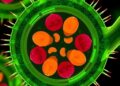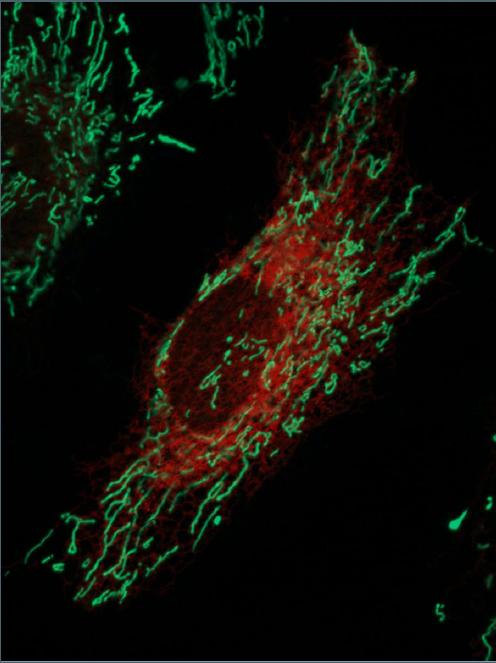
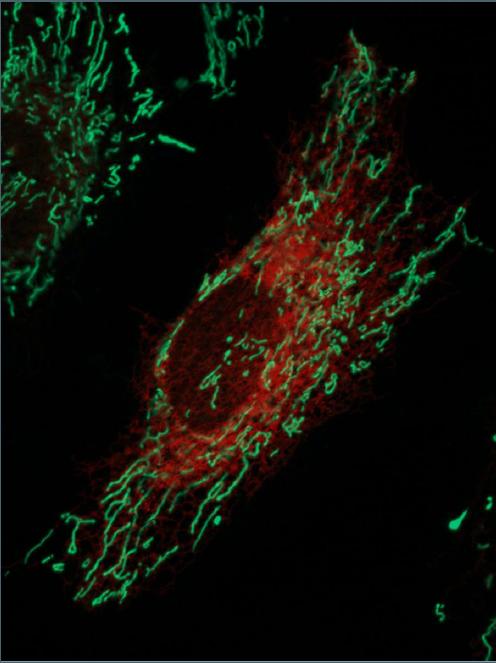
Credit: Images acquired by Ginam Cho.
Inside every cell is a complex infrastructure of organelles carrying out different functions. Organelles must exchange signals and materials to make the cell operate correctly. New technologies are allowing researchers to see and understand the networks that connect these organelles, allowing them to build maps of the trade routes that exist within a cell. A study to be published in the September 29 issue of the Journal of Biological Chemistry reports the use of an emerging method to identify proteins that allows two organelles, the mitochondria and the endoplasmic reticulum, to attach to each other.
"Think of [an organelle] like a ferry docking at one site, unloading and loading passengers and cars, and then going to another site and doing the same thing," said Jeffrey Golden, a professor at Brigham and Women's Hospital and Harvard Medical School who oversaw the work. "Their ability to dock, load, and unload cargo requires guides or ramps of specific width and heights that connect the boat and land or they cannot freely load and unload."
Contact points between the endoplasmic reticulum (ER) and mitochondria are those "ramps" and "guides" that enable these contacts. They permit important activities like signaling, exchange of calcium and lipids, and control of mitochondrial physiology. Faulty connections between ER and mitochondria have been implicated in several neurodegenerative diseases, including Alzheimer's, Parkinson's and Huntington's disease. The proteins that connect and bridge the ER and mitochondria are well-studied in yeast, but the connections between these organelles in multicellular organisms like mammals are more complex and less understood.
Golden's collaborator Ginam Cho and research fellow Il-Taeg Cho had the idea to search for proteins important for ER-mitochondrial contact using a method recently developed to show contact between proteins. The method takes advantage of an enzyme called ascorbate peroxidase, or APEX, which can attach biotin (commonly known as vitamin B7) to proteins nearby. The team engineered cells to produce mitochondria that had APEX attached to their outer membranes, and then added biotin to the cells for the APEX to use to label nearby proteins.
The team then isolated parts of the cell that contained the ER, purified those proteins that had biotin attached, and identified the ones found in the ER using mass spectrometry. Because the APEX was attached to mitochondria, only those proteins that came into close proximity to the mitochondria could have had biotin attached. Thus, the biotin served as a kind of passport stamp that indicated which proteins had been involved in the ER-mitochondria contact.
"It was previously feasible to only look at one molecule at a time to assess what it interacted with," Golden said. "The method we have used is more rapid and allows an unbiased look at a whole system and what's happening at that organelle's interface."
Using this screening method, the researchers zeroed in on an ER protein called RTN1a, which was previously known to contribute to the ER's shape. In follow-up experiments, they confirmed that this protein also helped mitochondria to attach to the ER.
This study raises the possibility that defects in RTN1a could contribute to the problems experienced by patients with neurodegenerative diseases, but the researchers won't know for sure until they conduct additional experiments including similar studies in neural cells.
Golden speculates that the proteins important for ER-mitochondrial contact might be different in different cell types.
"Does the liver use the same proteins to control these kinds of interactions that neural cells do? Is one [protein] more important for calcium exchange and another set of proteins more important for lipid exchange?" Golden asked. "I think there's a lot of cell biology that we just don't know and could be answered [using this method]."
The team is now using the APEX-mass spectrometry method to compare proteins involved in ER-mitochondrial contacts between normal and patient-derived neural cells.
"There are a lot of interesting things we can do," Il-Taeg Cho said.
###
The work was funded by Harvard Medical School.
About the Journal of Biological Chemistry
JBC is a weekly peer-reviewed scientific journal that publishes research "motivated by biology, enabled by chemistry" across all areas of biochemistry and molecular biology. The read the latest research in JBC, visit http://www.jbc.org/.
About the American Society for Biochemistry and Molecular Biology
The ASBMB is a nonprofit scientific and educational organization with more than 12,000 members worldwide. Most members teach and conduct research at colleges and universities. Others conduct research in various government laboratories, at nonprofit research institutions and in industry. The Society's student members attend undergraduate or graduate institutions. For more information about ASBMB, visit http://www.asbmb.org.
Media Contact
Sasha Mushegian
[email protected]
@asbmb
http://www.asbmb.org
Related Journal Article
http://dx.doi.org/10.1074/jbc.M117.795286