New experimental research shows that muscle metabolic activity may be an important factor in the incredible longevity of the world’s oldest living vertebrate species – the Greenland shark. These findings may have applications for conservation of this vulnerable species against climate change or even for human cardiovascular health.
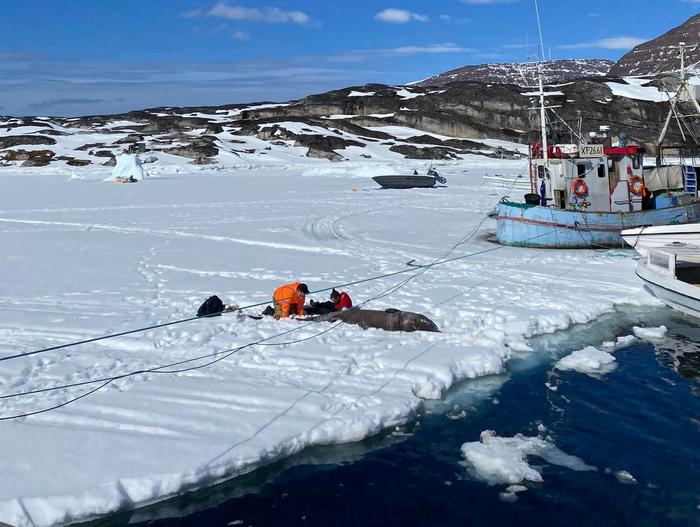
Credit: Ewan Camplisson
New experimental research shows that muscle metabolic activity may be an important factor in the incredible longevity of the world’s oldest living vertebrate species – the Greenland shark. These findings may have applications for conservation of this vulnerable species against climate change or even for human cardiovascular health.
Greenland sharks (Somniosus microcephalus) are the longest living vertebrate with an expected lifespan of at least 270 years and possible lifespan beyond 500 years. “We want to understand what adaptations they have that allow them to live so long,” says Mr Ewan Camplisson, a PhD student at the University of Manchester, UK.
Previously it was thought that this long lifespan was due to the shark’s cold environment and minimal movement, but the factors behind this species extreme longevity appear to be far more complex – prompting Mr Camplisson and his team to investigate alternative theories.
“Most species show variation in their metabolism when they age,” says Mr Camplisson. “We want to determine if Greenland sharks also show this traditional sign of aging or if their metabolism remains unaltered over time.”
To measure the metabolism of the sharks, Mr Camplisson and his team conducted enzyme assays on preserved muscle tissue samples from Greenland sharks. They measured the metabolic activity of these enzymes with a spectrophotometer across a range of different shark ages and environmental temperatures.
Surprisingly, Mr Camplisson and his team found no significant variation in muscle metabolic activity across different ages, suggesting that their metabolism does not appear to decrease over time and may play a key role in their longevity. “This is quite different to most animals which tend to show some variation in their metabolic enzyme activity as they age,” he says. “The results support our hypothesis that the Greenland shark does not show the same traditional signs of aging as other animals.”
The results of this study also show that the Greenland shark’s metabolic enzymes were significantly more active at higher temperatures. “This would suggest that the shark’s red muscle metabolism is not specially adapted for the polar environment, otherwise we would have expected to see less of a temperature related difference in activity,” says Mr Camplisson.
In a world with a rapidly changing climate, long-lived species that are less able to adapt may be the most at risk of extinction. “A female Greenland shark may not become sexually mature until it is 150 years old and with such a long generation time, the species will have far less of a chance to adapt to anthropogenic changes in their environment,” says Mr Camplisson.
Mr Camplisson plans to test more enzymes and tissue types to gain an even deeper understanding of the shark’s metabolic activity. “My ultimate goal is to protect the species and the best way to do this is to better understand them,” he says.
Mr Camplisson is also interested in the possible applications of this research for our understanding of human heart disease. “By studying the Greenland shark and its heart, we may be able to better understand our own cardiovascular health,” he says. “These are issues that become progressively more common and severe with increasing age.”
This research is being presented at the Society for Experimental Biology Annual Conference in Prague on the 2-5th July 2024.