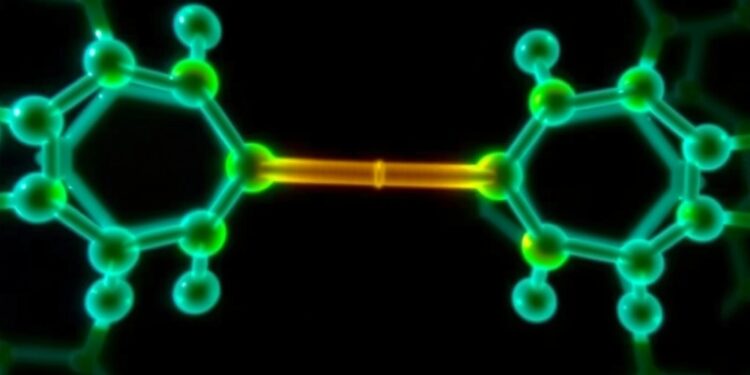
Muon spin rotation spectroscopy has become a pivotal tool in the realm of materials science, particularly for deciphering the complex behaviors of radicals at the atomic level. This technique employs muons, which are fundamental particles resembling protons but demonstrate a significantly lighter mass. When these muons are introduced into various materials, they interact with the local magnetic fields, yielding unprecedented insights into the material’s internal structures and dynamic processes. This technique is exceptionally valuable when investigating highly reactive species such as radicals, where traditional methods may falter.
A groundbreaking study spearheaded by Associate Professor Shigekazu Ito and a team at the Institute of Science Tokyo has recently unveiled the efficacy of muon spin rotation spectroscopy in the examination of 12-phosphatetraphene—a compound notable for its phosphorus congener characteristics. This extensive investigation sheds light on not only the molecular architecture of this complex structure but also the profound implications of its reactivity, especially through processes categorized as regioselective muoniation. The significance of this discovery extends beyond pure chemistry, as it possesses potential applications across various domains, including advanced materials science and biological regulation.
The exploratory journey of this research commenced with the realization of muonium formation, an intriguing process initiated by the capture of electrons by positively charged muons. The synthesis of muonium is a fascinating chemical reaction that forms the foundation of subsequent interactions with other compounds, particularly those that house phosphorus atoms. The researchers discovered that the muonium reacts exclusively with the phosphorus site in the 12-phosphatetraphene structure. This regioselective addition manifests a decisive reaction pathway driven by the phosphorus’s inherent reactivity—an essential characteristic inherent to polyaromatic hydrocarbons.
As the team meticulously measured the outcomes through transverse-field muon spin rotation (TF-μSR) spectroscopy, the findings illuminated the striking formation of a stable yet reactive muoniated radical at the phosphorus site. This revelation underscores the node’s reaction potential, establishing new frontiers for exploring the behaviors of similar reactive molecules under rigorous experimental conditions. Notably, the reactions initiated efficiently even at remarkably low concentrations, indicating a promising avenue for probing reactive species in various molecular environments. Such insights are vital for not only understanding fundamental chemical reactions but also for advancing the design of materials tailored for specific applications.
The theoretical foundation for this research expanded through the utilization of density functional theory (DFT), which furnished crucial insights into the electronic structure and stability of the muoniated radicals formed. The computed hyperfine parameters (Aμ and A31P) revealed essential structural characteristics that contribute to the stabilization of the muoniated radical—a finding that emphasizes the role of electronic interactions in the configurational stability of such reactive species. This stabilization occurs in a flat, π-delocalized structure, allowing for optimal energy dispersion and impeding the formation of less favored alternate structural forms.
One of the more compelling aspects of the study emerged when examining the temperature-dependent behavior of the muoniated radicals. As temperatures increased, both the Aμ and A31P parameters exhibited a noticeable decline, suggesting an augmentation of structural stability in the radicals formed. These discoveries were further corroborated by complementary experiments integrating muon (avoided) level-crossing resonance techniques, which elucidated deeper dynamics and structural properties of the radicals under study.
The collaborative endeavor presents a substantial advancement in our comprehension of phosphorus-centered radicals and emphasizes the versatile applicability of muon spin resonance spectroscopy. These findings not only contribute to theoretical knowledge but also hold the promise of practical implications in material applications. The stabilization mechanisms elucidated could guide future research in optimizing radical stability and reactivity, facilitating the establishment of innovative technologies and therapeutic modalities.
The regioselective muoniation of peri-trifluoromethylated 12-phosphatetraphene exemplifies a new frontier in radical chemistry, with anticipated implications spanning the fields of both material science and molecular biology. The development of electron-spin functional materials and nucleic acid regulating agents stem from this powerful investigation, laying the groundwork for significant advancements in how we design materials and engineer molecular interactions at an elementary level.
As we delve deeper into this fascinating realm, the potential to revolutionize our understanding of radical behavior remains enticing. The intricate balance between reactivity and stability within these systems could open new pathways for exploring reactive species and could enhance their utility in practical applications. The findings of this research herald an exciting era for both theoretical and experimental chemists eager to harness the capabilities of cutting-edge techniques like muon spin spectroscopy.
In conclusion, the implications of this study are vast and multi-faceted, shedding light on a myriad of unexplored pathways within radical chemistry and materials science. While reinforcing the importance of rigorous experimental methodologies, the highlights of this investigation serve as a beacon for future explorations into the radical universe. The convergence of innovative research methodologies and theoretical frameworks signals a monumental shift in how we conceptualize and apply knowledge of reactive species, ensuring that this field remains vibrant and ripe for discovery.
Subject of Research: Not applicable
Article Title: Muon spectroscopy of a 12-phosphatetraphene with extremely efficient radical trapping properties
News Publication Date: January 7, 2025
Web References: Scientific Reports
References: None available
Image Credits: Institute of Science Tokyo
Keywords
Muon spin rotation, 12-phosphatetraphene, reactive radicals, transverse-field muSR spectroscopy, density functional theory, material science, electron-spin functional materials, molecular biology, radical behavior, stabilization mechanisms, regioselective muoniation, phosphorus congener.
Tags: 12-phosphatetraphene studiesadvanced materials developmentapplications in biological regulationfundamental particle interactionshighly reactive species investigationinsights into dynamic processesmaterials science advancementsmolecular architecture analysisMuon spin rotation spectroscopymuonium formation researchradical trapping techniquesregioselective muoniation processes