• HOME
  • NEWS
  • EXPLORE
    • CAREER
      • Companies
      • Jobs
    • EVENTS
    • iGEM
      • News
      • Team
    • PHOTOS
    • VIDEO
    • WIKI
  • BLOG
  • COMMUNITY
    • FACEBOOK
    • INSTAGRAM
    • TWITTER
Sunday, May 17, 2026
BIOENGINEER.ORG
No Result
View All Result
  • Login
  • HOME
  • NEWS
  • EXPLORE
    • CAREER
      • Companies
      • Jobs
        • Lecturer
        • PhD Studentship
        • Postdoc
        • Research Assistant
    • EVENTS
    • iGEM
      • News
      • Team
    • PHOTOS
    • VIDEO
    • WIKI
  • BLOG
  • COMMUNITY
    • FACEBOOK
    • INSTAGRAM
    • TWITTER
  • HOME
  • NEWS
  • EXPLORE
    • CAREER
      • Companies
      • Jobs
        • Lecturer
        • PhD Studentship
        • Postdoc
        • Research Assistant
    • EVENTS
    • iGEM
      • News
      • Team
    • PHOTOS
    • VIDEO
    • WIKI
  • BLOG
  • COMMUNITY
    • FACEBOOK
    • INSTAGRAM
    • TWITTER
No Result
View All Result
Bioengineer.org
No Result
View All Result
Home NEWS Science News Biology

Directed evolution of endogenous genes opens door to rapid agronomic trait improvement

Bioengineer by Bioengineer
January 13, 2020
in Biology
Reading Time: 2 mins read
0
IMAGE
Share on FacebookShare on TwitterShare on LinkedinShare on RedditShare on Telegram

IMAGE

Credit: IGDB


A research team led by Profs. GAO Caixia and LI Jiayang from the Institute of Genetics and Developmental Biology of the Chinese Academy of Sciences have engineered five saturated targeted endogenous mutagenesis editors (STEMEs) and generated de novo mutations to facilitate the directed evolution of plant genes. Their study was published in Nature Biotechnology on Jan. 13.

Heredity and variation are the basis of organismic evolution. Random mutagenesis by physical or chemical methods has long been applied to improve traits in plants, but it is labor-intensive and time-consuming.

In higher organisms, especially in plants, a target gene is usually transferred into a bacterial or yeast cell to generate the required diversity for selection, but once a target gene is no longer in situ, the functional consequences of such a change may not be the same as in the native context. Moreover, most important agronomic traits cannot be selected in bacteria or yeast.

“To establish powerful tools for directly inducing saturated targeted mutations and selection in plants will accelerate the development of agronomic traits and important functional genes,” said Prof. GAO Caixia.

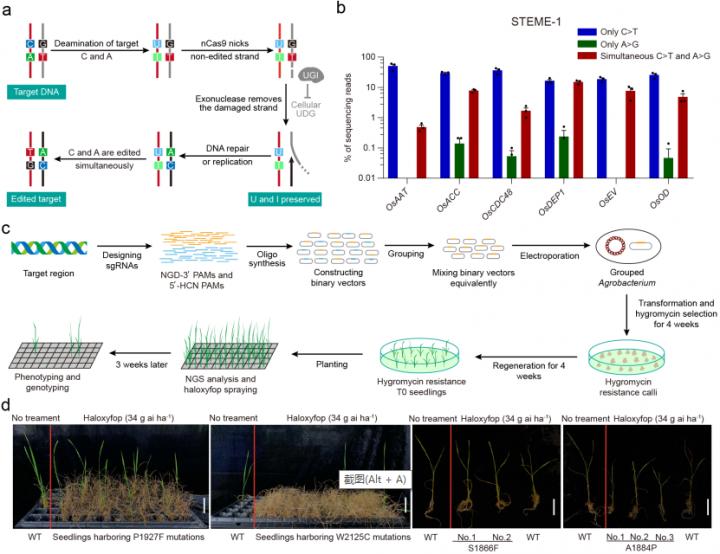
The researchers fused cytidine deaminase with adenosine deaminase to obtain four STEMEs. All four STEMEs efficiently produced simultaneous C>T and A>G conversions using only a sgRNA.

They also produced the fifth dual cytosine and adenine base editor – STEME-NG – to expand the targeting scope. With only 20 sgRNAs in rice protoplasts, STEME-NG can produce near-saturated mutagenesis for a 56-amino-acid portion of the rice acetyl-coenzyme A carboxylase gene (OsACC).

In a proof-of-concept experiment, the researchers used STEMEs to direct the evolution of OsACC gene in rice plants. They sprayed the regenerated rice seedlings with haloxyfop as the selection pressure. The scientists then identified three novel (P1927F, W2125C, and S1866F) and one known (W2125C) amino acid substitutions for herbicide resistance. These mutations were found to affect the haloxyfop-binding pocket directly or indirectly, based on the homology model of the CT domain of yeast ACC.

The development of STEME paves the way for directed evolution of endogenous plant genes in situ, which is important for breeding via molecular design.

Moreover, this STEME process might also be applicable beyond plants. For example, it may be useful for screening drug resistance mutations, altering cis elements on noncoding regions and correcting pathogenic SNVs in cell lines, yeast or animals.

###

The study was supported by the Strategic Priority Research Program of the Chinese Academy of Sciences, the National Natural Science Foundation of China, and the National Key Research and Development Program of China.

Media Contact
QI Lei
[email protected]

Related Journal Article

http://dx.doi.org/10.1038/s41587-019-0393-7

Tags: BiologyGenesGeneticsPlant Sciences
Share12Tweet8Share2ShareShareShare2

Related Posts

Uncovering C. elegans Immunity via Genetic Screens — Biology

Uncovering C. elegans Immunity via Genetic Screens

May 16, 2026
Single mother must adapt swiftly — the survival of her colony depends on it — Biology

Single mother must adapt swiftly — the survival of her colony depends on it

May 15, 2026

Why Are Nearly Everyone Right-Handed? It Might Be Linked to How We Learned to Walk

May 15, 2026

Excessive Neuronal Activity Initiates Severe Autoimmune Brain Disorder

May 15, 2026
Please login to join discussion

POPULAR NEWS

  • Research Indicates Potential Connection Between Prenatal Medication Exposure and Elevated Autism Risk

    844 shares
    Share 338 Tweet 211
  • New Study Reveals Plants Can Detect the Sound of Rain

    730 shares
    Share 291 Tweet 182
  • Salmonella Haem Blocks Macrophages, Boosts Infection

    62 shares
    Share 25 Tweet 16
  • Breastmilk Balances E. coli and Beneficial Bacteria in Infant Gut Microbiomes

    58 shares
    Share 23 Tweet 15

About

We bring you the latest biotechnology news from best research centers and universities around the world. Check our website.

Follow us

Recent News

Flexible Framework Optimizes Data Center Site Planning

Short-Term Home Cognitive & Physical Training Tested in Seniors

Stress Evolution and Time Control in Retreat Roadways

Subscribe to Blog via Email

Success! An email was just sent to confirm your subscription. Please find the email now and click 'Confirm' to start subscribing.

Join 82 other subscribers
  • Contact Us

Bioengineer.org © Copyright 2023 All Rights Reserved.

Welcome Back!

Login to your account below

Forgotten Password?

Retrieve your password

Please enter your username or email address to reset your password.

Log In
No Result
View All Result
  • Homepages
    • Home Page 1
    • Home Page 2
  • News
  • National
  • Business
  • Health
  • Lifestyle
  • Science

Bioengineer.org © Copyright 2023 All Rights Reserved.