• HOME
  • NEWS
  • EXPLORE
    • CAREER
      • Companies
      • Jobs
    • EVENTS
    • iGEM
      • News
      • Team
    • PHOTOS
    • VIDEO
    • WIKI
  • BLOG
  • COMMUNITY
    • FACEBOOK
    • INSTAGRAM
    • TWITTER
Sunday, May 24, 2026
BIOENGINEER.ORG
No Result
View All Result
  • Login
  • HOME
  • NEWS
  • EXPLORE
    • CAREER
      • Companies
      • Jobs
        • Lecturer
        • PhD Studentship
        • Postdoc
        • Research Assistant
    • EVENTS
    • iGEM
      • News
      • Team
    • PHOTOS
    • VIDEO
    • WIKI
  • BLOG
  • COMMUNITY
    • FACEBOOK
    • INSTAGRAM
    • TWITTER
  • HOME
  • NEWS
  • EXPLORE
    • CAREER
      • Companies
      • Jobs
        • Lecturer
        • PhD Studentship
        • Postdoc
        • Research Assistant
    • EVENTS
    • iGEM
      • News
      • Team
    • PHOTOS
    • VIDEO
    • WIKI
  • BLOG
  • COMMUNITY
    • FACEBOOK
    • INSTAGRAM
    • TWITTER
No Result
View All Result
Bioengineer.org
No Result
View All Result
Home NEWS Science News Chemistry

Direct observation of the ad- and desorption of guest atoms into a mesoporous host

Bioengineer by Bioengineer
April 21, 2021
in Chemistry
Reading Time: 3 mins read
0
IMAGE
Share on FacebookShare on TwitterShare on LinkedinShare on RedditShare on Telegram

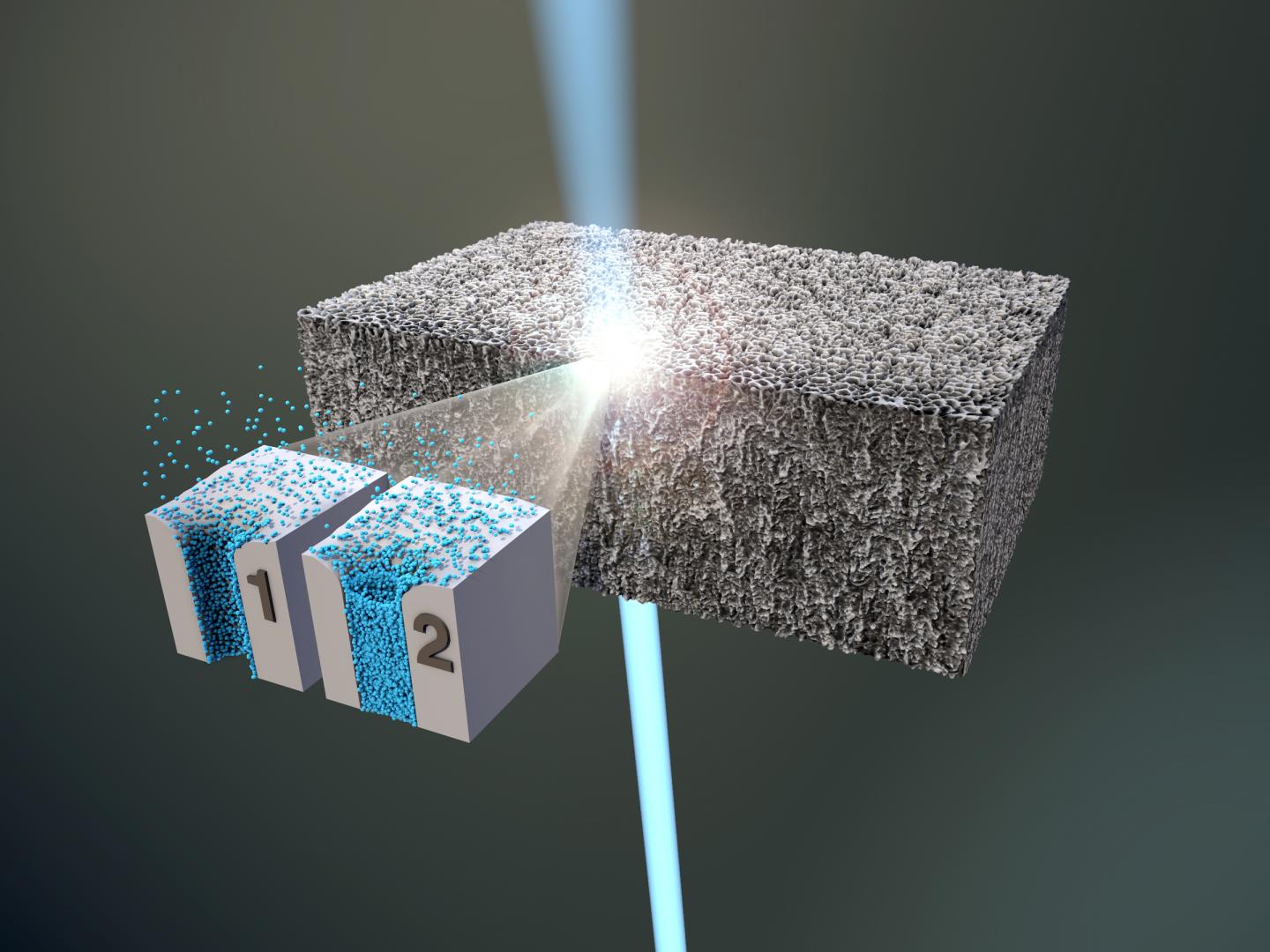
Battery electrodes, storage devices for gases, and some catalyst materials have tiny functional pores that can accommodate atoms, ions, and molecules.
IMAGE

Credit: M. Künsting/HZB

Most battery materials, novel catalysts, and storage materials for hydrogen have one thing in common: they have a structure comprised of tiny pores in the nanometer range. These pores provide space which can be occupied by guest atoms, ions, and molecules. As a consequence, the properties of the guest and the host can change dramatically. Understanding the processes inside the pores is crucial to develop innovative energy technologies.

Observing the filling process

So far, it has only been possible to characterise the pore structure of the substrate materials precisely. The exact structure of the adsorbate inside the pores has remained hidden. To probe this, a team from the HZB together with colleagues from the University of Hamburg, from Germany’s national metrology institute PTB, and Humboldt-Universität zu Berlin combined for the first time two different X-ray methods applied in-situ during filling and emptying of the porous host. Doing so, they made the structure of the guest atoms alone visible.

Model system: Mesoporous Silicon with Xenon

The team examined the process on a model system made of mesoporous silicon. The noble gas xenon was brought into contact with the silicon sample in a custom-made physisorption cell under temperature and pressure control. They examined the sample using anomalous small-angle X-ray scattering (ASAXS) and X-ray absorption near-edge structure (XANES) spectroscopy simultaneously, near the X-ray absorption edge of the guest xenon. In this way, they were able to sequentially record how xenon migrates into the pores. They could observe that the atoms first form a monoatomic layer on the pores’ inner surfaces. Further layers are added and undergo rearrangements until the pores are filled. It gets clear that the filling and emptying of the pores proceed through different mechanisms with distinct structures.

Signal of the Xenon guests extracted

“Using conventional X-ray scattering (SAXS), you mainly see the porous material, the contributions of the guests are hardly visible”, says Eike Gericke, first author of the study, who is doing his PhD on X-ray techniques. “We changed that by using ASAXS and measured at the X-ray absorption edge of xenon. The interactions between xenon and the X-ray beam change at this edge, so we can mathematically extract the signal of the xenon guests.”

Empirical insight into confined matter

“This gives us for the first time direct access to an area that previously could only be speculated about”, explains Dr. Armin Hoell, a corresponding author of the paper. “Applying the combination of these two X-ray methods to the process now makes it possible to observe the behaviour of matter confined in nanostructures empirically. This is a powerful new tool to gain deeper insights into battery electrodes, catalysts, and hydrogen storage materials.”

###

Media Contact
Antonia Roetger
[email protected]

Original Source

https://www.helmholtz-berlin.de/bin/news_seite?nid=22740;sprache=en;intern=1

Related Journal Article

http://dx.doi.org/10.1021/acs.jpclett.1c00557

Tags: Chemistry/Physics/Materials Sciences
Share13Tweet8Share2ShareShareShare2

Related Posts

Study Reveals How Valproate Affects Early Brain Development: Insights into the Antiepileptic Drug’s Impact — Chemistry

Study Reveals How Valproate Affects Early Brain Development: Insights into the Antiepileptic Drug’s Impact

May 22, 2026
Sustainable Chemistry: Iron Replaces Noble Metals in Catalytic Reactions — Chemistry

Sustainable Chemistry: Iron Replaces Noble Metals in Catalytic Reactions

May 22, 2026

Advancing Thin-Film Device Manufacturing with Imaging Ellipsometry for Enhanced Process Control

May 22, 2026

Simple Adjustment in 3D Printing Enhances Fit of Dental Crowns

May 22, 2026
Please login to join discussion

POPULAR NEWS

  • ESMO 2025: mRNA COVID Vaccines Enhance Efficacy of Cancer Immunotherapy

    314 shares
    Share 126 Tweet 79
  • New Study Reveals Plants Can Detect the Sound of Rain

    734 shares
    Share 293 Tweet 183
  • Research Indicates Potential Connection Between Prenatal Medication Exposure and Elevated Autism Risk

    847 shares
    Share 339 Tweet 212
  • Common Food Preservatives Associated with Elevated Blood Pressure and Increased Heart Disease Risk

    56 shares
    Share 22 Tweet 14

About

We bring you the latest biotechnology news from best research centers and universities around the world. Check our website.

Follow us

Recent News

Comparing Robust Intelligent Controls for 3-DOF Robots

Predicting Flashover on Polluted Insulators with CNN-LSTM

Sepsis from C. difficile Infection Has Comparable Mortality

Subscribe to Blog via Email

Enter your email address to subscribe to this blog and receive notifications of new posts by email.

Join 83 other subscribers
  • Contact Us

Bioengineer.org © Copyright 2023 All Rights Reserved.

Welcome Back!

Login to your account below

Forgotten Password?

Retrieve your password

Please enter your username or email address to reset your password.

Log In
No Result
View All Result
  • Homepages
    • Home Page 1
    • Home Page 2
  • News
  • National
  • Business
  • Health
  • Lifestyle
  • Science

Bioengineer.org © Copyright 2023 All Rights Reserved.