• HOME
  • NEWS
  • EXPLORE
    • CAREER
      • Companies
      • Jobs
    • EVENTS
    • iGEM
      • News
      • Team
    • PHOTOS
    • VIDEO
    • WIKI
  • BLOG
  • COMMUNITY
    • FACEBOOK
    • INSTAGRAM
    • TWITTER
Tuesday, July 7, 2026
BIOENGINEER.ORG
No Result
View All Result
  • Login
  • HOME
  • NEWS
  • EXPLORE
    • CAREER
      • Companies
      • Jobs
        • Lecturer
        • PhD Studentship
        • Postdoc
        • Research Assistant
    • EVENTS
    • iGEM
      • News
      • Team
    • PHOTOS
    • VIDEO
    • WIKI
  • BLOG
  • COMMUNITY
    • FACEBOOK
    • INSTAGRAM
    • TWITTER
  • HOME
  • NEWS
  • EXPLORE
    • CAREER
      • Companies
      • Jobs
        • Lecturer
        • PhD Studentship
        • Postdoc
        • Research Assistant
    • EVENTS
    • iGEM
      • News
      • Team
    • PHOTOS
    • VIDEO
    • WIKI
  • BLOG
  • COMMUNITY
    • FACEBOOK
    • INSTAGRAM
    • TWITTER
No Result
View All Result
Bioengineer.org
No Result
View All Result
Home NEWS Science News Biology

Dinosaur feathers reveal traces of ancient proteins

Bioengineer by Bioengineer
September 21, 2023
in Biology
Reading Time: 2 mins read
0
Dr Tiffany Slater
Share on FacebookShare on TwitterShare on LinkedinShare on RedditShare on Telegram

Palaeontologists at University College Cork (UCC) in Ireland have discovered X-ray evidence of proteins in fossil feathers that sheds new light on feather evolution.    
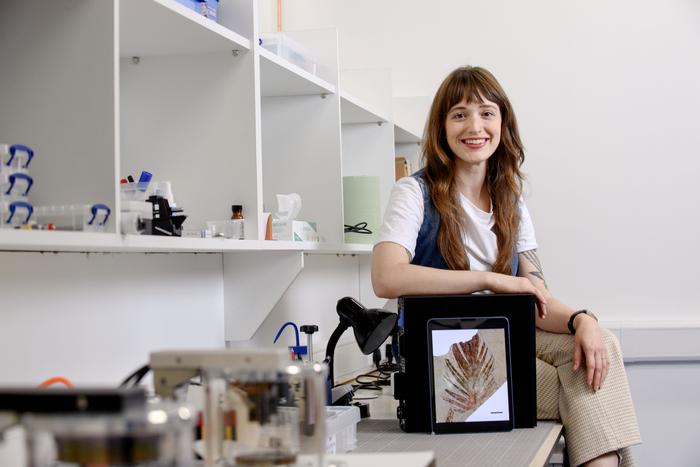
Dr Tiffany Slater

Credit: Daragh Mc Sweeney/Provision

Palaeontologists at University College Cork (UCC) in Ireland have discovered X-ray evidence of proteins in fossil feathers that sheds new light on feather evolution.    

Previous studies suggested that ancient feathers had a different composition to the feathers of birds today. The new research, however, reveals that the protein composition of modern-day feathers was also present in the feathers of dinosaurs and early birds, confirming that the chemistry of feathers originated much earlier than previously thought. 

The research, published today in Nature Ecology and Evolution, was led by palaeontologists Dr Tiffany Slater and Prof. Maria McNamara of UCC’s School of Biological, Earth, and Environmental Science, who teamed with scientists based at Linyi University (China) and the Stanford Synchrotron Radiation Lightsource (USA). 

The team analysed 125-million-year-old feathers from the dinosaur Sinornithosaurus and the early bird Confuciusornis from China, plus a 50-million-year-old feather from the USA. 

“It’s really exciting to discover new similarities between dinosaurs and birds,” Dr Slater says. “To do this, we developed a new method to detect traces of ancient feather proteins. Using X-rays and infrared light we found that feathers from the dinosaur Sinornithosaurus contained lots of beta-proteins, just like feathers of birds today.” 

To help interpret the chemical signals preserved in the fossil feathers, the team also ran experiments to help understand how feather proteins break down during the fossilization process. 

“Modern bird feathers are rich in beta-proteins that help strengthen feathers for flight,” Dr Slater says.  

“Previous tests on dinosaur feathers, though, found mostly alpha-proteins. Our experiments can now explain this weird chemistry as the result of protein degradation during the fossilization process. So although some fossil feathers do preserve traces of the original beta-proteins, other fossil feathers are damaged and tell us a false narrative about feather evolution.” 

This research helps answer a long-standing debate about whether feather proteins, and proteins in general, can preserve in deep time.  

Prof. Maria McNamara, senior author on the study, said  

“Traces of ancient biomolecules can clearly survive for millions of years, but you can’t read the fossil record literally because even seemingly well-preserved fossil tissues have been cooked and squashed during fossilization. We’re developing new tools to understand what happens during fossilization and unlock the chemical secrets of fossils. This will give us exciting new insights into the evolution of important tissues and their biomolecules. “ 

ENDS 


Journal

Nature

DOI

10.1038/s41559-023-02177-8

Method of Research

Imaging analysis

Subject of Research

Animals

Article Title

Preservation of corneous β-proteins in Mesozoic feathers

Article Publication Date

21-Sep-2023

COI Statement

None

Share12Tweet8Share2ShareShareShare2

Related Posts

Here are a few rewritten headlines for a science magazine post, each with a slightly different tone: Intriguing & poetic: How do organs sculpt themselves? Sea stars hold the secret Direct & research-focused: Sea stars reveal the hidden rules of organ formation Metaphorical & inviting: Tiny architects beneath the waves: What sea stars teach us about building organs Short & punchy: Star-shaped clues to how our organs take shape Question-led: Could a sea star show us how organs form? Elegant & feature-style: The body’s blueprint, glimpsed in a sea star’s arm

July 6, 2026
Bacteria evolve faster with unconventional gene copies — Biology

Bacteria evolve faster with unconventional gene copies

July 6, 2026

Neighbours rewire soil feedback via root microbiome shifts

July 6, 2026

Evolution-Inspired Biosensors Revolutionize Lipid Tracking in Real Time

July 2, 2026

POPULAR NEWS

  • Detection of EDCs in Breast Milk and Infant Urine Up to Six Months Highlights Early Exposure Risks

    77 shares
    Share 31 Tweet 19
  • New Drug Candidate Developed at McMaster Shows Potential for Treating Brain Cancer

    58 shares
    Share 23 Tweet 15
  • Saying Goodbye to PGY-6: Pediatric Fellowship Realities

    103 shares
    Share 41 Tweet 26
  • KTU Researchers Explore Ultrasound’s Role in Enhancing Blood Flow Beyond Diagnostics

    53 shares
    Share 21 Tweet 13

About

We bring you the latest biotechnology news from best research centers and universities around the world. Check our website.

Follow us

Recent News

Flame retardant BDE-209 targets molecularly linked to ulcerative colitis

Ultra-high frequency particle impacts mimic rockbursts to shatter hard rock

Kidney transplant outcomes in older adults studied by German researchers

Subscribe to Blog via Email

Enter your email address to subscribe to this blog and receive notifications of new posts by email.

Join 83 other subscribers
  • Contact Us

Bioengineer.org © Copyright 2023 All Rights Reserved.

Welcome Back!

Login to your account below

Forgotten Password?

Retrieve your password

Please enter your username or email address to reset your password.

Log In
No Result
View All Result
  • Homepages
    • Home Page 1
    • Home Page 2
  • News
  • National
  • Business
  • Health
  • Lifestyle
  • Science

Bioengineer.org © Copyright 2023 All Rights Reserved.