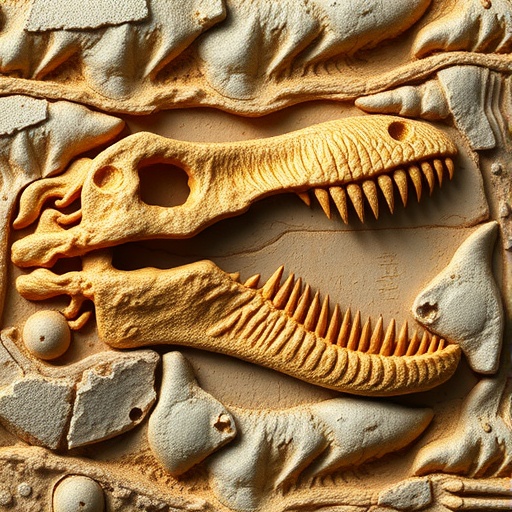
A groundbreaking study out of Ohio State University has revealed compelling new evidence about the social behavior and parental care strategies of Maiasaura peeblesorum, a duck-billed dinosaur species that roamed North America during the Late Cretaceous period approximately 75 to 80 million years ago. Through meticulous examination of dental microwear patterns on fossilized teeth, researchers have uncovered differences in the diets of juveniles and adults that suggest sophisticated parental provisioning—an evolutionary behavior long presumed to be exclusive to birds and mammals.
Maiasaura, whose name fittingly means “good mother lizard,” has long fascinated paleontologists due to its well-preserved nesting sites in Montana, which display indications of social living and reproduction involving extensive care for hatchlings. This latest research builds on that foundation by analyzing the microscopic wear features on teeth from different life stages, revealing distinct functional adaptations between juveniles and adults. Juvenile teeth exhibit pronounced crushing wear, indicative of a diet consisting predominantly of softer, low-fiber, and presumably higher-nutrient foods such as fruits. In contrast, adult teeth display more pronounced shearing wear patterns, consistent with consuming tougher, high-fiber plant material.
The significance of these findings cannot be overstated, as they provide the earliest direct evidence suggesting that Maiasaura parents may have actively fed their young higher-quality food, a behavior commonly seen in modern birds but rare among reptiles and other dinosaurs. Such targeted feeding strategies would have facilitated rapid growth rates in juvenile dinosaurs, enabling better survival odds during vulnerable early life stages. This parental investment strategy aligns Maiasaura’s ecology more closely with extant avian species, suggesting that complex social behaviors evolved at the origins of dinosauria.
Lead author John Hunter emphasized the evolutionary implications by stating that this form of parental care might extend far beyond the emergence of birds, possibly dating back to the earliest dinosaurs. The concept that the fundamental urge to feed offspring could have deep evolutionary roots challenges previous assumptions about dinosaur behavior and hints at sophisticated social systems more complex than previously appreciated in the Mesozoic era.
Comparative anatomy supports the dietary differentiation found in Maiasaura, as similar tooth wear patterns are evident in modern herbivorous mammals. For instance, adult Maiasaura resemble extant grazers such as horses and antelopes, which consume fiber-rich grasses and rough vegetation requiring considerable occlusal shearing to process. Juvenile Maiasaura dental wear parallels that of animals like tapirs, which consume softer, less fibrous foods. This analogy not only bolsters the interpretations of the fossil record but also underlines the ecological nuances within dinosaur herds.
The implications of this dietary heterogeneity point toward the role of niche differentiation within a single species, where resource partitioning between age classes minimized intraspecific competition and may have been a driver for social cohesion. Fast juvenile growth fueled by nutrient-rich diets would ensure the development of an individual’s robust dental and musculoskeletal systems necessary for processing tougher vegetation as adults, highlighting an ontogenetic dietary shift critical to hadrosaurid life history strategies.
Alternate hypotheses to explain these patterns were also considered, including the possibility that parents regurgitated partially digested food to their offspring, a feeding behavior well-documented in modern avian taxa. Another scenario posits that juveniles may have ventured from the nest to forage independently on softer vegetation, akin to behaviors seen in modern herbivorous lizards. However, the likelihood of these alternatives remains low given the known immobility of hatchlings and nest-dependence observed in fossil nesting assemblages.
This research also underscores the value of dental microwear analysis as a window into paleodiets and behavioral ecology. The microabrasions and polish on teeth reflect the physical properties of consumed food items and have emerged as crucial proxies for reconstructing the subtleties of extinct animal life. By integrating these microscopic patterns with fossil nesting data, scientists have forged a more comprehensive understanding of dinosaur parental behaviors and resource allocation strategies.
Furthermore, these insights deepen our understanding of evolutionary continuity from non-avian dinosaurs to birds, illuminating how behavioral repertoires such as parental provisioning may have been established deeply in dinosaurian lineage prior to the advent of flight and endothermy. Such findings exemplify the intricate interplay between morphology, behavior, and ecology in the evolutionary narrative.
As paleontology advances, the team behind this study advocates for further examination of dental microwear in embryonic and hatchling fossils, where available. Such investigations could refine our knowledge of ontogenetic dietary changes, embryonic development, and parental care across diverse dinosaur taxa. This approach promises to unravel additional dimensions of prehistoric life that remain obscured in the fossil record.
Co-author Christine Janis of the University of Bristol and Brown University contributed critical expertise linking the dental wear patterns to ecological and evolutionary frameworks, while the study garnered support from Brown University, indicating robust interdisciplinary collaboration. The findings appeared recently in the journal Palaeogeography, Palaeoclimatology, Palaeoecology, marking a significant contribution to dinosaur paleobiology and our broader understanding of ancient ecosystems.
Ultimately, this study illuminates how sophisticated social behaviors and developmental strategies evolved early in the dinosaur lineage, reinforcing the exceptional nature of Maiasaura as a species that exhibited care and provisioning far earlier than once assumed. Their legacy provides a vital blueprint for tracing the evolution of parental care and sociality that echoes through modern birds and mammals today.
Subject of Research: Animals
Article Title: Tooth wear in juvenile and adult hadrosaurs: implications for parental care in Maiasaura☆
News Publication Date: 15-May-2026
Web References: http://dx.doi.org/10.1016/j.palaeo.2026.113707
References: Palaeogeography, Palaeoclimatology, Palaeoecology (Journal)
Keywords: Dinosaurs, Herbivores, Natural history, Evolutionary biology, Developmental biology, Organismal biology, Animal science, Animals, Modern birds, Wild birds
Tags: dinosaur dental microwear analysisdinosaur herbivory dietary adaptationsdinosaur juvenile versus adult dietdinosaur nesting site discoveriesdinosaur reproduction and social livingevolutionary origins of parental carefossil evidence of dinosaur parentingLate Cretaceous dinosaur dietLate Cretaceous North American dinosaursMaiasaura fossil teeth studyMaiasaura parental care behaviorMaiasaura peeblesorum social behavior