


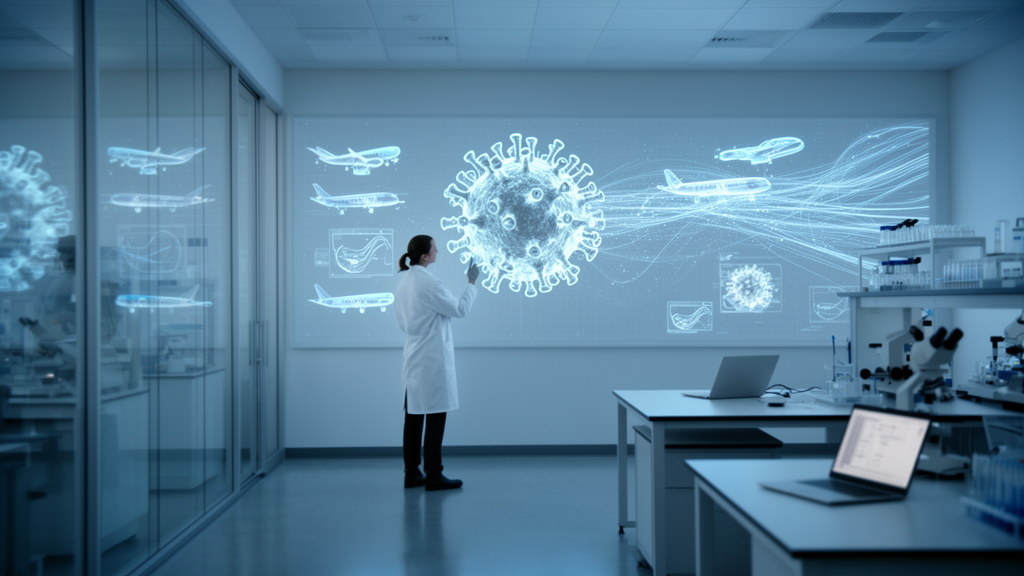
Virtual replicas of physical systems, known as digital twins, took centre stage at the 10th session of the World Health Organization’s Pandemic and Epidemic Intelligence Innovation Forum, a meeting convened by the WHO Hub for Pandemic and Epidemic Intelligence in Berlin on June 20, 2024. The session brought together a leading scientist from the International Institute for Applied Systems Analysis in Vienna, contributors from the Barcelona Supercomputing Center, the WHO Data and Analytics division, and the Collaboration for Advanced Analytics Unit at the WHO Hub in Berlin. Their shared goal was to define what digital twins are, examine how they are already used across sectors from climate adaptation to aerospace, and assess what it would take to deploy them for pandemic preparedness and public health surveillance. The meeting report, published in BMC Proceedings, captures a technology at an inflection point: mature enough to simulate cities, climate systems and aircraft components, yet still in its early stages when applied to the sprawling, messy reality of population health.
Digital twins are dynamic, virtual replicas that integrate real-time data to provide a comprehensive digital representation of physical objects, processes or systems. The concept traces back to NASA’s efforts in the 1960s, when so-called mirroring technology was developed to simulate spacecraft behaviour and minimise risks during missions. The term digital twin was officially coined in 2000, and the technology has since spread from aerospace into manufacturing, healthcare and urban planning, reaching a peak of attention during the COVID-19 pandemic. What distinguishes a digital twin from a static model or a simple three-dimensional representation is the continuous feedback loop between the physical and digital realms: the twin mirrors the real-time status, condition or position of its physical counterpart. Data serves as the backbone of these systems. Sensors embedded in mobile devices, hospital equipment, environmental monitoring stations and urban infrastructure continuously transmit variables such as temperature, movement, patient vitals and air quality, keeping the virtual replica accurate and responsive to changing conditions.
The forum was careful to draw a line between digital twins and conventional artificial intelligence models. Traditional models rely on fixed inputs and produce defined outputs, whereas digital twins are continuously evolving systems that integrate real-time data, generative AI, machine learning, predictive analytics and cloud computing. They require continuous human oversight, expert validation and real-world feedback loops, which allow the virtual representation to be refined and improved over time. The information and advanced analytics embedded in these systems enable them to learn and reason, so that they can simulate scenarios, identify patterns and optimise performance. This represents a broader movement, as the IIASA scientist framed it, from abstract simulation toward integrated, interactive system replication. The distinction matters for public health, because a twin that continuously ingests new data and updates itself behaves very differently from a one-off forecast model built on a fixed dataset.
Outside health, digital twins are already transforming multiple sectors by enabling real-time simulation, predictive analytics and data-driven decision-making. The Barcelona Supercomputing Center demonstrated how the technology is playing a critical role in climate adaptation. The Climate Adaptation Digital Twin at BSC leverages advanced computational models to assess climate risks across multiple sectors, going beyond standard climate projections by incorporating AI-driven climate pattern recognition and infrastructure modelling. Its use of real-time data streaming and high-performance computing allows simulations to be continuously updated with the latest information on anthropogenic emissions and satellite observations. By integrating high-resolution climate simulations with environmental, infrastructural and socioeconomic data, these models help decision-makers move from reactive crisis management to proactive adaptation strategies, in which sectors such as energy, water management and urban planning can optimise their responses to droughts, water shortages and ecosystem changes.
Urban planning offers some of the most tangible examples. By aggregating data from sensors embedded in roads, buildings and public transit systems, digital twins provide real-time insights that improve urban mobility, reduce congestion and support efficient energy consumption. Cities can test how different adaptation strategies affect long-term sustainability, such as redesigning transportation networks to cope with heat stress, planning new green spaces to improve air quality, or modifying building materials to withstand extreme temperature fluctuations. BSC’s climate adaptation digital twin can analyse rising temperatures and urban heat islands, allowing cities to accelerate the assessment of how heatwaves affect different neighbourhoods, identify at-risk populations and optimise heat mitigation strategies such as urban greening and cooling infrastructure. Digital twins can also simulate flood risks by integrating rainfall projections with topographical and hydrological data, helping urban planners design better stormwater drainage systems, flood barriers and emergency response plans. Singapore, Dubai and Helsinki, where digital twins already manage traffic, optimise energy use and enhance emergency preparedness, were cited as offering valuable lessons for other cities.
Industrial applications reinforce the pattern. In aerospace engineering, digital twins facilitate continuous monitoring of aircraft components, allowing early detection of potential failures and reduced downtime. In energy production, they optimise power grid performance, renewable energy integration and demand forecasting, supporting more reliable and sustainable energy distribution. The WHO Data and Analytics division explored how digital twins improve supply chain resilience and crisis management by modelling potential disruptions, optimising logistics and streamlining resource allocation. Real-time visibility into supply chain operations enables organisations to anticipate bottlenecks, assess geopolitical risks and develop contingency plans. In disaster response, digital twins can simulate wildfires, floods or infrastructure breakdowns, allowing emergency teams to allocate resources efficiently and coordinate large-scale interventions.
In public health, the potential applications span several levels. At the individual level, digital twins can integrate patient data from electronic health records, wearable sensors and genomic profiling, creating a dynamic, continuously updating health model that supports personalised treatment plans and early disease detection. Clinicians could, in principle, test different treatment options on a virtual replica before applying them in real life, minimising risks and improving outcomes, an approach with significant implications for precision medicine. At the institutional level, digital twins can simulate patient flow, optimise bed occupancy and predict resource needs in hospitals and healthcare systems. In a pandemic scenario, such models could anticipate surges in hospital admissions, track intensive care unit capacity and identify supply chain vulnerabilities, allowing administrators to adjust operations in real time. The forum repeatedly stressed that one of the greatest advantages of the technology is its ability to move healthcare systems from reactive crisis management to proactive planning.
The most ambitious vision discussed at the meeting concerns epidemiological modelling and population-level surveillance. Digital twins could continuously assimilate real-time inputs from diverse sources, such as mobility patterns, environmental factors and clinical case reports, enabling more accurate forecasting of outbreaks. By simulating the interactions between populations, healthcare infrastructure and policy interventions, they could help authorities evaluate the effectiveness of containment measures before those measures are implemented. Yet the WHO Collaboration for Advanced Analytics Unit was explicit that the use of digital twins in large-scale public health interventions remains in its early stages. Public health is multifactorial: building a useful twin requires integrating social behaviour, climate data, economic factors and epidemiological trends into a unified model. Unlike the isolated digital twins common in industry, public health applications must account for diverse and often incompatible data streams, which makes implementation substantially more challenging. The discussions reinforced the idea that public health digital twins should integrate multiple domains rather than operate in isolation.
Significant barriers stand between that vision and reality. Forum participants identified challenges related to data security, interoperability, computational requirements, ethical governance and technical capacity. Data security, privacy and user trust emerged as a key concern: as digital twins integrate sensitive and diverse data, from clinical records to environmental sensors and behavioural indicators, the risks of unauthorised access, misuse and breaches grow more acute, and public confidence will depend on transparency, validation mechanisms and governance structures that clearly define how data is used, protected and shared. Public health data is also fragmented, often siloed across institutions and formatted inconsistently, which constrains a twin’s ability to ingest real-time data and respond effectively to outbreaks. Participants further warned that AI-enhanced digital twins can become black boxes without deliberate design choices ensuring auditability, traceable data lineage and stakeholder accountability. Generative AI, while promising for improving simulations and scenario modelling, introduces the risk of bias when training datasets are skewed toward high-income contexts, potentially producing models that perform poorly in low-resource settings.
Infrastructure and expertise compound the problem. BSC noted that high-resolution digital twins demand computational resources and infrastructure that many public health institutions do not possess, and that without dedicated support this technological gap risks widening health inequities, particularly if under-represented regions are excluded from model development or decision frameworks. There is also a shortage of specialised expertise spanning AI, data science, epidemiology and computational modelling, and BSC highlighted that many qualified professionals migrate to the private sector for more competitive salaries and career opportunities, leaving public institutions at a disadvantage. Against these challenges, the forum proposed a pragmatic path forward: developing sentinel digital twins, targeted models focused on specific regions, systems or diseases, as proof-of-concept pilots that can be rigorously tested and refined before scaling up to more complex, integrated ecosystems. The participants concluded that with sustained multilateral collaboration, transparent data-sharing practices, legal safeguards, continuous validation and equitable investment in computing infrastructure and training, digital twins could mature into an integrated infrastructure for real-time public health intelligence, shifting the field from periodic, aggregate analyses toward more timely, granular and adaptive pandemic preparedness.
Subject of Research: Applications of digital twin technology in public health surveillance and pandemic preparedness
Article Title: Harnessing digital twins for public health surveillance and pandemic preparedness
Article References: Hassani, H., Tornimbene, B., Doblas-Reyes, F. J., Fitzner, J., & MacFeely, S. (2026). Harnessing digital twins for public health surveillance and pandemic preparedness. BMC Proceedings, 19(S4), Article 40. https://doi.org/10.1186/s12919-026-00397-x
Image Credits: AI Generated
DOI: 10.1186/s12919-026-00397-x
Keywords: digital twins, public health surveillance, pandemic preparedness, WHO, climate adaptation, epidemiological modelling, data governance, interoperability, healthcare systems, AI, urban planning, BMC Proceedings
News Source: Douglas Pierce. (October 29, 2026). Digital Twins Move From Aerospace to Pandemic Preparedness. Scienmag.



