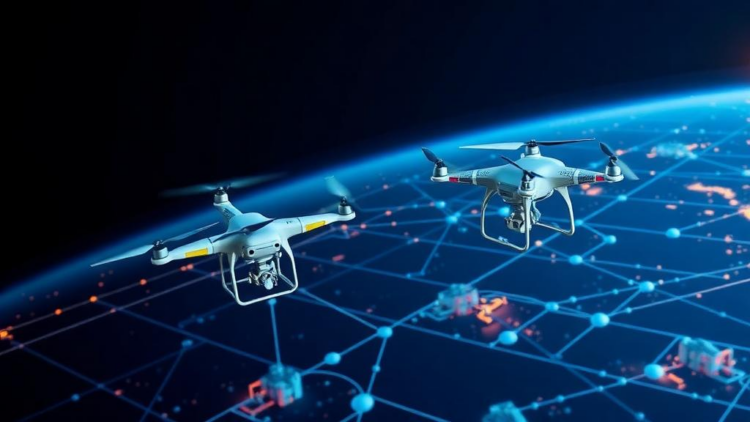
Imagine a future where satellites hurtling overhead, drones patrolling the sky, and base stations rooted in the ground behave less like separate machines and more like a single, living organism that senses, thinks, and adapts in real time. That vision moved a step closer to reality with new research published in the journal Mobile Networks and Applications, in which a team of Chinese engineers describes a framework that pairs a digital twin of a space-air-ground integrated network with a federated, multi-agent reinforcement learning algorithm. The work, led by JunFei Li, QingTao Zeng, LiKun Lu, and ZiHeng Qi of the Beijing Institute of Graphic Communication, tackles one of the thorniest problems in sixth-generation wireless research: how to squeeze maximum performance out of a network whose components never stop moving, never stop changing, and never stop generating data.
The space-air-ground integrated network, or SAGIN, is widely regarded as a cornerstone architecture for 6G. By fusing satellites in orbit, unmanned aerial vehicles in the lower atmosphere, and terrestrial stations on the ground, SAGIN promises global seamless coverage, low latency, and efficient energy use. That matters most precisely where conventional networks fail: remote regions with sparse communication infrastructure, and disaster zones where sudden events can knock out fixed base stations altogether. Traditional mobile edge computing, which depends on fixed infrastructure, simply cannot guarantee the ultra-high reliability, ultra-low latency, and high data rates that next-generation applications demand in such environments. SAGIN’s heterogeneous fleet of platforms can blanket vast areas and compensate for the blind spots of terrestrial networks, but that same heterogeneity creates a scheduling nightmare.
The difficulty is fundamental rather than incidental. Satellites sweep across the sky on predictable but relentless orbits, UAVs drift with wind and mission demands, and ground stations contend with fluctuating user loads. Devices differ wildly in computing power, energy reserves, and communication capabilities. Deployment is inherently distributed, spanning thousands of kilometers. Deciding which node should process which task, when to offload computation, and how to allocate bandwidth and energy across such a system is a resource optimization problem of extraordinary complexity. Every decision made by one node ripples through the others, so treating each element in isolation produces suboptimal, often unstable, outcomes.
The researchers’ answer begins with a digital twin. Digital twin technology creates a precise, real-time virtual replica of a physical system, allowing operators and algorithms to observe, model, and test the network without touching the real hardware. In manufacturing and industry 4.0 settings, digital twins have already proven their worth, and recent studies have extended the concept to vehicular edge networks, satellite constellations, and 6G ultra-reliable low-latency communications. Building on that lineage, the team designed and implemented DT-SAG, a digital twin-based integrated simulation platform that models satellites, UAVs, and ground stations collaboratively. The platform achieves what the authors describe as collaborative modeling and intelligent scheduling across all three layers, giving the learning algorithms a faithful sandbox in which to experiment before committing decisions to the physical network.
Inside that sandbox, the intelligence comes from a marriage of two machine learning techniques. The first is multi-agent deep reinforcement learning, specifically the Multi-Agent Deep Deterministic Policy Gradient algorithm, known as MADDPG. In multi-agent environments, naive reinforcement learning can become wildly unstable, because each agent’s policy changes while the others are still learning to respond to it. MADDPG tames this chaos through a paradigm called centralized training with distributed execution: during training, a critic sees the actions and observations of all agents and learns the global dynamics of the system, while at execution time each agent acts using only its own local observations. This makes the approach well suited to SAGIN, where each satellite, drone, or ground station must make fast, autonomous decisions under real-world conditions.
The second ingredient is federated learning, a distributed training framework that flips the usual logic of machine learning on its head. Instead of shipping raw data to a central server, federated learning lets each node train locally on its own data and then share only model parameters, which are aggregated into a global model. In the SAGIN context, this design delivers three benefits at once. It slashes communication overhead, a critical concern when the links in question run through space and air. It protects data privacy, since sensitive user information never leaves the local node. And it improves training efficiency by parallelizing learning across the network’s distributed agents. The authors combined MADDPG with federated learning into a single algorithm they call FLMADDPG, which enables efficient collaboration among agents while sidestepping the privacy risks and communication bottlenecks that plague centralized learning.
The technical logic of the combination is elegant. Each agent in the network, whether a satellite, a UAV, or a ground station, runs its own MADDPG instance, learning how to schedule tasks, allocate resources, and manage energy based on local conditions mirrored in the digital twin. Periodically, the agents federate: their learned policy parameters are aggregated to produce a shared global policy that captures the collective experience of the whole network. Each agent then refines that global policy against its own local realities. The result is a system that learns both the fine-grained particulars of each node and the coarse-grained dynamics of the network as a whole, without any single point of data collection. The digital twin supplies the accurate state information and safe rehearsal environment that such learning requires, closing the loop between the virtual and physical layers.
Experimental results reported in the study indicate that the FLMADDPG approach delivers measurable gains across the three metrics that matter most for SAGIN: network coverage efficiency, energy management, and communication performance. The authors report that the method effectively enhances all three, demonstrating the potential of integrating digital twins with federated learning for network optimization. While the study is computational rather than a field deployment, the simulation platform’s collaborative modeling of satellites, UAVs, and ground stations suggests that the framework could be ported to real constellations and aerial fleets as 6G standardization matures. The research was supported in part by the Open Foundation of the State Key Laboratory of Networking and Switching Technology at Beijing University of Posts and Telecommunications and by Beijing municipal education programs.
The broader significance of the work lies in its convergence of three frontier technologies at once. Digital twin research has flourished in factories and vehicular networks, and recent studies have explored blockchain-aided twin-based offloading in space-air-ground systems. Federated learning has been adapted to aerial and space networks in frameworks such as topology-aware olive branch learning, and multi-agent reinforcement learning has been applied to computation offloading in air-ground networks and low Earth orbit satellite edge computing. What distinguishes the new study is the integration of all three into a single coherent pipeline: a twin that mirrors the network, agents that learn within the twin, and a federation mechanism that lets them learn together without surrendering privacy or drowning the network’s own links in training traffic.
Challenges remain before such systems fly for real. The dynamism of orbital mechanics, atmospheric conditions, and user mobility means that a digital twin must be continuously synchronized with its physical counterpart, and any lag between the two could degrade the quality of learned policies. Federated aggregation across nodes with wildly different computational capacities and intermittent connectivity is itself an open research problem, one that other teams have begun addressing with weighted aggregation schemes for aerial and space networks. Yet the direction is clear. As 6G ambitions stretch from dense cities to disaster zones, oceans, and the far reaches of the planet, the networks that serve them will need to be simulated before they are built, and taught before they are trusted. This study offers a concrete blueprint for how a digital mirror, a swarm of learning agents, and a privacy-preserving federation protocol can together turn a chaotic three-layer network into a coordinated, self-optimizing whole.
Subject of Research: Resource optimization in space-air-ground integrated networks using digital twins and federated multi-agent reinforcement learning
Article Title: Resource Optimization of Space-Air-Ground Integrated Network Based on Digital Twin and Federated Multi-agent Reinforcement Learning
Article References: Li, J., Zeng, Q., Lu, L., & Qi, Z. (2026). Resource Optimization of Space-Air-Ground Integrated Network Based on Digital Twin and Federated Multi-agent Reinforcement Learning. Mobile Networks and Applications. https://doi.org/10.1007/s11036-026-02518-4
Image Credits: AI Generated
DOI: 10.1007/s11036-026-02518-4
Keywords: 6G, space-air-ground integrated network, digital twin, federated learning, multi-agent reinforcement learning, MADDPG, mobile edge computing, resource allocation, UAV networks, satellite communication, energy efficiency, task offloading
Cite Scienmag News
APA MLA Chicago
Mallory Mcbride. (October 1, 2026). Digital Twins and Federated AI Team Up to Orchestrate Satellite, Drone and Ground Networks. Scienmag. https://scienmag.com/digital-twins-and-federated-ai-team-up-to-orchestrate-satellite-drone-and-ground-networks/
Mallory Mcbride. “Digital Twins and Federated AI Team Up to Orchestrate Satellite, Drone and Ground Networks.” Scienmag, 1 October 2026, https://scienmag.com/digital-twins-and-federated-ai-team-up-to-orchestrate-satellite-drone-and-ground-networks/. Accessed 1 October 2026.
Mallory Mcbride. “Digital Twins and Federated AI Team Up to Orchestrate Satellite, Drone and Ground Networks.” Scienmag. October 1, 2026. https://scienmag.com/digital-twins-and-federated-ai-team-up-to-orchestrate-satellite-drone-and-ground-networks/
Copy citation Download RIS
Tags: 6G6G wireless network optimizationAI-driven autonomous network performance enhancementand terrestrial networksdecentralized AI algorithms for dynamic network environmentsdigital twinDigital twins for space-air-ground networksdroneenergy efficiencyenergy-efficient 6G network designfederated learningfederated multi-agent reinforcement learning in satellite and drone communicationfuture of interconnected satelliteintegrated satellite and ground network managementMADDPGMobile edge computingmulti-agent reinforcement learningmulti-modal network orchestration through digital twinsreal-time network sensing and adaptationremote area and disaster zone communication solutionsresource allocationSAGIN architecture for seamless global connectivitysatellite communicationspace-air-ground integrated networktask offloadingUAV networks