


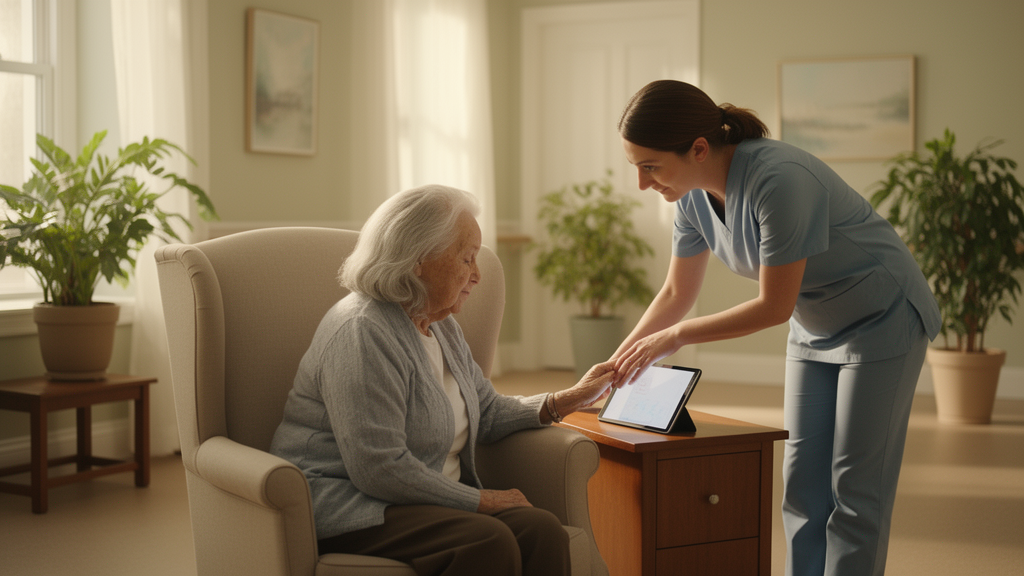
Digital technologies are reshaping how buildings, care homes and communities support people living with dementia, but a new systematic review argues that their benefits are far from uniform. The review, published in the journal Architectural Intelligence, synthesizes 76 peer-reviewed studies published between 2014 and 2024 on the use of digital technologies in dementia-friendly environments, the specially designed spaces intended to meet the needs of people with dementia. Rather than concluding that technology is simply beneficial, the authors map specific technological configurations to particular spatial goals, settings and stages of dementia, and they warn that deployment must be guided by generation-sensitive evidence, explicit data-governance frameworks and personalized, human-centred care.
The urgency behind the work is demographic. Citing World Health Organization estimates, the authors note that around 152 million people worldwide are expected to be living with dementia by 2050, a trend with profound impacts on families, communities and healthcare systems. Dementia-friendly environments aim to provide safe, comfortable spaces that promote social and physical activity, improve spatial navigation, enhance social interactions and provide emotional support. Yet current practices, the review notes, often fail to fully meet these needs, and the application of digital technologies in this field remains relatively new. Smart sensors, for example, can monitor patients’ behavior patterns to prevent wandering and other safety risks, while virtual reality offers simulated environments in which users can practice navigation and daily tasks under controlled conditions.
To bring order to a rapidly evolving field, the review adopts a practice-oriented framework of five dimensions: smart building frameworks, virtual and augmented reality, assistive robotics and sensor integration, remote health and activity monitoring systems, and multisensory stimulation and user-experience design. The authors stress that these dimensions are not arbitrary. Each is derived from core dementia-friendly design principles, including safety and comfort, autonomy and activities of daily living, cognitive support and orientation, social participation, and affect regulation. Together they cover the full continuum from building-scale infrastructures down to micro-level human-environment interactions, from physical to virtual contexts, and from passive monitoring to active intervention.
The methodology follows a systematic review process reported with reference to PRISMA logic. The researchers searched multiple databases, including PubMed, Web of Science, Scopus, IEEE Xplore and PsycINFO, using a core construct of dementia and cognition overlaid with focused terms across seven domains ranging from environment and architecture to technology, rehabilitation and evaluation, populations and settings, and policy, ethics and smart cities. Screening proceeded in three steps: duplicate removal, title and abstract screening, and full-text assessment against eligibility criteria, with two authors independently screening and discrepancies resolved through discussion or consultation with a third author. The search window was deliberately limited to 2014 through 2024, a ten-year span chosen not to flatten technological differences but to trace how digital tools evolved from early prototypes to implementation-ready systems.
That time-sliced analysis revealed a qualitative shift around the late 2010s. Early work up to roughly 2016 and 2017 predominantly featured information and communication technologies, single-function assistive technologies, ambient assisted living prototypes such as reminder systems, basic telecare and stand-alone sensor networks, and non-immersive or semi-immersive virtual reality setups in laboratory settings. By contrast, studies published after 2018 increasingly report consumer-grade head-mounted VR and AR systems, IoT-based multi-sensor smart homes and AI-enhanced solutions deployed in real homes, long-term care facilities and community environments, often accompanied by formal usability and user-experience evaluations. The authors grouped all included studies into an early generation, 2014 to 2017, and a new generation, 2018 to 2024, for comparative analysis of device characteristics, deployment contexts and applicability.
The review’s findings on virtual reality are notably conditional. New-generation VR can improve spatial navigation and wayfinding in people with mild dementia, but the benefits are far less clear for moderate-to-severe stages and are constrained by cybersickness, interface complexity and safety concerns. Cybersickness has a higher incidence among older adults and cognitively impaired populations, potentially causing nausea and dizziness and leading to user rejection. Even when simplified, the acts of donning a headset, calibrating it and navigating menus can be prohibitively difficult for individuals with moderate to severe dementia. Immersive experiences may also cause users to neglect their physical surroundings, increasing the risk of falls or collisions, and some patients may experience fear or increased disorientation when they cannot distinguish the virtual from the real. The authors conclude that VR implementation must adhere to strict principles of gradual exposure, personalized adaptation and continuous supervision.
By contrast, IoT-based sensor systems demonstrate more robust and consistent effects on safety outcomes, including fall detection and wandering prevention, across home, residential and community environments. Smart building technologies can monitor residents with declining cognitive abilities through IoT, communications and AI technologies and offer assistive services, such as automatically increasing corridor lighting when a resident leaves their bedroom at night or slowing elevator doors for users with mobility and cognitive impairments. Multisensory environments and user-experience interventions support emotional regulation and engagement in daily activities, with multisensory spaces filled with diverse sensory stimuli helping to alleviate anxiety and depression and improve emotional states. Assistive robots and remote monitoring systems show promise for reducing caregiver burden and supporting autonomy, but they raise significant questions about privacy, data governance and cost.
The review also examines how these technologies intersect with psychological, sociological and architectural concerns. On the psychological side, digital cognitive training, including VR with visual, auditory and spatial inputs, has been reported to activate patients’ cognitive neural networks, and emotional support robots and virtual companions have been associated in studies with significant reductions in loneliness and anxiety. On the sociological side, social networking platforms, online communities and virtual reality social platforms offer new spaces for interaction, though the authors note ongoing debate about whether smart technologies genuinely align with the actual needs of dementia patients. On the architectural side, virtual reality and spatial simulation allow designers to build three-dimensional models during the design phase and observe how spatial layout, furniture arrangement and lighting affect patients, while smart buildings can automatically adjust temperature, humidity and lighting based on patients’ physiological and psychological states.
Challenges remain substantial. Technological compatibility is a persistent obstacle, since products vary in technical standards, data formats and interface protocols, complicating the integration of multiple technologies into a unified environment and affecting system stability and reliability. Acceptance also differs among patients and caregivers, with some resisting new technologies for fear they are too complicated or may compromise privacy. Privacy and data security concerns are especially acute for camera-based monitoring systems, wearable sensors and GPS-enabled wandering-prevention devices that concentrate risk around location and movement data, and for emotion-recognition systems and AI-driven decision support that increase opacity and potential algorithmic bias. The authors call for granular consent, strict data-retention policies, explainability, audit trails and human-in-the-loop overrides.
Looking forward, the review recommends longitudinal studies, cost-effectiveness analyses and mixed-methods research centered on user acceptance. For designers and clinicians, it proposes a technology ladder approach, starting with simple, low-risk interventions such as adaptive lighting before introducing complex systems such as VR, with practical checklists such as pre-VR assessment of balance and the use of tangible controllers. For policymakers, it suggests that reimbursement and subsidy schemes should explicitly distinguish between experimentally promising technologies, such as advanced VR and social robots, and implementation-ready technologies, such as fall-detection sensors, bed-exit alarms and automated lighting, and tie funding to demonstrated clinical and quality-of-life outcomes. The authors’ bottom line is measured: digital technologies offer transformative potential for creating more supportive, engaging and safe environments, but they are neither universally beneficial nor uniformly mature, and must serve as a scaffold for, rather than a substitute for, social and architectural support.
Subject of Research: Digital technologies in dementia-friendly environments
Article Title: Digitizing Dementia-Friendly Environments (DFEs): the application of digital technologies in promoting inclusive spaces
Article References: Chen, F., Yang, B., Jia, Z., & Zhao, F. (2026). Digitizing Dementia-Friendly Environments (DFEs): the application of digital technologies in promoting inclusive spaces. Architectural Intelligence, 5(1), Article 8. https://doi.org/10.1007/s44223-026-00115-9
Image Credits: AI Generated
DOI: 10.1007/s44223-026-00115-9
Keywords: dementia, dementia-friendly environments, virtual reality, smart buildings, IoT sensors, assistive robotics, remote monitoring, multisensory design, systematic review, data governance, spatial navigation, caregiver burden
News Source: Cassandra Pierce. (October 30, 2026). Digital tools in dementia-friendly spaces show promise, but benefits depend on stage and setting. Scienmag.



