


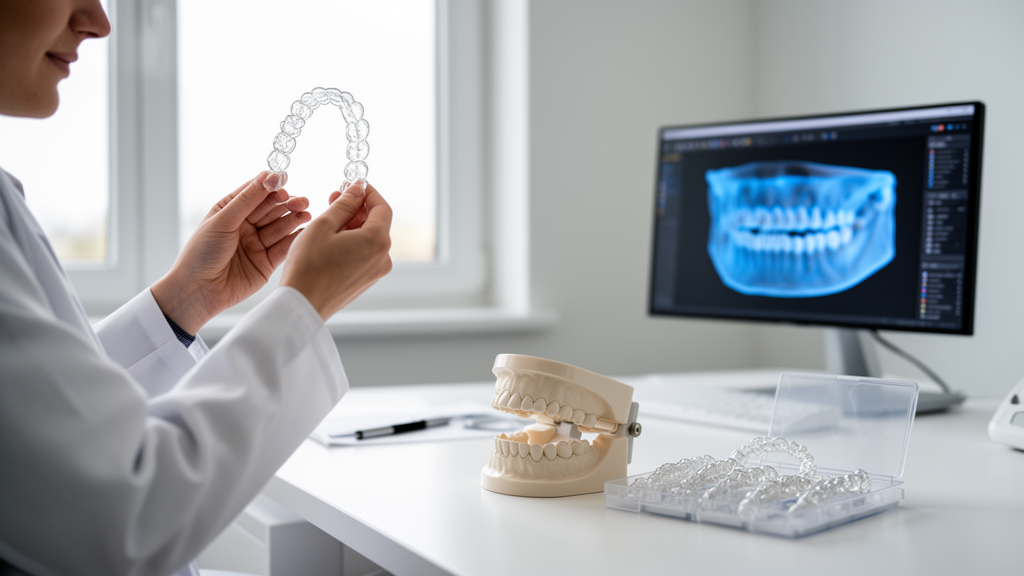
Orthognathic surgery, the surgical repositioning of the upper and lower jaws to correct severe dentofacial deformities, has for nearly five decades followed a rigid three-stage sequence: months of presurgical orthodontic decompensation, the operation itself, and a final round of postsurgical orthodontic finishing. In three adult patients treated with a digitally planned surgery-first protocol combined with clear aligner therapy, the mean treatment time from surgery to completion of orthodontic refinement was 14.3 months, and all three patients completed therapy with high satisfaction and stable occlusal outcomes.
The conventional sequence exists for a reason. Presurgical orthodontics typically lasts 15 to 24 months to eliminate dental compensations, the tooth positions that have drifted to mask an underlying skeletal discrepancy, followed by surgery and a postsurgical phase of roughly 5 to 12 months. That prolonged presurgical phase carries a well-documented cost: it often worsens facial appearance before it improves it, negatively impacts quality of life, and erodes patient motivation, largely because the esthetic payoff is delayed for years. The surgery-first approach inverts the sequence entirely. Orthognathic surgery is performed without any presurgical orthodontic preparation, delivering immediate correction of skeletal discrepancies and facial esthetics, which previous work has linked to improved psychological well-being and satisfaction. Postsurgical orthodontics then lasts approximately 8 to 12 months, a substantial reduction in overall treatment time.
The biology behind that efficiency is the regional acceleratory phenomenon, a process described by Frost in which bone healing after osteotomy temporarily accelerates local remodeling. Increased osteoclastic activity persists for approximately three to four months after surgery, creating a window in which teeth move faster in response to orthodontic forces. The surgery-first protocol exploits this window deliberately. In the third case of the series, aligners were changed on a five-day schedule specifically to benefit from the regional acceleratory phenomenon. Skeletal anchorage with miniscrews or miniplates can further assist in managing the transient postoperative malocclusions that are the main technical challenge of the approach.
What makes the new series distinctive is the marriage of surgery-first sequencing with clear aligner therapy, a combination that remains rare in practice despite two decades of aligner development. Survey data cited in the paper indicate that approximately two-thirds of orthodontists in the United States lack confidence in using clear aligners for severe skeletal Class II or Class III malocclusions requiring orthognathic surgery, while 88 percent of orthodontists in the United Kingdom and Ireland report never combining the two. Among maxillofacial surgeons, nearly 50 percent report no experience with the combination, primarily due to concerns about postoperative occlusal stability, intermaxillary fixation, and elastic wear protocols. Fixed appliances have historically dominated orthognathic care because they provide precise tooth control and facilitate intermaxillary fixation, but they carry esthetic concerns, plaque accumulation, enamel demineralization, soft tissue irritation, and compromised periodontal health during long treatment periods.
The three patients spanned the spectrum of dentofacial deformity. The first, a 25-year-old woman, presented with relapse of an anterior open bite, a 4-millimeter overjet, a 3-millimeter anterior open bite, and a skeletal Class II pattern driven by mandibular retrusion, with an SNB angle of 75.7 degrees and mentalis muscle strain during lip closure. Her virtual surgical plan included a segmental Le Fort I osteotomy with three-piece maxillary segmentation, mandibular advancement with counterclockwise rotation that raised SNB from 75.7 to 80.2 degrees, and a genioplasty with a planned net Pogonion projection of 15.1 millimeters. The surgical splint was removed at six weeks, an intraoral scan was taken at nine weeks, and Invisalign therapy began shortly afterward. At twelve months postoperatively, after seven months of aligner treatment plus a refinement phase of seven additional mandibular aligners, the anterior open bite was fully corrected, lip incompetence had resolved, and the final overjet and overbite measured 3 and 2 millimeters respectively.
The second case illustrates the protocol’s reach into airway surgery. A 25-year-old man with obstructive sleep apnea who could not tolerate continuous positive airway pressure therapy underwent maxillomandibular advancement planned digitally in ProPlan CMF software. The planned mandibular movements were substantial: 12.6 millimeters of advancement at Point B, 22.2 millimeters at Pogonion, and 23.3 millimeters at Menton, with SNB increasing from 77.2 to 84.0 degrees and the maxillary occlusal plane angle dropping from 17.1 to 6.2 degrees. The postoperative occlusion was intentionally overcorrected into a mild Class III tendency to compensate for possible relapse. Orthodontics was deliberately deferred for three months to evaluate functional airway improvement, during which spontaneous enhancement of dental interdigitation was observed. By eighteen months postoperatively, after 44 aligners across an initial phase and two refinement phases, the patient reported complete resolution of obstructive sleep apnea symptoms, including elimination of snoring and daytime fatigue.
The third patient, a 24-year-old man with skeletal Class III malocclusion from mandibular prognathism, required a three-piece segmental Le Fort I osteotomy with maxillary advancement of approximately 3.0 to 4.7 millimeters and superior repositioning of the posterior maxilla of roughly 1.6 to 2.9 millimeters to correct a mild occlusal cant. The transverse maxillary dimension increased from 40.8 to 41.2 millimeters at the first molar level. Notably, this case exposed a practical limit of the aligner workflow: at the final stage, fixed appliances were placed to optimize fine occlusal detailing and posterior intercuspation, because refinement of minor occlusal discrepancies was considered more predictable with fixed appliances, and the patient’s aligner compliance was not ideal. Total treatment time was approximately thirteen months from surgery to completion of orthodontic refinement.
The technical core of the series is the integration of virtual surgical planning with digital orthodontic simulation. Three-dimensional virtual surgical planning using dedicated software allowed the team to simulate skeletal movements, design surgical splints, and reverse-plan the skeletal movements in harmony with the anticipated postoperative occlusion visualized in ClinCheck. This matters acutely in surgery-first cases, where occlusal stability must be predicted rather than established through prolonged presurgical decompensation. Published accuracy data indicate that linear and angular discrepancies between planned and achieved virtual surgical movements are typically within 2 millimeters and 2 degrees, a threshold considered clinically acceptable, with virtual planning offering particular advantages in controlling frontal symmetry. Two of the three patients required segmental maxillary osteotomies, which increase surgical complexity and demand accurate prediction of intersegmental relationships, underscoring the value of precise digital planning.
The authors are careful about scope. This is a case series of three patients, not a controlled trial, and the conclusions rest on individual outcomes rather than comparative statistics. Success, they emphasize, depends on precise diagnosis, careful case selection, accurate digital planning, and close interdisciplinary coordination. The approach appears best suited to patients with mild crowding, minimal transverse discrepancy, mild curve of Spee, and adequate initial occlusal stability, criteria consistent with a systematic review by Shafaee and colleagues concluding that careful case selection is essential for predictable surgery-first outcomes. Long-term skeletal stability, however, has supporting evidence: Li and colleagues found no significant difference in postoperative stability between surgery-first and conventional groups in Class III patients, and Kankam and colleagues reported no significant difference in outcomes between clear aligners and fixed appliances in orthognathic patients.
For patients, the practical significance lies in what the protocol removes. The months of visible facial worsening during decompensation disappear, the esthetic improvement arrives on the day of surgery, and in this series the mean treatment time from surgery to completion of orthodontic refinement was 14.3 months, with individual cases ranging from about 12 to 18 months. Clear aligners add esthetics, comfort, easier oral hygiene, and better periodontal outcomes during the postsurgical phase, which the authors note is clinically relevant because healthy gingiva may reduce the risk of wound dehiscence after orthognathic surgery. The trade-offs are real: aligner therapy depends heavily on patient compliance, may slightly increase treatment time compared with fixed appliances, and demands a surgical team confident in operating against a predicted rather than a prepared occlusion. Whether the efficiency and predictability seen in these three carefully selected cases holds across broader populations will require larger comparative studies, but the series demonstrates that a fully digital, aligner-based surgery-first workflow is technically feasible across Class II deformities, Class III deformities, and airway-driven maxillomandibular advancement alike.
Subject of Research: A clinical case series of digitally planned surgery-first orthognathic treatment combined with clear aligner therapy in three adult patients with dentofacial deformities.
Article Title: Digitally planned surgery-first orthognathic treatment combined with clear aligner therapy: a clinical case series
Article References: Hormozi, B., Fernandes Poleti, T., Steinbacher, D. M., & Uribe, F. (2026). Digitally planned surgery-first orthognathic treatment combined with clear aligner therapy: a clinical case series. Digital and Aligner Orthodontics, 1(1), Article 4. https://doi.org/10.1007/s44525-026-00001-9
Image Credits: AI Generated
DOI: 10.1007/s44525-026-00001-9
Keywords: orthognathic surgery, surgery-first approach, clear aligner therapy, virtual surgical planning, dentofacial deformities, obstructive sleep apnea, maxillomandibular advancement, Le Fort I osteotomy, regional acceleratory phenomenon, Invisalign, Class II malocclusion, Class III malocclusion
News Source: Ophelia Keating. (October 29, 2026). Digital planning plus clear aligners streamlines jaw surgery in three reported cases. Scienmag.



