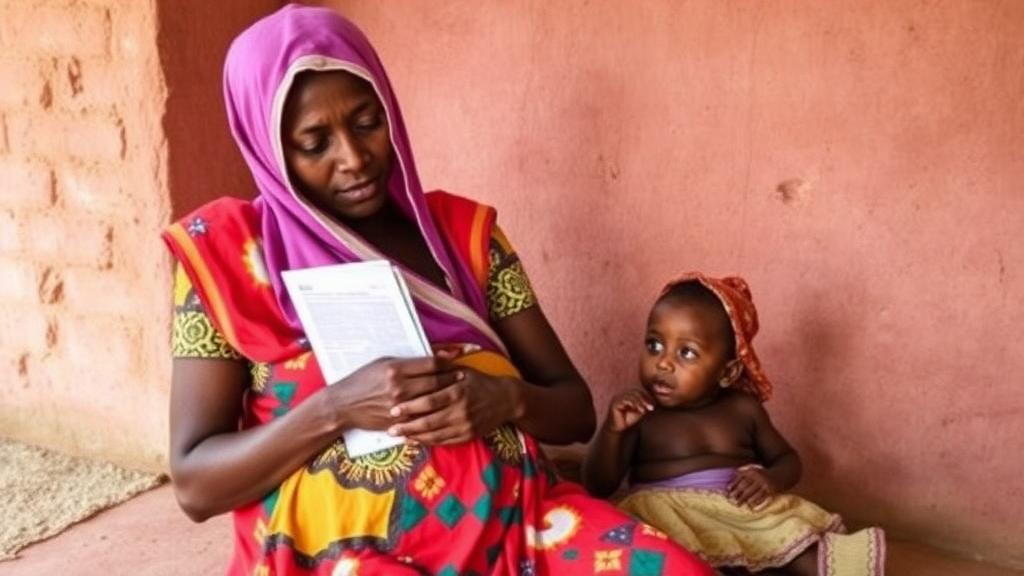
In rural Ethiopia, fewer than one in five pregnant women once made it through the full journey of maternal care: four or more antenatal visits, a birth attended by a skilled provider, and a postnatal checkup within 48 hours. A new study published in PLOS Digital Health reports that a smartphone-based community health information system, deployed alongside targeted implementation strategies, more than doubled that figure. Among women served by health facilities using the electronic Community Health Information System’s Reproductive, Maternal, Newborn, Child Health and Nutrition module, completion of the full continuum of care rose from 19.6 percent to 47.7 percent over nine months, while comparison facilities that continued routine paper-based services saw only a modest climb from 19.1 percent to 23.7 percent.
The research, led by Serbesa Dereje Degaga of Addis Ababa University with colleagues Solomon Shiferaw and Girma Taye Aweke, is notable for its design. Most evaluations of digital health tools in low-income settings rely on single-group before-and-after comparisons, which cannot separate a program’s effect from seasonal trends or other concurrent changes. This study instead used a prospective controlled quasi-experimental design across ten Primary Health Care Units in East Shewa Zone, about 100 kilometers southeast of Addis Ababa. Five units implemented the digital module; five matched units continued conventional service delivery. The team enrolled 839 pregnant women at 26 weeks of gestation or earlier and followed them for nine months, achieving an exceptionally high follow-up rate of 97.5 percent, with 409 women completing the study in each arm.
To estimate the intervention’s effect, the researchers applied a Difference-in-Differences fixed-effects model with cluster-robust standard errors at the facility level. Each woman contributed two observations: one from her most recent previous pregnancy, recalled at baseline and cross-checked against facility registers, and one from the prospectively followed index pregnancy. The woman-specific fixed effects absorbed all time-invariant characteristics, such as education, ethnicity, and parity, isolating the change associated with the intervention. The headline result was a 23.5-percentage-point greater improvement in full continuum-of-care completion in the intervention group (β = 0.235, 95% CI: 0.155–0.314), a statistically robust finding that survived wild cluster bootstrap analysis, a technique designed for situations with few clusters.
The intermediate indicators told a consistent story. Coverage of four or more antenatal care visits rose from 37.9 percent to 61.9 percent in intervention facilities, compared with a smaller rise from 42.1 percent to 46.7 percent in controls, yielding a Difference-in-Differences estimate of 19.3 percentage points. The combined indicator of four or more antenatal visits plus skilled birth attendance climbed from 25.7 percent to 48.2 percent in the intervention arm versus 31.1 percent to 36.2 percent in controls, a 17.4-point differential. Postnatal care within 48 hours also improved, reaching 63.1 percent in intervention facilities. Sensitivity analyses adjusting for baseline imbalances in age, religion, ethnicity, parity, and reproductive history produced estimates broadly consistent with the primary findings.
What makes the technology effective is not a single feature but an integrated architecture. The RMNCHN module digitizes the work of Health Extension Workers, Ethiopia’s frontline community health cadre. It generates appointment dates automatically from gestational age and displays them through a four-color reminder system: gray for upcoming visits, green for on-time attendance, yellow for clients three to six days overdue, and red for those seven or more days late, signaling urgent follow-up. Structured counseling guides standardize communication about obstetric danger signs across pregnancy, childbirth, and the postpartum period. Clinical decision support helps providers determine whether a woman can be managed at the primary level or requires referral, and an electronic referral system connects Health Extension Workers with health-center midwives, closing feedback loops that paper systems often leave open.
Crucially, the researchers paired the technology with implementation strategies derived from the Consolidated Framework for Implementation Research and the Expert Recommendations for Implementing Change methodology, known together as CFIR-ERIC. A prior assessment in the same setting had identified specific barriers: limited leadership engagement, gaps in technical support, weak community follow-up, and inconsistent performance monitoring. The intervention package responded point by point. Leadership orientation sessions were held for health office heads and facility directors. Health Information Technicians conducted routine mentorship visits, resolving connectivity failures and synchronization delays. Women Development Groups and community volunteers were mobilized to identify pregnant women and trace missed appointments. Dashboard data were reviewed in routine meetings, and high-performing health workers received certificates of recognition.
The magnitude of the gains stands out against the international evidence base. A cluster-randomized trial in Zanzibar using mobile phone reminders improved antenatal attendance, but by less than the 19.3-point antenatal gain observed here. A mobile application evaluated in rural India, the ReMiND project, improved danger-sign recognition and some antenatal processes but produced no statistically significant increase in institutional delivery. A locally developed platform in Ethiopia’s Semen Shewa area raised institutional delivery and postnatal care use through reminders and messaging, with more modest effects on repeat antenatal attendance. The authors suggest that reminders alone are rarely sufficient; the East Shewa results likely reflect the combination of digital tracking with supervision, mentorship, community linkage, and accountability structures.
The study is candid about its limitations. Facilities were not randomly assigned, so unmeasured differences between them could have influenced outcomes. With only one pre-intervention measurement, the parallel-trends assumption underpinning Difference-in-Differences analysis could not be tested empirically, though baseline outcome levels were comparable and historical service indicators from 2023 and 2024 showed no significant between-group differences. Baseline outcomes referred retrospectively to a previous pregnancy while endline outcomes were prospectively ascertained, introducing potential recall and documentation asymmetries. The authors also note a subtle interpretive issue: because the electronic system may improve both service delivery and record completeness, part of the measured improvement could reflect better documentation rather than more care received.
There is also a quality caveat. Recent national evidence indicates that intervention-adjusted antenatal coverage and process-quality-adjusted skilled birth attendance in Ethiopia stand at roughly 16 percent and 19 percent respectively, far below contact-based coverage figures. The composite outcome in this study measured whether women reached services, not whether those services met clinical standards. The authors emphasize that future evaluations of the electronic system should incorporate measures of service content, process quality, and patient outcomes, and should examine whether benefits are distributed equitably across socioeconomic groups rather than assumed to be universal.
Even with those caveats, the findings carry substantial weight for global maternal health. Roughly 260,000 women died from pregnancy-related causes in 2023, nearly 70 percent of them in sub-Saharan Africa, and Ethiopia’s maternal mortality ratio, though down from 953 to 267 deaths per 100,000 live births between 2000 and 2020, remains almost four times the Sustainable Development Goal target. Continuity of care across pregnancy, birth, and the postpartum period is one of the most reliable levers against preventable deaths, and this study offers rare controlled evidence that a government-led digital platform, embedded in a real primary health care system rather than a research bubble, can move that lever at scale. The authors argue that sustained implementation, leadership engagement, technical support, community involvement, and continuous performance monitoring will be essential as Ethiopia considers expanding the system nationwide, and that better interoperability with the national District Health Information Software 2 platform could reduce duplicate reporting and further strengthen the feedback loops that appear to drive these results.
Subject of Research: Effect of an electronic community health information system on completion of the maternal continuum of care in rural Ethiopia
Article Title: Effectiveness of the electronic Community Health Information System on maternal continuum of care completion in rural East Shewa Zone, Eastern Ethiopia: A prospective controlled quasi-experimental study
Article References: Degaga, S. D., Shiferaw, S., & Aweke, G. T. (2026). Effectiveness of the electronic Community Health Information System on maternal continuum of care completion in rural East Shewa Zone, Eastern Ethiopia: A prospective controlled quasi-experimental study. PLOS Digital Health, 5(10), e0001775. https://doi.org/10.1371/journal.pdig.0001775
Image Credits: AI Generated
DOI: 10.1371/journal.pdig.0001775
Keywords: digital health, maternal health, Ethiopia, continuum of care, eCHIS, antenatal care, skilled birth attendance, postnatal care, quasi-experimental study, community health workers, mHealth, implementation science
News Source: Harold Sullivan. (October 8, 2026). Digital Health Records Boost Maternal Care Completion in Rural Ethiopia. Scienmag.