


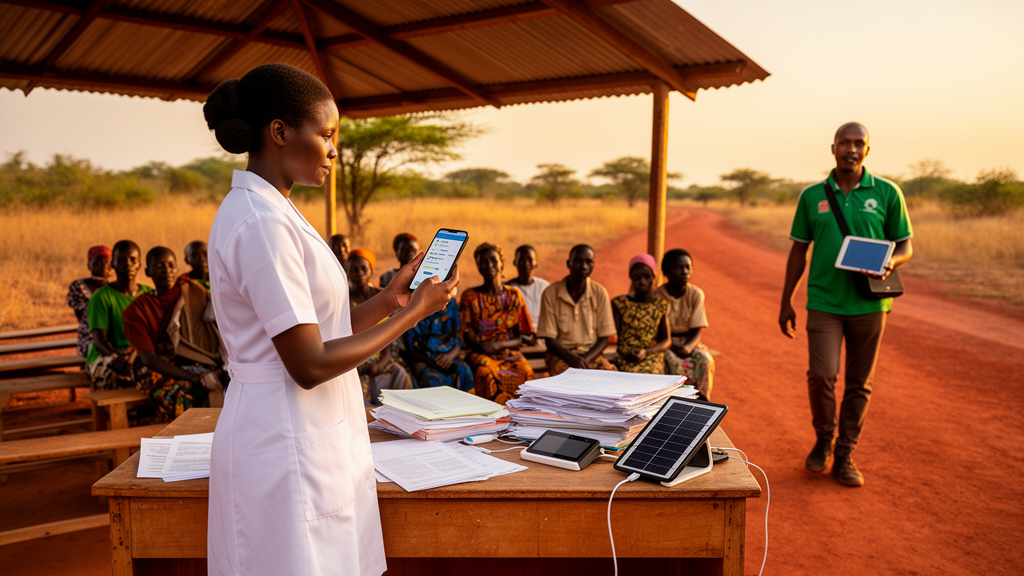
Digital health technologies are spreading across rural Sub-Saharan Africa, but a new systematic review concludes that their success depends far less on the technology itself than on the readiness of the health systems into which they are introduced. The review, published in BMC Digital Health, synthesized evidence from 35 studies conducted in 18 countries between 2015 and 2025, examining which digital tools are being deployed in rural primary health care, what benefits they deliver, and what stands in the way of sustainable implementation.
The research team, led by Sharon R. T. Chilunjika and Patrick Ngulube, followed PRISMA 2020 reporting guidelines and searched PubMed, Scopus and Google Scholar for studies published between 1 January 2015 and 28 February 2025. Two independent reviewers screened 967 records, and methodological quality was assessed using the Joanna Briggs Institute critical appraisal checklists. After removing 350 duplicates and excluding studies that failed eligibility or quality thresholds, 35 primary empirical studies remained for a structured narrative synthesis. The authors note that a review protocol was developed before the study began but was not prospectively registered, and that only English-language, peer-reviewed publications were included, which may have introduced language and publication bias.
Mobile health, or m-health, emerged as the most frequently implemented technology, appearing in 16 of the 35 included studies across eight countries. The district health information platform DHIS2 was reported in five studies, while electronic health records and artificial intelligence applications each appeared in four, concentrated in countries with more developed digital health ecosystems. Telemedicine, despite being one of the earliest digital health modalities, was the least frequently reported of the five core categories, appearing in only three studies, from Cameroon and South Africa. The authors interpret this distribution as reflecting differences in health system readiness, digital infrastructure and implementation capacity rather than technological novelty alone.
The reported benefits were substantial where implementation succeeded. Mobile phone-based interventions improved patient-provider communication, treatment adherence, appointment attendance, maternal and child health services, and chronic disease management. Quantitative studies included in the review reported measurable improvements in HIV treatment outcomes, including increased viral load suppression and better retention in care. SMS reminder systems were associated with increases in childhood immunization coverage of roughly 25 to 35 percent in rural Ghana, and digital job-aids and maternal health messaging improved adherence to antenatal care protocols. Additional benefits included reduced stigma and improved access to sexual and reproductive health information among adolescents, improved youth mental health screening, and strengthened HIV information management in hard-to-reach settings.
Telemedicine expanded access to specialist care in geographically isolated communities, improving diagnostic support, enabling specialist consultation, and strengthening cardiovascular disease and tuberculosis management. Studies evaluating DHIS2 consistently reported better health information management and disease surveillance, including improved data quality, timelier reporting and more efficient resource allocation. In Tanzania, DHIS2 enabled real-time malaria surveillance, while implementation in Ethiopia improved reporting timeliness by 21 percent for antimicrobial resistance surveillance, and Zimbabwe saw fewer reporting errors and delays in HIV surveillance data. Electronic health records strengthened clinical documentation, continuity of care and workflow efficiency, and artificial intelligence applications showed high diagnostic performance for cervical cancer screening using AI-supported digital microscopy, improved detection of vision-threatening diabetic retinopathy, early diagnosis of birth asphyxia using machine-learning algorithms, and identification of patients at risk of disengaging from HIV care through predictive modelling.
Yet the review’s central finding is cautionary. Three interrelated implementation patterns emerged across the evidence. First, adoption differed according to health system readiness: simpler technologies such as m-health and DHIS2, which can operate with basic mobile coverage or offline data capture, were widely implemented, whereas EHRs and AI were concentrated in better-resourced settings such as South Africa and Kenya, where reliable electricity, stable internet and stronger digital capacity exist. The authors warn that this uneven adoption risks creating a two-tier digital health landscape in which rural populations with the greatest health needs remain excluded from advanced innovations.
Second, a persistent gap separated successful pilot projects from sustainable scale-up. Many m-health and telemedicine initiatives were implemented as small-scale or externally funded projects with limited evidence of long-term institutionalization, while DHIS2 was one of the few technologies consistently integrated into routine national health information systems, for example in Zimbabwe and Tanzania. The suspension of digital health initiatives in Burkina Faso following budgetary constraints illustrates how dependence on donor funding can undermine programs despite demonstrated effectiveness. The review concludes that the principal challenge is no longer demonstrating technical feasibility but achieving sustainable integration within resilient health systems.
Third, the barriers to implementation were found to be deeply interdependent. Inadequate infrastructure was the most frequently reported constraint, with unreliable internet connectivity, poor network coverage and inconsistent electricity supply limiting both patient-facing technologies and health information systems. Financial constraints compounded these deficits: the costs of devices, data, software, maintenance and technical support limited affordability for health systems and rural households alike, and data unaffordability was identified as a major barrier to m-health use in Zimbabwe. Limited digital literacy among clinicians and communities reduced adoption and uptake, sociocultural factors including gender norms and limited trust in digital services shaped acceptance, and weak governance and regulatory frameworks left gaps in data security, patient privacy, informed consent and interoperability.
The review also highlights persistent inequities in who benefits. Positive outcomes were most consistently reported among populations with reliable mobile phone ownership, adequate digital literacy, stable electricity and internet connectivity, while poorer households, older adults, women with limited phone access, and geographically isolated communities were less likely to benefit. The authors characterize this as a second-level digital divide, defined not only by unequal access to technology but by unequal capacity to derive meaningful benefit from it, and caution that digital interventions may improve access for some groups while excluding others unless implementation explicitly considers who benefits and who bears the additional costs.
The authors stress that the evidence base itself has important limitations. The heterogeneity of study designs and outcome measures precluded quantitative meta-analysis, formal health economic evaluation appeared in only one of the 35 included studies, and evidence on long-term sustainability, cost-effectiveness, equity impacts and pathways to scale remains limited. The review was also restricted to three databases, and funding sources of the included primary studies were not systematically extracted. Nevertheless, the overall conclusion is clear: digital health technologies including m-health, telemedicine, EHRs, DHIS2 and AI can strengthen rural primary health care in Sub-Saharan Africa, but they are not a standalone solution. The authors recommend coordinated investments in reliable digital infrastructure, workforce digital competencies, interoperable regulatory and data governance frameworks, and sustainable domestic financing, alongside explicit attention to digital inclusion, so that digital health functions as an enabler of broader health system strengthening rather than a substitute for it.
Subject of Research: Digital health technologies for rural primary health care in Sub-Saharan Africa
Article Title: Digital health technologies for primary health care in rural Sub-Saharan Africa: a systematic review of benefits and implementation challenges
Article References: Chilunjika, S. R. T., & Ngulube, P. (2026). Digital health technologies for primary health care in rural Sub-Saharan Africa: a systematic review of benefits and implementation challenges. BMC Digital Health, 4(1), Article 66. https://doi.org/10.1186/s44247-026-00300-w
Image Credits: AI Generated
DOI: 10.1186/s44247-026-00300-w
Keywords: digital health, m-health, telemedicine, DHIS2, electronic health records, artificial intelligence, primary health care, Sub-Saharan Africa, health system readiness, systematic review, health equity, implementation challenges
News Source: Denise Maddox. (October 29, 2026). Digital health helps rural African clinics, but only where health systems are ready. Scienmag.



