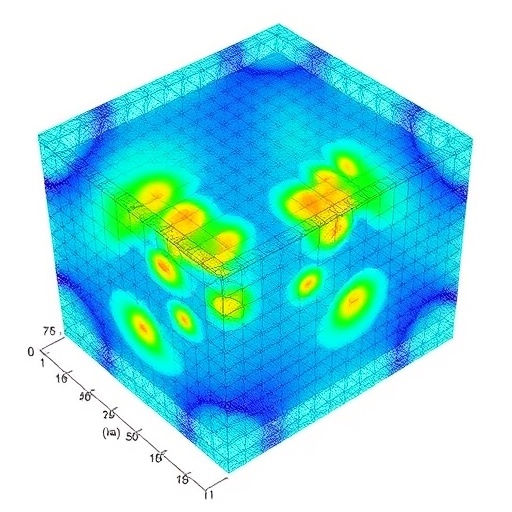
In a groundbreaking advancement set to revolutionize renewable energy technology, researchers have unveiled a novel application of diffusion models to predict fuel cell impedance spectra with unprecedented accuracy based on short time-domain measurements. This breakthrough offers a transformative approach to the diagnostics and optimization of fuel cell systems, which are pivotal for sustainable energy infrastructure globally. The intricate dynamics of fuel cells have long posed significant challenges for researchers seeking efficient and reliable monitoring methods. However, the innovative utilization of advanced diffusion algorithms now allows for a rapid and high-fidelity prediction of impedance spectra, thereby opening new frontiers in performance characterization.
At the heart of this development lies the sophisticated mathematical framework of diffusion models, originally employed in fields such as image generation and signal processing. The research team, led by Yuan, H., Tan, D., and Zhong, Z., has ingeniously repurposed these models to decode the complex electrochemical signals emanating from fuel cells. Traditional impedance spectroscopy, which is crucial for diagnosing the electrochemical health and identifying degradation mechanisms within fuel cells, typically requires extensive frequency sweeps that are time-consuming and resource-intensive. By contrast, the introduced method harnesses short time-domain profiles—brief segments of the fuel cell’s transient response—to reconstruct a comprehensive impedance spectrum, revolutionizing the speed and efficiency of this characterization.
Fuel cells convert chemical energy directly into electrical energy through electrochemical reactions, offering a clean alternative to fossil fuel combustion. The impedance spectrum of a fuel cell encapsulates vital information about its internal resistances, capacitances, and diffusion characteristics. These parameters are essential for understanding processes such as charge transfer resistance, mass transport limitations, and membrane hydration levels. Precisely capturing these features enables engineers to optimize fuel cell performance and predict longevity, yet the variability and complexity of these signals have historically hindered the development of streamlined diagnostic tools.
The research team’s application of diffusion models leverages the stochastic nature of these frameworks to iteratively refine estimates of impedance spectra. By starting with a rough initial guess from the brief time-domain data, the model undergoes a series of transformations akin to a diffusion process that progressively corrects and enhances the spectral estimation. This adaptive procedure exploits deep learning principles, enabling the model to learn from vast datasets of fuel cell responses and generalize effectively across varying operating conditions and fuel cell types.
Crucially, the model’s ability to predict the impedance spectrum from minimal input data reduces the burden on experimental setups and accelerates diagnostic turnaround times. In conventional studies, comprehensive impedance measurements mandate long-duration frequency scanning, often rendering real-time monitoring impractical. The diffusion-based approach, however, allows for near-instantaneous analysis, facilitating dynamic system adjustments and proactive maintenance schedules that can substantially extend fuel cell lifespan and reliability.
The implications of this research stretch far beyond mere efficiency gains. Fuel cells are central components in hydrogen-powered vehicles, stationary power generation, and portable electronic devices aimed at reducing carbon footprints. Enhanced diagnostic tools directly influence these sectors by providing operators with detailed insight into system health, enabling early detection of faults such as catalyst degradation or membrane drying. Such foresight is indispensable for scaling up fuel cell adoption, as it addresses widespread concerns about durability and operational stability.
From a technical perspective, the researchers integrated advanced neural network architectures within the diffusion model framework to robustly handle noise and variability inherent in short time-domain signals. This architectural sophistication ensures that the model maintains high prediction accuracy even in the presence of real-world disturbances, positioning it as a highly practical tool for laboratory and field applications. Furthermore, comprehensive validation against experimental datasets verified the model’s reliability across a diverse array of fuel cell configurations, demonstrating its versatility.
The fusion of diffusion models with fuel cell impedance analysis also aligns with broader trends in scientific instrumentation where artificial intelligence catalyzes paradigm shifts. As the energy sector veers towards smarter, AI-powered systems, methodologies like these exemplify the convergence of computational sciences with electrochemical engineering. This interdisciplinary synergy promises not only enhanced performance diagnostics but also deeper mechanistic understanding, enabling researchers to unravel complex electrochemical phenomena with greater precision than ever before.
Moreover, the speed and ease of the diffusion-based predictive technique open doors to integrating these models with automated control systems in fuel cells. Such integration could lead to self-optimizing energy devices that continuously monitor their own impedance spectra, detect anomalies, and autonomously adjust operational parameters to maintain optimal performance, effectively embodying the concept of “smart” fuel cells.
This notable breakthrough was detailed in a peer-reviewed article slated for publication in Nature Communications in 2026. The study provides comprehensive analyses of the model’s architecture, training procedure, and comparative performance metrics against conventional impedance spectroscopy methods. Notably, the researchers emphasized the scalability of their approach, underscoring potential extensions to other electrochemical systems such as batteries and electrolyzers, where similar diagnostic challenges exist.
Looking ahead, the roadmap established by this research suggests promising avenues for exploration. Integration with in situ measurement technologies, deployment in commercial fuel cell systems, and expansion into multi-parameter diagnostics are among the immediate priorities highlighted by the authors. As the global energy landscape increasingly embraces hydrogen and fuel cell technologies, tools that enhance operational transparency and reliability will play indispensable roles in their successful proliferation.
In summary, the union of diffusion models with fuel cell impedance prediction encapsulates a leap forward in both theoretical modeling and practical application realms. It heralds a new era in energy diagnostics where rapid, accurate, and minimal-input assessments become the norm rather than exceptions. The research stands as a testament to the power of interdisciplinary innovation, showcasing how machine learning paradigms can solve longstanding technical bottlenecks and accelerate the transition towards sustainable energy futures.
Subject of Research:
Fuel cell impedance spectrum prediction using diffusion models based on short time-domain profiles.
Article Title:
Diffusion models enable high-fidelity prediction of fuel cell impedance spectrum from short time-domain profiles.
Article References:
Yuan, H., Tan, D., Zhong, Z. et al. Diffusion models enable high-fidelity prediction of fuel cell impedance spectrum from short time-domain profiles. Nat Commun (2026). https://doi.org/10.1038/s41467-026-69321-3
Image Credits:
AI Generated
Tags: advanced diffusion algorithms in energy systemschallenges in fuel cell monitoringdiffusion models for fuel cell impedanceelectrochemical signal analysis in fuel cellsfuel cell diagnostics and optimizationimpedance spectroscopy methods for fuel cellsinnovative approaches to electrochemical health assessmentperformance characterization of fuel cellsrapid impedance prediction techniquesrenewable energy technology advancementsshort time-domain measurements in fuel cellssustainable energy infrastructure development