Were the first animals predators or filter feeders like the sponges living in today’s oceans? And what role did symbiosis with algae play, as with reef-building corals? Surprising findings by a research group led by Prof. Dr Thomas W. Holstein of Heidelberg University on the development of sea anemones suggest that a predatory lifestyle moulded their evolution and had a significant impact on the origin of their nervous system. The researchers were able to show that the young life stages (larvae) of the small sea anemone Aiptasia actively feed on living prey and are not dependent on algae. To capture its prey, the anemone larvae use specialised stinging cells and a simple neuronal network.
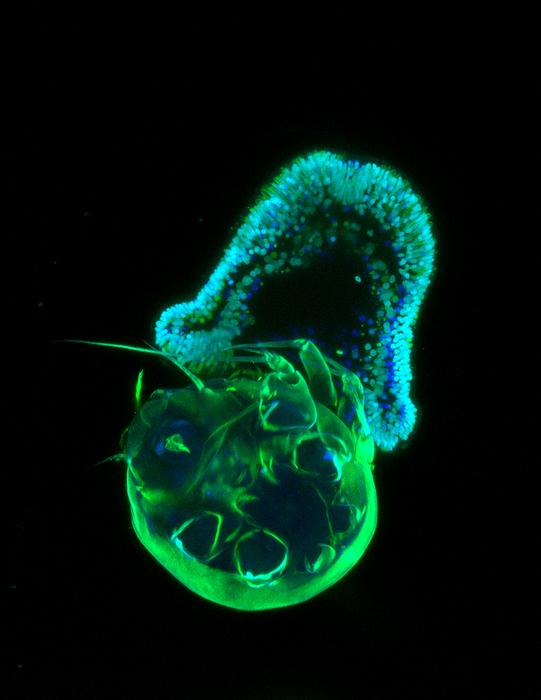
Credit: Ira Mägele and Ulrike Engel
Were the first animals predators or filter feeders like the sponges living in today’s oceans? And what role did symbiosis with algae play, as with reef-building corals? Surprising findings by a research group led by Prof. Dr Thomas W. Holstein of Heidelberg University on the development of sea anemones suggest that a predatory lifestyle moulded their evolution and had a significant impact on the origin of their nervous system. The researchers were able to show that the young life stages (larvae) of the small sea anemone Aiptasia actively feed on living prey and are not dependent on algae. To capture its prey, the anemone larvae use specialised stinging cells and a simple neuronal network.
In the early embryonic development of multicellular organisms, gastrulation plays a key role. “In its simplest form, the gastrula develops from a hollow sphere of cells, the blastula, forming a larval stage with gut and mouth; imagine pushing a ball inwards at one side. All animals pass through this gastrula stage, which could also have existed at the beginning of animal evolution,” explains Prof. Holstein, a development and evolutionary biologist at the Centre for Organismal Studies (COS) at Ruperto Carola. Ira Mägele, a member of his research group, succeeded in proving that already in the late gastrula stage, the larvae of the Aiptasia sea anemone capture prey of suitable size with their stinging cells, ingest them with their mouth and digest them in their primitive gut.
The Aiptasia sea anemone is a model system for research on endosymbiosis in corals and other cnidarians. “Corals live in nutrient-poor waters and as larvae or young polyps, take up symbiotic algae cells. In Aiptasia, however, this process is important for adults but does not lead to growth and settlement of the larvae, suggesting that nutrition is a critical step in closing the life cycle,” states Thomas Holstein. Laboratory studies of the nutritional conditions showed that the food for the tiny Aiptasia larvae had to be small enough and alive. Nauplius larvae of Tisbe copepods, 50 to 80 micrometres small, are of similar size to Aiptasia larvae, making them an ideal food.
The larvae increase continually and rapidly in size, followed by settlement on the substrate and metamorphosis into primary polyps. “In this way, we were able to grow mature polyps as well as their descendants for the first time,” explains Ira Mägele. Dr Elizabeth Hambleton, a participating researcher from the University of Vienna (Austria), stresses: “By thus closing the life cycle of Aiptasia, it will finally be possible to carry out necessary molecular genetic experiments required for functional studies on this key endosymbiotic model organism”. Prof. Dr Annika Guse from Ludwig Maximilian University of Munich, also a study co-author, views this experimental approach as a breakthrough for work on this model system.
As Prof. Holstein underscores, the data obtained paint a new picture of the predatory lifestyle as a primary characteristic of the cnidarian gastrula. Evolutionary theorist Ernst Haeckel (1834 to 1919) first posed the “gastrula hypothesis”. “But Haeckel’s hypothetical gastrula was a particle-filtering life form, like sponges. In contrast, the predatory gastrula of Aiptasia and other cnidarians possess specialised stinging cells used for capturing prey.” The predatory lifestyle of gastrula-like forms with extrusive organelles that excrete toxins and are likewise found in single-celled organisms and simple worms, adds the Heidelberg biologist, could have been a critical driver of the early evolution of multicellular organisms and the development of complex, organised nervous systems.
The results of the study were published in the journal PNAS. Funding was provided by the German Research Foundation as part of Heidelberg University’s “Mechanisms and Functions of Wnt Signaling” Collaborative Research Centre as well as the ERC Consolidator Grant “SYMCELLS – Resolving the molecular mechanisms of intracellular coral-algal symbiosis” led by Prof. Guse.
Journal
Proceedings of the National Academy of Sciences
DOI
10.1073/pnas.2311872120
Method of Research
Observational study
Subject of Research
Not applicable
Article Title
A predatory gastrula leads to symbiosis-independent settlement in Aiptasia.