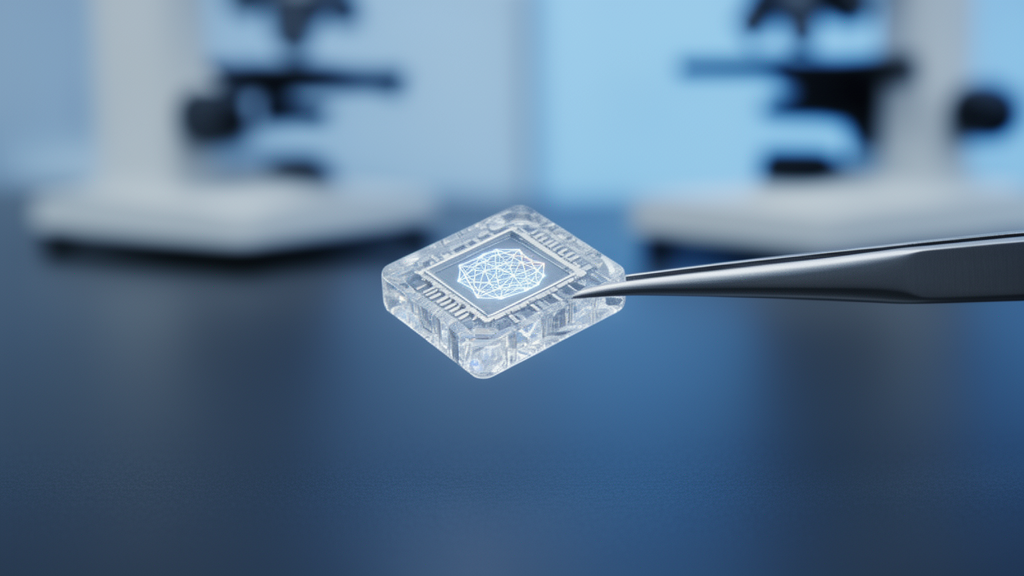
Micro-electromechanical systems, or MEMS, are the tiny mechanical devices hidden inside microphones, accelerometers and biosensors. They are extraordinarily useful, but their small size makes them vulnerable: physical stress can degrade their performance, stability and reliability. Monitoring that stress has always been awkward, because attaching a separate sensor to a structure measured in micrometres is a formidable engineering challenge. Researchers at Tohoku University now report a way around the problem by building the sensor directly into the mechanical device itself.
The key to the new approach is a famous imperfection in diamond. A nitrogen vacancy (NV) center is a defect in a diamond crystal lattice in which a nitrogen atom replaces one carbon atom next to a vacant lattice site. Despite being a flaw, the NV center has remarkable quantum properties. When illuminated with green laser light it emits red fluorescence, and its electronic spin state can be manipulated with microwaves. When the microwave frequency matches the spin-resonance frequency, the fluorescence intensity changes. This technique is known as optically detected magnetic resonance, or ODMR.
ODMR is what makes the defect useful as a sensor. The resonance frequency is sensitive not only to magnetic fields but also to temperature and mechanical stress. That means an NV center embedded in a mechanical structure can, in principle, report on the forces acting on that structure simply by how its fluorescence responds to microwaves. The challenge was to place such centers inside a moving MEMS device without disrupting the mechanics.
The research team formed NV centers inside a single-crystal diamond MEMS cantilever, a structure supported at one end and unsupported at the other, like the hand of a clock. When the device experiences mechanical stress, the unsupported end vibrates, and those movements travel through the whole system, triggering shifts in the resonance of the embedded NV centers in opposite directions. The diamond layer, an ion-implantation-induced defective layer and a graphite sacrificial layer together form the fabricated cantilever.
Crucially, the study reports that the NV centers responded to changes in cantilever vibrations, not merely to a static deformation. This means the embedded centers can probe the changing stress state of a vibrating MEMS structure. That distinction matters, because the goal is not simply to detect whether stress is present or absent, but to track how that stress changes over time and what kind of stress it is.
“The most exciting aspect of this work is that the quantum sensor is formed as part of the MEMS fabrication process itself,” says Masaya Toda of Tohoku University. “We were able to show that this integrated NV-center region functions as an effective stress sensor, responding as expected to both tensile and compressive bending. In other words, the mechanical structure and the quantum-sensing function can be created together within a single diamond device.”
The work demonstrates a fabrication route for integrating a quantum-sensing region into a MEMS structure without attaching a separate sensing element. According to the team, the study provides a platform to create an all-in-one system within the same single-crystal diamond structure. This is useful not only for stress sensing but also for research on interactions between mechanical deformation and quantum spin states. The researchers hope to continue improving the accuracy of the system in future studies.
The findings, published in Functional Diamond on August 28, 2026, could support the future development of compact and highly integrated diamond quantum devices for next-generation technology. Because the sensing region is part of the mechanical device itself, the approach removes the need for any external attachment, which has long been a barrier to monitoring stress in structures this small.
For now, the result is a demonstration on a laboratory-fabricated single-crystal diamond cantilever, and the team itself notes that accuracy improvements remain future work. Even so, the study points toward a class of MEMS in which the material that moves is also the material that measures, opening a path to stress-aware microscopic devices built from a single diamond crystal.
Subject of Research: Quantum stress sensing using NV centers in a single-crystal diamond MEMS cantilever
Article Title: Built-in quantum sensor detects bending stress in microscopic devices
Article References: Built-in quantum sensor detects bending stress in microscopic devices. Original publication (Bibliographic details unavailable.)
Image Credits: AI Generated
DOI: Not provided
Keywords: MEMS, nitrogen vacancy centers, diamond quantum sensors, ODMR, bending stress, cantilever, Tohoku University, single-crystal diamond, stress sensing, quantum devices, Built-in, quantum
News Source: Katie Riggs. (October 28, 2026). Diamond MEMS carry their own quantum stress sensor inside the device. Scienmag.