


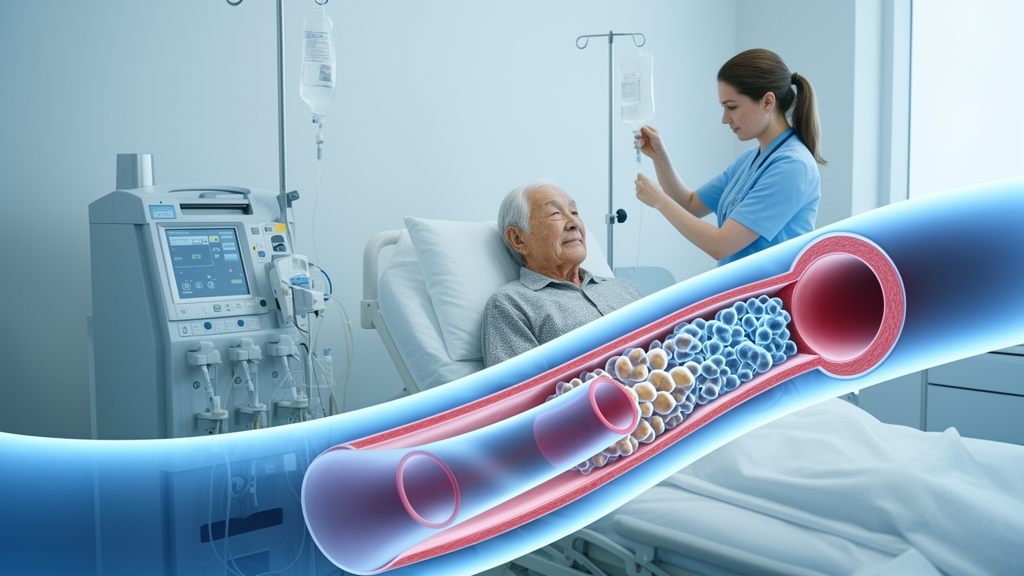
People on dialysis face a cardiovascular burden far heavier than the general population, and the stiffness of their arteries sits close to the heart of that risk. A new network meta-analysis published in Artery Research suggests that a routinely adjusted dialysis parameter — the calcium concentration of the dialysate fluid — is associated with arterial stiffness measurements that point in opposite directions depending on which part of the arterial tree is examined. Pooling six studies and 554 dialysis patients, the analysis found that higher dialysate calcium concentrations were linked to greater stiffness in the body’s central elastic arteries, yet to lower stiffness values on mixed indices that combine central and peripheral arterial segments.
The work, led by Iván Cavero-Redondo and colleagues, was conducted according to PRISMA-NMA reporting guidelines and registered in PROSPERO (CRD420251129181). The researchers searched PubMed, Scopus, Web of Science and the Cochrane Library from database inception to 25 May 2025, looking for controlled trials or observational studies that compared at least two dialysate calcium concentrations and reported arterial stiffness assessed by pulse wave velocity, or PWV. Six studies published between 2009 and 2017 met the criteria: four randomized controlled trials and two observational studies, conducted in Canada, Turkey, China, Australia and the United Kingdom. One of the six was carried out in a peritoneal dialysis population; sensitivity analyses indicated its inclusion did not materially change the estimates.
The distinction the authors draw between arterial stiffness measures is central to interpreting the findings. Carotid–femoral pulse wave velocity, the reference non-invasive measure, predominantly reflects the aorta and other large elastic arteries — so-called central stiffness. Other indices, including aortic–brachial, brachial and carotid–radial pulse wave velocity, traverse both central and peripheral, more muscular arterial segments, and the authors classify these as mixed measures. Because mixed indices are more sensitive to short-term hemodynamic changes, vascular tone and volume status during dialysis, the researchers argue they should be treated as complementary to, not interchangeable with, central measures.
The analysis used a frequentist network meta-analysis framework, with a dialysate calcium concentration of 1.0 mmol/L as the statistical reference category because it was the lowest connected node in the network. For central arterial stiffness, concentrations of 1.25 mmol/L (effect size 1.70, 95% confidence interval 1.44 to 1.96), 1.35 mmol/L (1.74, 1.29 to 2.19) and 1.5 mmol/L or higher (3.54, 3.24 to 3.84) were significantly associated with higher stiffness than the reference. In conventional pairwise meta-analyses, however, only 1.25 mmol/L remained significantly different from 1.0 mmol/L for central stiffness (effect size 1.02, 95% CI 0.32 to 1.71).
The mixed arterial stiffness results ran in the opposite direction. Network estimates associated concentrations of 1.12 mmol/L (effect size −0.67, 95% CI −1.09 to −0.25), 1.25 mmol/L (−0.32, −0.41 to −0.22), 1.35 mmol/L (−0.27, −0.36 to −0.18) and 1.5 mmol/L or higher (−0.48, −0.65 to −0.32) with lower mixed stiffness values. In the pairwise analysis for mixed stiffness, no comparison against the reference reached statistical significance. The authors emphasize that because 1.0 mmol/L dialysate calcium is rarely used in contemporary practice, these estimates should be read primarily as network-based statistical comparisons, with the most clinically relevant contrasts being those among the commonly prescribed concentrations of 1.25, 1.35 and 1.5 mmol/L or higher.
When the concentrations were ranked using SUCRA values — the surface under the cumulative ranking curve — 1.12 mmol/L came out on top for both central (96.0%) and mixed (62.1%) stiffness. The authors urge strong caution here: that ranking rested on a single study with a small number of exposed participants, and 1.12 mmol/L is not routinely available in many dialysis settings. They describe the result as exploratory and hypothesis-generating rather than confirmatory, and explicitly not a clinical recommendation.
The mechanistic backdrop the authors sketch helps explain why the two stiffness domains might diverge. Higher dialysate calcium can acutely raise ionized calcium and increase vascular smooth muscle contraction, raising pulse wave velocity within a single session; over time, a sustained positive calcium balance may promote medial arterial calcification and reduce distensibility. Conversely, they propose that higher dialysate calcium could transiently increase systemic vascular resistance, maintaining perfusion pressure and damping baroreflex-mediated sympathetic activation, which might dampen pulsatile stress in smaller muscular arteries — an acute vasoconstrictor effect that could register as improved functional stiffness in the periphery even as central elastic arteries fare worse. They note a similar dissociation between central and peripheral stiffness responses has been described in antihypertensive trials.
The quality of the underlying evidence limits how firmly any of this can be stated. Using the Cochrane Risk of Bias 2 tool, the team judged 33.3% of included studies at high risk of bias, 50.0% with some concerns and 16.7% at low risk, with missing blinding information the dominant problem. GRADE ratings for mixed arterial stiffness placed 57.1% of pairwise comparisons at low certainty and 42.9% at very low certainty; central stiffness comparisons were more evenly spread across high, moderate, low and very low categories. Heterogeneity was substantial for some mixed stiffness comparisons (I² of 64.5 and 70.4), and meta-regression suggested mean age could modify the pooled effect on mixed stiffness (p = 0.026), while age and the proportion of female participants did not influence the central stiffness estimate. Egger’s tests found no evidence of publication bias for either outcome.
The authors are explicit that the pooled estimates should not be read as causal effects, since the network combined randomized and observational designs, and residual confounding by indication may exist in the observational data — patient characteristics, comorbidities, dialysis vintage and mineral and bone disorder management could all have influenced both calcium prescriptions and stiffness measurements. They also flag that the short-term nature of most included data precludes conclusions about long-term effects of dialysate calcium on stiffness progression or cardiovascular events, and that the different mixed PWV indices are not physiologically identical. The choice of 1.0 mmol/L as reference, while statistically appropriate, further limits clinical interpretability.
Taken together, the analysis does not identify a single optimal dialysate calcium concentration. Instead, the authors suggest the available evidence may support individualized prescription based on vascular status, intradialytic hemodynamic tolerance, mineral and bone disorder profile and cardiovascular risk — noting that very low dialysate calcium carries risks of intradialytic hypotension, myocardial stunning and secondary hyperparathyroidism, while high concentrations may acutely improve peripheral hemodynamics but accelerate central calcification and stiffness over time. They call for well-designed prospective studies and long-term randomized trials to determine whether fine-tuning dialysate calcium could causally affect arterial stiffness progression and cardiovascular outcomes in the dialysis population.
Subject of Research: Network meta-analysis of dialysate calcium concentrations and arterial stiffness in dialysis patients
Article Title: Comparison of Dialysate Calcium Concentrations and Arterial Stiffness in Dialysis Patients: A Network Meta-analysis
Article References: Cavero-Redondo, I., Del Saz-Lara, A., Cuevas-Budhart, M. Á., Valladolid-Ayllón, S., Martínez-Cifuentes, Ó., Otero-Luis, I., & Saz-Lara, A. (2026). Comparison of Dialysate Calcium Concentrations and Arterial Stiffness in Dialysis Patients: A Network Meta-analysis. Artery Research, 32(1), Article 30. https://doi.org/10.1007/s44200-026-00129-8
Image Credits: AI Generated
DOI: 10.1007/s44200-026-00129-8
Keywords: dialysate calcium, arterial stiffness, pulse wave velocity, hemodialysis, network meta-analysis, chronic kidney disease, vascular calcification, central arterial stiffness, mixed arterial stiffness, GRADE certainty, Comparison, Dialysate
News Source: Jerry Hayes. (October 30, 2026). Dialysate Calcium Levels Tied to Divergent Arterial Stiffness Patterns in Dialysis. Scienmag.



