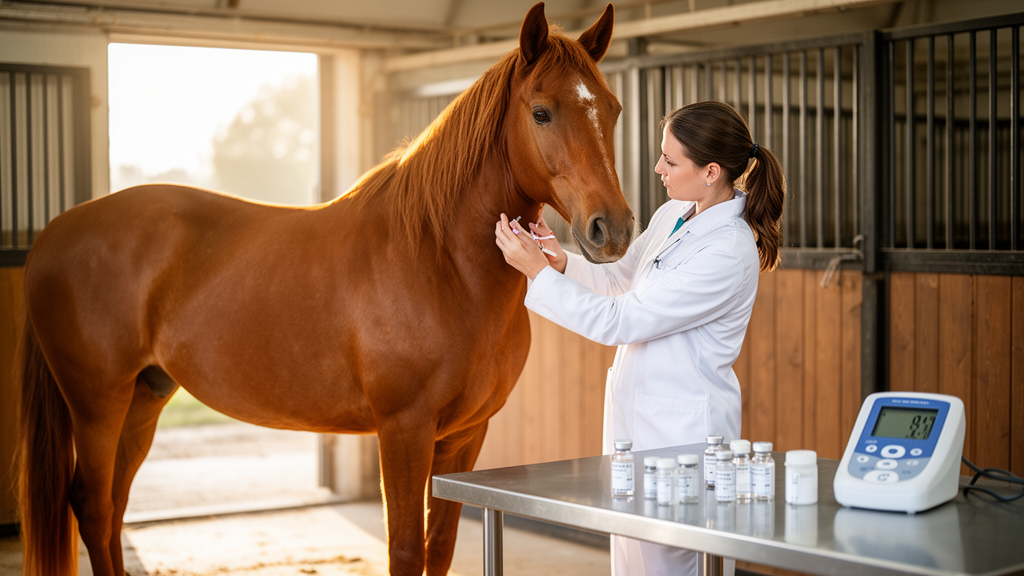
A four-week course of canagliflozin, a drug already known to lower dangerous insulin levels in horses, appears to do something more profound than simply flush sugar into the urine: it directly dampens how strongly the pancreas responds to glucose. That is the central finding of a randomized, double-blind clinical trial published in the Journal of Veterinary Internal Medicine, in which 42 insulin-dysregulated horses underwent sophisticated metabolic testing before and after treatment. The results offer the clearest evidence yet that sodium-glucose co-transporter 2 (SGLT2) inhibitors reshape pancreatic beta-cell function in horses, not just blood sugar numbers.
Insulin dysregulation is one of the most consequential metabolic disorders in modern equine medicine. Affected horses produce excessive amounts of insulin even when their blood glucose looks deceptively normal, and this hyperinsulinemia is tightly linked to laminitis, a devastating and often career-ending disease of the hoof’s laminar attachments. While careful diet and exercise management can control insulin levels in many animals, some horses need pharmacological help, and SGLT2 inhibitors such as canagliflozin, velagliflozin, dapagliflozin, and ertugliflozin have rapidly become the leading option. Until now, however, the field assumed these drugs worked mainly by one route: blocking glucose reabsorption in the kidney, thereby lowering blood glucose and, passively, insulin secretion along with it.
The new trial, conducted across multiple equine hospitals, set out to test whether something deeper was happening at the level of the pancreatic beta cells themselves. Forty-two privately owned horses and ponies, all older than two years and all diagnosed with insulin dysregulation based on insulin concentrations exceeding 100 microIU/mL after an oral sugar test, were enrolled. The cohort was deliberately diverse, including 14 British native pony breeds, 12 Icelandic horses, 6 Scandinavian native breeds, 4 crossbreed ponies, and 6 warmblood or draft types. Horses were randomly allocated in equal numbers to receive oral canagliflozin at 0.6 mg/kg, canagliflozin at 1.2 mg/kg, or a placebo, given once daily by their owners for four weeks. Only one horse, a placebo-treated animal injured in a transport accident, failed to complete the study.
The researchers’ key instrument was the graded glucose infusion test, a 240-minute procedure in which glucose is delivered intravenously at stepwise increasing rates of 0.4, 0.8, 1.2, 1.6, 2.4, and 3.2 mg/kg/min, with each step lasting 40 minutes. Blood samples collected throughout the test allowed the team to chart insulin secretion across a wide range of glucose concentrations. Because the glucose is given intravenously, the test bypasses the gut entirely, excluding any influence of incretin hormones, the intestinal signals that amplify insulin release after meals and are known to be exaggerated in insulin-dysregulated horses. This makes the GGI a uniquely direct window into the intrinsic sensitivity of the beta cells.
The results were striking. Beta-cell responsiveness, quantified as the slope of the linear relationship between insulin and glucose concentrations, fell from 38.4 plus or minus 3.3 mIU/mmol in placebo-treated horses to 22.0 plus or minus 3.5 mIU/mmol with the lower canagliflozin dose and 21.1 plus or minus 3.2 mIU/mmol with the higher dose, differences that were highly significant at P less than or equal to .001. A second index, the ratio of incremental areas under the curve for insulin and glucose, told the same story: 33.1 mIU/mmol for placebo versus 19.3 and 16.4 mIU/mmol for the two canagliflozin groups. Remarkably, doubling the dose produced no additional benefit, with no detectable difference between the 0.6 and 1.2 mg/kg regimens on any measure.
The suppression of insulin secretion was dramatic in absolute terms. The incremental insulin response over the test, expressed as the geometric least squares mean of the incremental area under the curve, dropped by 63.9 percent at the lower dose and 70.3 percent at the higher dose compared with placebo. Maximal insulin concentrations during the infusion fell from a geometric mean of roughly 289 microIU/mL in placebo horses to around 103 and 95 microIU/mL in the treated groups. Fasting plasma insulin likewise collapsed from 32.0 microIU/mL in placebo animals to approximately 14.8 and 14.7 microIU/mL with either dose. Glucose responses fell in parallel, with the incremental glucose area under the curve declining by 34.2 percent and 37.4 percent, and maximal glucose concentrations dropping by more than 2 to 3 mmol/L.
Crucially, insulin fell proportionally further than glucose did. If canagliflozin’s only effect were urinary glucose dumping, insulin secretion should have declined roughly in step with the reduced glycemic stimulus. Instead, the dose-response curves plotted for treated horses were shifted both leftward, reflecting lower glucose concentrations, and downward, following shallower slopes than those of placebo animals. That combination points to a genuine reduction in beta-cell responsiveness, a change in how much insulin the pancreas releases for any given glucose level, rather than a simple mechanical consequence of glucose lowering.
The findings also resolve a puzzle that has lingered in the literature. Earlier studies in healthy horses given a single dose of canagliflozin found no change in beta-cell responsiveness during graded glucose infusion, while a prior trial in insulin-dysregulated horses suggested the opposite. The new data support two possible reconciliations: the effect may be time-dependent, requiring sustained treatment rather than a single dose, or it may be specific to horses with hyperinsulinemia rather than those with normal insulin regulation. Notably, the placebo-treated horses in this trial showed a baseline beta-cell responsiveness of 38.4 mIU/mmol, roughly 2.6 to 3.7 times higher than values of 14.3 and 10.1 mIU/mmol reported for healthy Icelandic horses and Standardbred trotters in separate studies using comparable methods. This confirms that exaggerated beta-cell responsiveness is a real feature of equine insulin dysregulation, operating independently of gut hormones.
What mechanism explains the effect? The authors weigh several possibilities. Improved insulin sensitivity, perhaps driven by the modest weight loss of 2.9 to 3.9 percent observed in the parent study, could secondarily reduce beta-cell demand, although substantial weight loss is generally needed for meaningful sensitivity gains in horses. Alternatively, beta cells may adapt over weeks to chronically lower glucose exposure. A direct pharmacological action on the beta cells seems less likely, since single-dose studies in healthy horses showed no immediate effect, and SGLT2 expression in beta cells has never been demonstrated in any species. The team also notes a limitation: without a validated equine C-peptide assay, they could not distinguish reduced insulin secretion from increased insulin clearance, though the insulin-versus-glucose slope is known to correlate well with gold-standard measures based on C-peptide deconvolution.
Perhaps the most provocative implication lies across species lines. In humans with type 2 diabetes, SGLT2 inhibitors tend to enhance beta-cell responsiveness to intravenous glucose. But horses with insulin dysregulation may better resemble people with metabolic syndrome or prediabetes, conditions marked by mild hyperglycemia and hyperinsulinemia. Intriguingly, studies in obese, insulin-resistant humans without diabetes have shown that SGLT2 inhibitors substantially reduce the insulinogenic index, a standard measure of beta-cell responsiveness, mirroring the equine findings. If insulin resistance is a shared thread between equine insulin dysregulation and human metabolic syndrome, this drug class may be modulating beta-cell function in a way that crosses species boundaries, offering veterinarians a powerful tool against laminitis and, potentially, endocrinologists a fresh perspective on early metabolic disease.
Subject of Research: Effect of canagliflozin on beta-cell responsiveness in insulin-dysregulated horses
Article Title: Effect of canagliflozin treatment on β-cell responsiveness in insulin-dysregulated horses: a 4-week, multi-arm, double-blind, randomized clinical trial
Article References: Svonni, E., Lindåse, S., Hanche-Olsen, S., Hellings, I. R., Fintl, C., Nostell, K., & Bröjer, J. (2026). Effect of canagliflozin treatment on β-cell responsiveness in insulin-dysregulated horses: a 4-week, multi-arm, double-blind, randomized clinical trial. Journal of Veterinary Internal Medicine, 40(5), Article aalag249. https://doi.org/10.1093/jvimsj/aalag249
Image Credits: AI Generated
Keywords: canagliflozin, SGLT2 inhibitors, insulin dysregulation, horses, beta-cell responsiveness, hyperinsulinemia, laminitis, graded glucose infusion, equine metabolic syndrome, veterinary internal medicine, insulin secretion, randomized clinical trial
News Source: William Thompson. (October 16, 2026). Diabetes drug reshapes pancreatic insulin response in horses with metabolic disease. Scienmag.