• HOME
  • NEWS
  • EXPLORE
    • CAREER
      • Companies
      • Jobs
    • EVENTS
    • iGEM
      • News
      • Team
    • PHOTOS
    • VIDEO
    • WIKI
  • BLOG
  • COMMUNITY
    • FACEBOOK
    • INSTAGRAM
    • TWITTER
Tuesday, October 6, 2026
BIOENGINEER.ORG
No Result
View All Result
  • Login
  • HOME
  • NEWS
  • EXPLORE
    • CAREER
      • Companies
      • Jobs
        • Lecturer
        • PhD Studentship
        • Postdoc
        • Research Assistant
    • EVENTS
    • iGEM
      • News
      • Team
    • PHOTOS
    • VIDEO
    • WIKI
  • BLOG
  • COMMUNITY
    • FACEBOOK
    • INSTAGRAM
    • TWITTER
  • HOME
  • NEWS
  • EXPLORE
    • CAREER
      • Companies
      • Jobs
        • Lecturer
        • PhD Studentship
        • Postdoc
        • Research Assistant
    • EVENTS
    • iGEM
      • News
      • Team
    • PHOTOS
    • VIDEO
    • WIKI
  • BLOG
  • COMMUNITY
    • FACEBOOK
    • INSTAGRAM
    • TWITTER
No Result
View All Result
Bioengineer.org
No Result
View All Result
Home NEWS Science News

DGIST-POSTECH sign an MOU for the joint research and development of brain neural network map

Bioengineer by Bioengineer
February 18, 2020
in Science News
Reading Time: 2 mins read
0
IMAGE
Share on FacebookShare on TwitterShare on LinkedinShare on RedditShare on Telegram

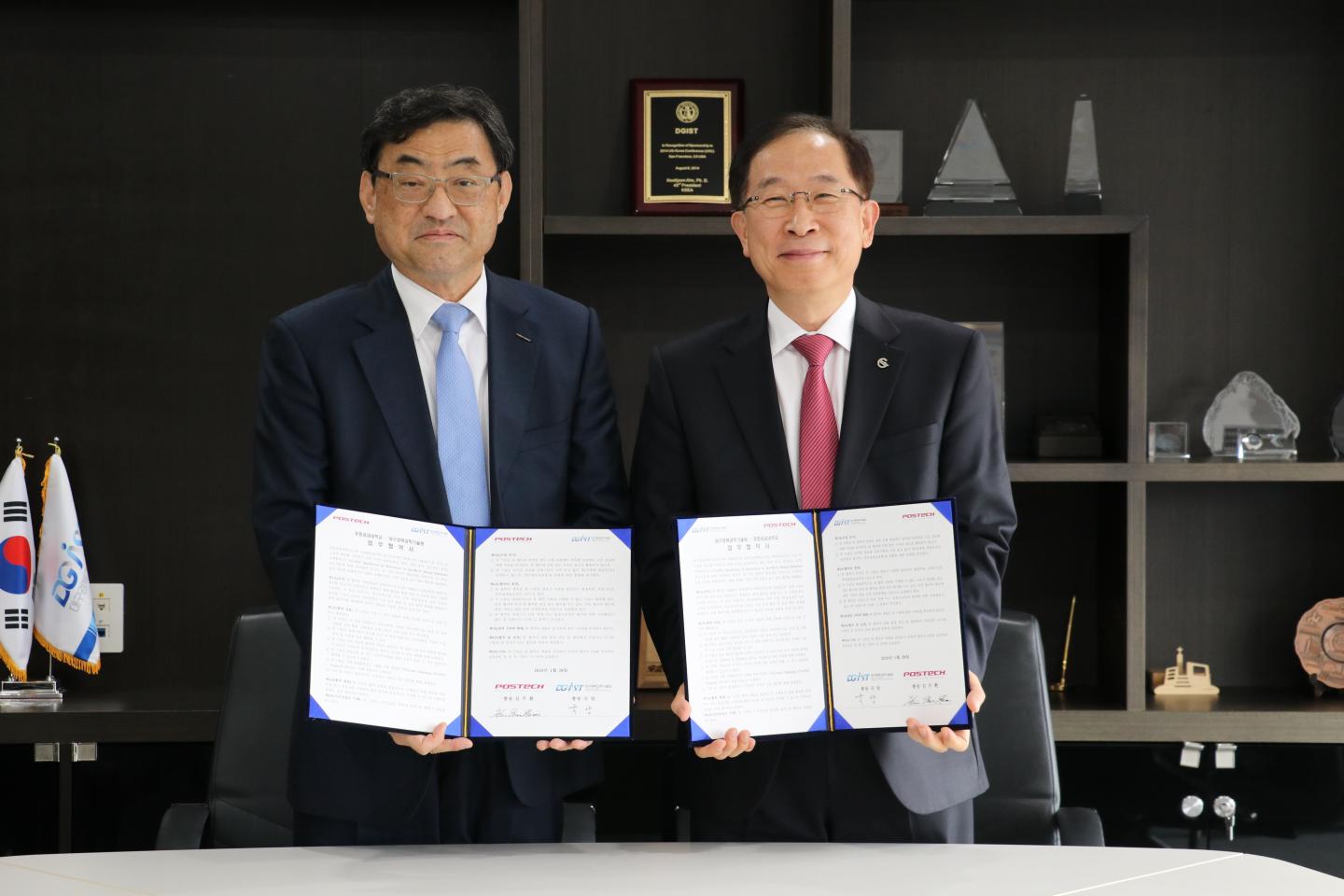
Participants of ‘International SYNAPSE Project,’ DGIST and POSTECH sign an MOU to build a joint cooperation system
IMAGE

Credit: dgist

DGIST signed a DGIST-POSTECH MOU to carry out ‘International SYNAPSE Project’ with POSTECH. They promised close research cooperation in their participants of project as South Korean representatives and are expected to contribute positively to the research and development of human brain neural network map, an international project.

The ‘International SYNAPSE Project’ is a research project to establish a human brain neural network map by a research group consisting of 6 Asia-Pacific countries (South Korea, Japan, Taiwan, Singapore, and Australia). Its aim is to lay the framework for research innovation to understand and clarify human brain diseases, cognition, behaviors, and mentality through a 5-year-long joint research cooperation which normally takes 30 years by an individual country.

Through this MOU, DGIST will be using the super computer in the Super Computing and Big Data Center and POSTECH will be using its radiation accelerator in the Pohang Accelerator Laboratory for the project. First, they will collect the neural network images of human brain and store/analyze them on super computer. After, they will calculate the synaptic interactions in human brain and build a network system. This project will allow both DGIST and POSTECH to play a significant role in setting a milestone for brain and neuroscience development.

President Moohwan Kim of POSTECH said “As we need to act as trailblazers to take a great step forward in the world through transnational research cooperation beyond institutions, we wish POSECH and DGIST play pivotal roles to lead tremendous innovations in neuroscience and brain science, which are still unexplored by 6 Asia-Pacific countries. The high-resolution brain images acquired from 3rd and 4th generation radiation accelerators in POSTECH will especially play crucial roles to build the neural network of human brain.”

President Yang Kuk of DGIST said “We hope that the 6 Asia-Pacific countries lead the neuroscience and brain science field through the spread of research findings based on the state-of-art super computer infrastructure at DGIST. This agreement will contribute to creating a virtuous cycle of breakthrough research achievements.”

Since establishing the first Pohang Light Source Accelerator in South Korea in 1994, the Pohang Accelerator Laboratory published about 6000 SCI research papers and has led remarkable growth in the domestic radiation research field from almost nothing. Currently, the lab is running Pohang Light Source Accelerator (Pohang Light Source: PLS, the 3rd generation radiation accelerator) and PAL-XFEL (Pohang Accelerator Laboratory X-Ray Free-Electron Laser, the and 4th generation radiation accelerator).

###

Media Contact
Kwanghoon Choi
[email protected]
82-537-851-135

Original Source

https://dgist.ac.kr/en/html/sub06/060202.html

Tags: BiologyNeurochemistrySoftware Engineering
Share12Tweet8Share2ShareShareShare2

Related Posts

Blood Tests That Read the Brain: A Roadmap for Molecular Biomarkers in Stroke Care

Blood Tests That Read the Brain: A Roadmap for Molecular Biomarkers in Stroke Care

October 6, 2026
Barcode-Based Mutagenesis Assay Reveals Strand-Bias Rules Behind Oxidative DNA Damage

Barcode-Based Mutagenesis Assay Reveals Strand-Bias Rules Behind Oxidative DNA Damage

October 6, 2026

Prostate Cancer Drug Enzalutamide Extends Lives but Fails the Cost-Effectiveness Test at Current Prices

October 6, 2026

Antidepressants and Breast Cancer: Landmark Analysis of Nearly Two Million Women Reveals Timing Matters

October 6, 2026
Please login to join discussion

POPULAR NEWS

  • Alloys That Shrink Their Own Grains: New PIX Mechanism Refines Metals With Heat Alone

    Alloys That Shrink Their Own Grains: New PIX Mechanism Refines Metals With Heat Alone

    29 shares
    Share 12 Tweet 7
  • Endurance Exercise Reshapes the Liver in Males and Females Through Distinct Molecular Routes

    29 shares
    Share 12 Tweet 7
  • Single Transcription Factor PU.1 Rapidly Converts Fibroblasts into Macrophage-Lineage Cells

    29 shares
    Share 12 Tweet 7
  • New Scale Measures How Ready Nurse Educators Really Are for the AI Era

    29 shares
    Share 12 Tweet 7

About

We bring you the latest biotechnology news from best research centers and universities around the world. Check our website.

Follow us

Recent News

Alloys That Shrink Their Own Grains: New PIX Mechanism Refines Metals With Heat Alone

Endurance Exercise Reshapes the Liver in Males and Females Through Distinct Molecular Routes

Single Transcription Factor PU.1 Rapidly Converts Fibroblasts into Macrophage-Lineage Cells

Subscribe to Blog via Email

Success! An email was just sent to confirm your subscription. Please find the email now and click 'Confirm' to start subscribing.

Join 85 other subscribers
  • Contact Us

Bioengineer.org © Copyright 2023 All Rights Reserved.

Welcome Back!

Login to your account below

Forgotten Password?

Retrieve your password

Please enter your username or email address to reset your password.

Log In
No Result
View All Result
  • Homepages
    • Home Page 1
    • Home Page 2
  • News
  • National
  • Business
  • Health
  • Lifestyle
  • Science

Bioengineer.org © Copyright 2023 All Rights Reserved.