December 7, 2022 / Kawasaki, JAPAN: Innovation Center for NanoMedicine (iCONM; Center Director: Prof. Kazunori Kataoka), a research institute of the Kawasaki Institute of Industrial Promotion (KIIP), has announced that a group lead by Prof. Horacio Cabral (Visiting Scientist of iCONM / Associate Professor of Bioengineering, Graduate School of Engineering, University of Tokyo) discovered a new way for the treatment of triple-negative breast cancer in collaboration with a group with Prof. Triantafyllos Stylianopoulos (Assistant Professor, University of Cyprus), National Cancer Center of Japan and iCONM and published a paper*, entitled ” Polymeric micelles effectively reprogram the tumor microenvironment to potentiate nano-immunotherapy in mouse breast cancer models” in Nature Communications on November 22, 2022.
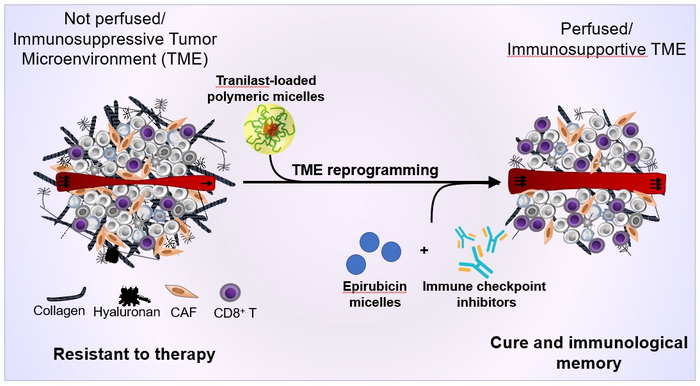
Refractory cancers such as triple negative breast cancer or pancreatic cancer develop a fibrous tissue called stroma, which is like an alien spacecraft protected with an energy shield and resistant to external attacks such as immune cells and anticancer drugs. The aim of this study is to remodel CAFs (cancer-associated fibroblasts) activated by oncogenesis and weaken the role of stroma, which acts as a cancer shield, so that they can respond to immunotherapy and chemotherapy. It is widely studied to identify compounds which weaken the stroma but their dose range that shows efficacy and does not lead to addiction seems to be narrow and such safety issue is a concern. In this study, we focused on a long-listed antiallergic drug “Tranilast” and investigated the degree to which it can weaken the stroma when delivered into the tumor interior in polymeric nanomicelles. As a result, we confirmed the CAF remodeling effect in triple-negative breast cancer mice at 100-fold reduced dosage of Tranilast compared to when Tranilast was used without micelles (free form). This indicates that nanomicelle incorporation into the tumor and CAF was enhanced compared to the free form. In addition, the combination of Tranilast-loaded micelles with nanomedicine (Epirubicin Micelle or Doxil) and immune checkpoint inhibitors increased immune T-cell infiltration into the tumor, resulting in complete response and immune memory in mice with immunotherapy-resistant breast cancer. In addition, the effects of Tranilast-loaded micelles on the tumor microenvironment were non-invasively followed by ultrasound shear wave elastography (SWE) (Note 3) for optimal dosing planning. The discovery that treatment response can be predicted from SWE measurements prior to treatment initiation is important and strongly suggests that this imaging modality has the potential to be used as a biomarker for response prediction.
Credit: Horacio Cabral
December 7, 2022 / Kawasaki, JAPAN: Innovation Center for NanoMedicine (iCONM; Center Director: Prof. Kazunori Kataoka), a research institute of the Kawasaki Institute of Industrial Promotion (KIIP), has announced that a group lead by Prof. Horacio Cabral (Visiting Scientist of iCONM / Associate Professor of Bioengineering, Graduate School of Engineering, University of Tokyo) discovered a new way for the treatment of triple-negative breast cancer in collaboration with a group with Prof. Triantafyllos Stylianopoulos (Assistant Professor, University of Cyprus), National Cancer Center of Japan and iCONM and published a paper*, entitled ” Polymeric micelles effectively reprogram the tumor microenvironment to potentiate nano-immunotherapy in mouse breast cancer models” in Nature Communications on November 22, 2022.
Refractory cancers such as triple negative breast cancer or pancreatic cancer develop a fibrous tissue called stroma, which is like an alien spacecraft protected with an energy shield and resistant to external attacks such as immune cells and anticancer drugs. The aim of this study is to remodel CAFs (cancer-associated fibroblasts) activated by oncogenesis and weaken the role of stroma, which acts as a cancer shield, so that they can respond to immunotherapy and chemotherapy. It is widely studied to identify compounds which weaken the stroma but their dose range that shows efficacy and does not lead to addiction seems to be narrow and such safety issue is a concern. In this study, we focused on a long-listed antiallergic drug “Tranilast” and investigated the degree to which it can weaken the stroma when delivered into the tumor interior in polymeric nanomicelles. As a result, we confirmed the CAF remodeling effect in triple-negative breast cancer mice at 100-fold reduced dosage of Tranilast compared to when Tranilast was used without micelles (free form). This indicates that nanomicelle incorporation into the tumor and CAF was enhanced compared to the free form. In addition, the combination of Tranilast-loaded micelles with nanomedicine (Epirubicin Micelle or Doxil) and immune checkpoint inhibitors increased immune T-cell infiltration into the tumor, resulting in complete response and immune memory in mice with immunotherapy-resistant breast cancer. In addition, the effects of Tranilast-loaded micelles on the tumor microenvironment were non-invasively followed by ultrasound shear wave elastography (SWE) (Note 3) for optimal dosing planning. The discovery that treatment response can be predicted from SWE measurements prior to treatment initiation is important and strongly suggests that this imaging modality has the potential to be used as a biomarker for response prediction.
What is the novelty of this study?
Hypo-perfusion is a hallmark of the microenvironment of many solid tumors. It leads to hypoxia, low pH and inadequate delivery of medicines, which compromises the efficacy of cancer therapies, including nanotherapy and immunotherapy. Impaired blood supply and the resulting hypoxic tumor microenvironment also help cancer cells evade the immune system and increase their invasive and metastatic potentials. Here, we show that
• encapsulation of TME modulating drugs improves their pharmacokinetic properties, while allows for drastic reduction in the dose of administration,
• effective modulation of the TME can lead to complete cures of nano-immunotherapy in breast cancer tumor models resistant to this therapy. It can also induce immunological memory, meaning that tumors could not grow again in animals that had survived because the animals’ immune system had obtained memory against the cancer cell line.
• ultrasound shear wave elastography can be employed for optimizing the use of TME modulating agents and for the prediction of tumor response to nano-immunotherapy allowing for optimized treatment protocols. Shear wave elastography is a clinically-applied, non-invasive imaging modality to quantify tumor stiffness. Our study highlights the potential of shear wave elastography and measures of tumor stiffness to be used as a biomarker to predict the efficacy of immunotherapy and separate tumors to responders and non-responders prior to treatment.
Why are these findings important and how is your study going to improve the current therapy?
The study is of importance because it proposes a new nanoparticle formulation that aims instead of directly killing cancer cells to effectively reprogram the tumor microenvironment making it easier for existing therapeutics to reach the tumor, and thus, improving drastically their efficacy. The potential of this new nanoparticle formulation has been showcased in drug-resistant breast tumor models but it is expected to be beneficial in other hypo-perfused tumors with abundant dysfunctional blood vessels, such as pancreatic cancers, sarcomas and colorectal cancers. Restoration of blood supply in these tumors – achieved with the developed tranilast-loaded micelles, along with the administration of the proper cocktail of nanotherapy and immunotherapy can induce a drastic reduction of primary tumor size and effectively diminish lung metastasis, resulting in significant improvement in overall survival rates and even in complete cures.
Also, the identification of tumor stiffness as a key determinant of the degree of tumor perfusion highlights the potential use of stiffness measures as biomarkers for immunotherapy prediction. To date there are no universal predictive biomarkers for immune checkpoint blockade. Biomarkers based on the expression of PD-L1, have been proposed only for certain tumor types. However, some tumors respond even when PD-L1 expression is low, while others do not respond even when PD-L1 expression is elevated. Different tumor types might have significantly different immunological backgrounds and thus, the identification of common predictive markers based on molecular information is extremely challenging. On the other hand, tumor stiffness can be measured with non-invasive and clinically-available methods in patients and should be tested as a biomarker in prospective trials. Indeed, ongoing clinical studies in collaboration with the German Oncology Center (Limassol, Cyprus) and the Bank of Cyprus Oncology Center (Nicosia, Cyprus) aim to transfer the knowledge obtained from the preclinical studies to the clinical setting.
Journal
Nature Communications
DOI
10.1038/s41467-022-34744-1
Method of Research
Experimental study
Subject of Research
Animals
Article Title
Polymeric micelles effectively reprogram the tumor microenvironment to potentiate nano-immunotherapy in mouse breast cancer models
Article Publication Date
22-Nov-2022
COI Statement
None of authors declare conflict of interests.