1. A research team consisting of NIMS, Hokkaido University and Yamaguchi University has developed a method for easily synthesizing a self-healing polymer gel made of ultrahigh molecular weight (UHMW) polymers (polymers with a molecular weight greater than 106 g/mol) and non-volatile ionic liquids. This recyclable and self-healable polymer gel is compatible with circular economy principles. In addition, it may potentially be used as a durable, ionically conductive material for flexible IoT devices.
Credit: Ryota Tamate
National Institute for Materials Science
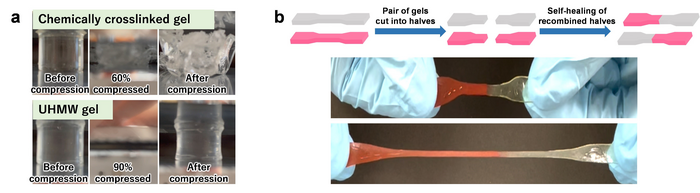
1. A research team consisting of NIMS, Hokkaido University and Yamaguchi University has developed a method for easily synthesizing a self-healing polymer gel made of ultrahigh molecular weight (UHMW) polymers (polymers with a molecular weight greater than 106 g/mol) and non-volatile ionic liquids. This recyclable and self-healable polymer gel is compatible with circular economy principles. In addition, it may potentially be used as a durable, ionically conductive material for flexible IoT devices.
2. Self-healing polymeric materials are capable of spontaneously repairing damaged areas, thereby increasing their material lifetimes, thus being expected to promote a circular economy. Most reported self-healing polymeric materials in recent years has taken a chemical approach, in which functional groups capable of reversible dissociation and reformation (e.g., hydrogen bonding) were integrated into polymeric networks. However, this approach often requires precise synthetic techniques and complex manufacturing processes. On the other hand, an alternative physical approach (i.e., the use of physical entanglement of polymer chains) to synthesizing versatile polymeric materials with self-healing capabilities had rarely been explored.
3. This research team recently developed a technique for easily synthesizing UHMW gels composed of entangled UHMW polymers using ionic liquids. The mechanical properties of UHMW gels were found to be superior to those of conventional, chemically crosslinked gels. In addition, they can be recycled via thermal processing, and exhibit high self-healing capabilities at room temperature.
4. The use of the newly developed recyclable, self-healing, easy-to-synthesize UHMW gel material is expected to promote a circular economy. In addition, because this material is synthesized using non-volatile, flammable ionic liquids, it may be used as a safe, ionically conductive soft material in flexible electronics.
***
5. This project was carried out in conjunction with another project entitled, “Development of soft materials based on ultra-high molecular weight polymers and exploration of their novel functions” (research director: Ryota Tamate, project number: JPMJPR2196) under the research category, “Nanoengineering on Mechanical Functions of Materials” supported by the JST Strategic Basic Research Program PRESTO. The project was also supported in part by the JSPS Grants-in-Aid for Scientific Research (grant numbers: 20K15349, 21H05604, 21H02006, 20H02804 and 20K21229) and the Shorai Foundation for Science and Technology.
6. This research was published in the October 19, 2022 issue (Vol. 8) of Science Advances.
Journal
Science Advances
DOI
10.1126/sciadv.add0226
Method of Research
Experimental study
Subject of Research
Not applicable
Article Title
Highly stretchable and self-healable polymer gels from physical entanglements of ultrahigh molecular weight polymers
Article Publication Date
19-Oct-2022