• HOME
  • NEWS
  • EXPLORE
    • CAREER
      • Companies
      • Jobs
    • EVENTS
    • iGEM
      • News
      • Team
    • PHOTOS
    • VIDEO
    • WIKI
  • BLOG
  • COMMUNITY
    • FACEBOOK
    • INSTAGRAM
    • TWITTER
Thursday, June 25, 2026
BIOENGINEER.ORG
No Result
View All Result
  • Login
  • HOME
  • NEWS
  • EXPLORE
    • CAREER
      • Companies
      • Jobs
        • Lecturer
        • PhD Studentship
        • Postdoc
        • Research Assistant
    • EVENTS
    • iGEM
      • News
      • Team
    • PHOTOS
    • VIDEO
    • WIKI
  • BLOG
  • COMMUNITY
    • FACEBOOK
    • INSTAGRAM
    • TWITTER
  • HOME
  • NEWS
  • EXPLORE
    • CAREER
      • Companies
      • Jobs
        • Lecturer
        • PhD Studentship
        • Postdoc
        • Research Assistant
    • EVENTS
    • iGEM
      • News
      • Team
    • PHOTOS
    • VIDEO
    • WIKI
  • BLOG
  • COMMUNITY
    • FACEBOOK
    • INSTAGRAM
    • TWITTER
No Result
View All Result
Bioengineer.org
No Result
View All Result
Home NEWS Science News Chemistry

Developing a technique to study past Martian climate

Bioengineer by Bioengineer
December 17, 2019
in Chemistry
Reading Time: 2 mins read
0
IMAGE
Share on FacebookShare on TwitterShare on LinkedinShare on RedditShare on Telegram

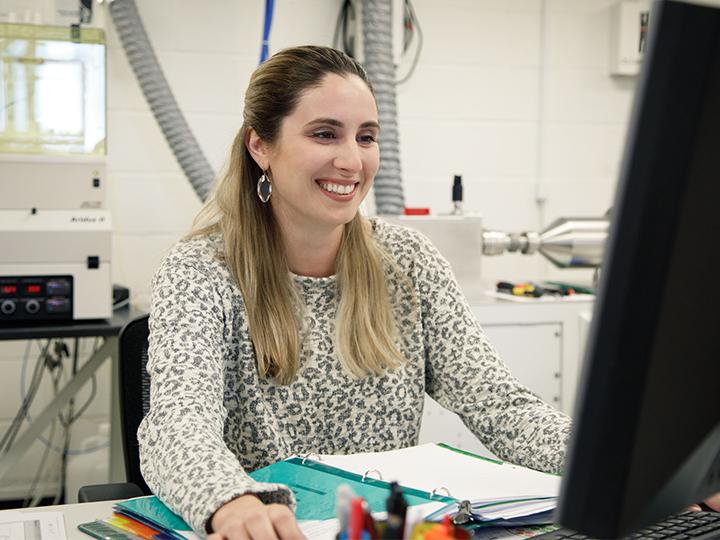
UH Geology student awarded $285,000 NASA grant
IMAGE

Credit: University of Houston


Joanna Clark has been interested in geology ever since she was a child. Today, the University of Houston doctoral student is turning that curiosity into a career and getting noticed by NASA, which awarded her a $285,000 grant to develop a technique that could one day be used to better understand past climate conditions on Mars.

“We hope to have samples from Mars one day and when we do, we need to be ready to evaluate them. This could help give us a better understanding of how the planet has changed over millions of years,” said Clark, who is studying the geochemistry of Mars.

For now, Clark’s research will focus on creating silica minerals in the laboratory to discover how they form in subzero temperatures, such as those on Mars. Silica minerals, including quartz, are commonly found in Earth surface sediment, but silica was also detected in rocks and sediment on Mars by NASA’s Curiosity Rover.

The initial experiments have begun. “I am working on how to get the silica out of solution as a solid with all the right chemistry. Once I am able to do that, I will take the solid and analyze it for oxygen isotopes,” explained Clark, who has done previous studies on cryogenic opal-A, which is silica that forms in brine veins between growing water ice crystals.

Tom Lapen, Clark’s research advisor and chair of the Department of Earth and Atmospheric Sciences in the UH College of Natural Sciences and Mathematics, said silica might be able to preserve the conditions under which it actually precipitated, or became a solid, from a liquid. In other words, silica found on Mars is a potential source of past climate information.

Lapen and Clark are working with Zach Sharp, who runs the Center for Stable Isotopes at the University of New Mexico. Sharp developed the analytical technique and Clark will build upon it by investigating silica samples formed below zero degrees Celsius.

“Joanna is competing with some of the best scientists in the country. Most of them are professors and researchers who have been doing this a long time,” said Lapen, referring to Clark’s NASA grant. “It indicates that the community views this project on really high merits and if successfully accomplished, it could have a big impact.”

Other project collaborators are Henry Chafetz, UH professor of geology and Elizabeth Rampe, an exploration mission scientist in the Astromaterials Research and Exploration Science Division at the Johnson Space Center.

###

Media Contact
Sara Tubbs
[email protected]
713-743-4248

Original Source

http://uh.edu/news-events/stories/2019/december-2019/12172019-geology-doctoral-student-awarded-nasa-grant.php

Tags: Climate ScienceEarth ScienceExperiments in SpaceGeology/SoilGeophysicsHydrology/Water ResourcesPlanets/MoonsSpace/Planetary Science
Share12Tweet8Share2ShareShareShare2

Related Posts

International Team Including Dresden Scientists Develops Novel Designer Proteins for Advanced Study of Living Tissue

June 25, 2026

New Study Uncovers Key Factors Driving Water Chemistry in Nanoscale Environments

June 25, 2026

Plasma Technology Extends Catalyst Lifespan in Hydrogen Production

June 24, 2026

Electric Field and Oxygen Spillover Collaborate to Control Electrode Migration in SOECs

June 24, 2026
Please login to join discussion

POPULAR NEWS

  • Saying Goodbye to PGY-6: Pediatric Fellowship Realities

    103 shares
    Share 41 Tweet 26
  • Multi-Hospital Study Reveals Long Covid Burden Is Twice as High as Current Estimates

    92 shares
    Share 36 Tweet 23
  • Detection of EDCs in Breast Milk and Infant Urine Up to Six Months Highlights Early Exposure Risks

    77 shares
    Share 31 Tweet 19
  • New Drug Candidate Developed at McMaster Shows Potential for Treating Brain Cancer

    58 shares
    Share 23 Tweet 15

About

We bring you the latest biotechnology news from best research centers and universities around the world. Check our website.

Follow us

Recent News

Energy-Saving Membrane Technology Developed by KAIST and Georgia Tech Enables Crude Oil Separation Without Boiling

Cracking the Code: How Cancer Evades Antibody-Drug Conjugates and New Strategies to Overcome Resistance

Chiral Laser Gyroscopes Surpass Lock-In Limit

Subscribe to Blog via Email

Enter your email address to subscribe to this blog and receive notifications of new posts by email.

Join 82 other subscribers
  • Contact Us

Bioengineer.org © Copyright 2023 All Rights Reserved.

Welcome Back!

Login to your account below

Forgotten Password?

Retrieve your password

Please enter your username or email address to reset your password.

Log In
No Result
View All Result
  • Homepages
    • Home Page 1
    • Home Page 2
  • News
  • National
  • Business
  • Health
  • Lifestyle
  • Science

Bioengineer.org © Copyright 2023 All Rights Reserved.