Wastewater treatment plants have considerably improved water quality around the world since the quantity of pollutants reaching aquatic ecosystems has been significantly reduced, as a result of environmental regulatory procedures. However, despite the fact that the effluent discharged through wastewater treatment plants is treated, what is left behind is a complex cocktail of pollutants, nutrients and pathogens, whose environmental effects, hidden by other factors, may pass unnoticed. More advanced WWTPs apply additional treatments to reduce nutrients, organic matter and metals in the sewage, and these wastewater discharges, despite being highly diluted, can exert minor effects if they continue for a long time.
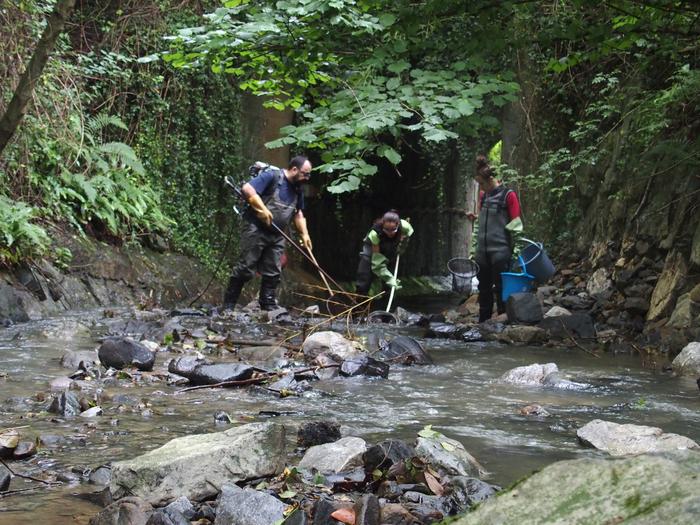
Credit: Stream Ecology group. UPV/EHU
Wastewater treatment plants have considerably improved water quality around the world since the quantity of pollutants reaching aquatic ecosystems has been significantly reduced, as a result of environmental regulatory procedures. However, despite the fact that the effluent discharged through wastewater treatment plants is treated, what is left behind is a complex cocktail of pollutants, nutrients and pathogens, whose environmental effects, hidden by other factors, may pass unnoticed. More advanced WWTPs apply additional treatments to reduce nutrients, organic matter and metals in the sewage, and these wastewater discharges, despite being highly diluted, can exert minor effects if they continue for a long time.
“To study the effects of these plants properly, we designed an innovative experiment that allowed us to handle the entire ecosystem over several years,” explained Ioar de Guzmán, a researcher in the UPV/EHU’s Stream Ecology group. Firstly, several variables were measured for one year in two selected reaches in an unpolluted stream, to see the difference between these reaches: “That way we knew how these stream variables changed depending on time and place,” she said. After that, properly treated, highly diluted water from a wastewater treatment plant was diverted to one of these downstream reaches, and “we took measurements over the period of another year in both reaches to see what changes had been brought about by these discharges on the diversity of the stream and on the trophic network (group of organisms organised by food relationships) and on the functioning of the ecosystem”.
Significant changes in the ecosystem
The study showed that treated wastewater can exert significant effects on the ecosystem and affect the structure and functioning of stream communities even if it is highly diluted when discharged. Although the toxicity of the effluent was found to be low, “in general, invertebrate diversity was reduced and communities became more heterogeneous; the amount of algae and herbivory (or tendency to feed on plants) increased,” explained the researcher. Although the wastewater is treated, certain nutrients that can help boost algae and organic matter enter the stream, but the pollutants can also lead to the disappearance of sensitive invertebrates and their replacement by more resistant ones.
It is therefore clear that the more advanced processes currently used in wastewater treatment continue to affect freshwater ecosystems, and that the conservation of freshwater food webs requires intensified efforts in the treatment of polluted waters: “We believe that by adhering to the limits stipulated by the legislation, the problems are reduced, but impacts are nevertheless generated; we must bear in mind that for an optimal conservation of the trophic networks of the streams, these treatments have to be even more stringent,” concluded the researcher from the Stream Ecology group.
Journal
Journal of Environmental Management
DOI
10.1016/j.jenvman.2023.118510
Method of Research
Experimental study
Article Title
Treated and highly diluted, but wastewater still impacts diversity and energy fluxes of freshwater food webs
Article Publication Date
28-Jun-2023