Wei Xiong receives $526K NSF CAREER Award for work on additive manufacturing of complex concentrated alloys
Credit: University of Pittsburgh
Additive manufacturing (AM), a burgeoning technology for alloy fabrication, allows engineers to specifically manufacture a complex component in any shape. However, due to the unique processing involved, the alloy behaves differently during fabrication using AM when compared with other traditional manufacturing techniques.
The alloy components produced by AM can easily develop a texture that makes them behave like wood in some ways–stronger along the grain than against it–and thus limits the strength (its resistance to distortion and fracture) and ductility (how much it can elongate before it breaks). There is a well-known trade-off between strength and ductility, which cannot be fully solved using current AM techniques, like reducing the grain size through externally applied deformation.
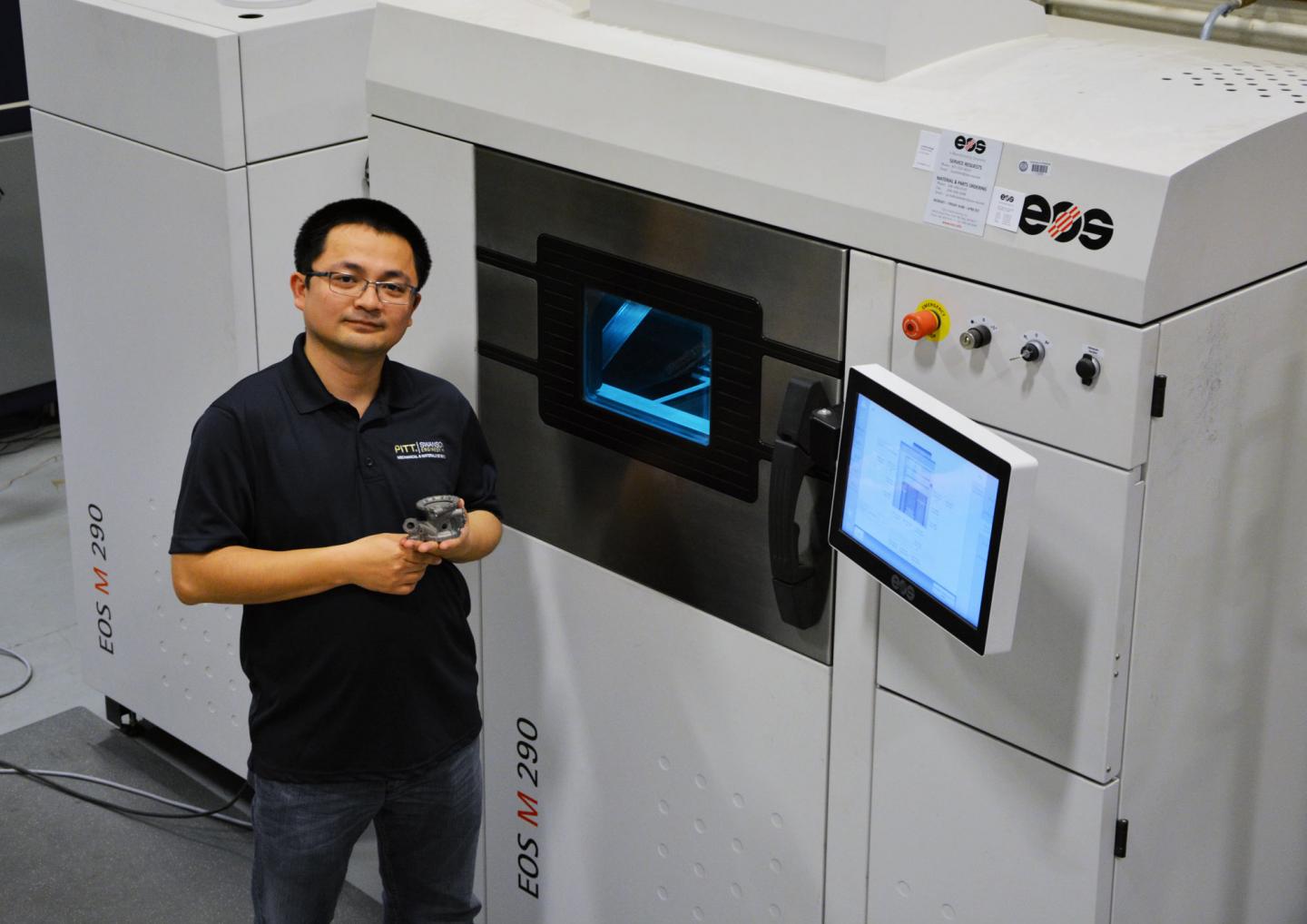
Wei Xiong, assistant professor of mechanical engineering and materials science at the University of Pittsburgh Swanson School of Engineering, will study the fundamental mechanisms behind this trade-off in a new project that received a $526,334 Faculty Early Career Development (CAREER) Award from the National Science Foundation (NSF). The five-year project, titled “Unraveling Fundamental Mechanisms Governing Grain Refinement in Complex Concentrated Alloys Made by Additive Manufacturing Towards Strong and Ductile Structures,” began on April 15, 2021.
“The ability to produce strong yet tough structural alloys is a necessary step toward getting the most out of new, innovative materials and manufacturing,” said Xiong, who last year also received the Early Career Faculty Fellow Award from the Minerals, Metals & Materials Society (known as TMS). “This project will provide a fundamental understanding that can overcome the well-known problem that, in general, the stronger a material is, the less ductile it becomes. Moreover, we will also design new alloys that can be additively manufactured”.
Grain refinement is a method used to augment a material by changing the size of its grain structure, improving both its strength and ductility. Xiong’s project aims to understand the underlying mechanism of grain refinements in complex concentrated alloys made by additive manufacturing of combinations of multiple chemical element additions.
Xiong’s Physical Metallurgy and Materials Design Lab will investigate whether increasing entropy, or disorder, in an alloy system will slow grain coarsening and stabilize microstructures, making the material both strong and ductile. Particularly, they will focus on mixing alloy powders to print complex concentrated alloys, which is a new type of material that usually stabilizes the microstructure due to its resulting high entropy.
There are plenty of earthly reasons that AM has exploded as a way to fabricate alloy parts. There are some good interplanetary reasons, too.
“Think about, in the future, if we colonize Mars and want to build stations using 3D printing. No one wants to bring hundreds of different alloy powders to travel with the rocket,” said Xiong. “We want to bring maybe only three or four different types of powders to serve the needs of building an entire station on Mars, so we can mix them with different ratios to fabricate different parts by additive manufacturing.”
“The developed technique can also help to save the cost of alloy powder production for various engineering purposes and enhance the sustainability of 3D printing by providing recipes to recycle and reuse existing metal powders,” he continued. “Therefore, it is important to explore the effective pathways of microstructure engineering of these alloys by additive manufacturing, and that is why I proposed such a topic.”
According to the NSF, the Faculty Early Career Development (CAREER) Program is its most prestigious award in support of early-career faculty who have the potential to serve as academic role models in research and education and to lead advances in the mission of their department or organization. This award marks the fourth consecutive year that a faculty member in the Department of Mechanical Engineering and Materials Science has received a CAREER Award.
###
Media Contact
Maggie Pavlick
[email protected]
Original Source
https:/