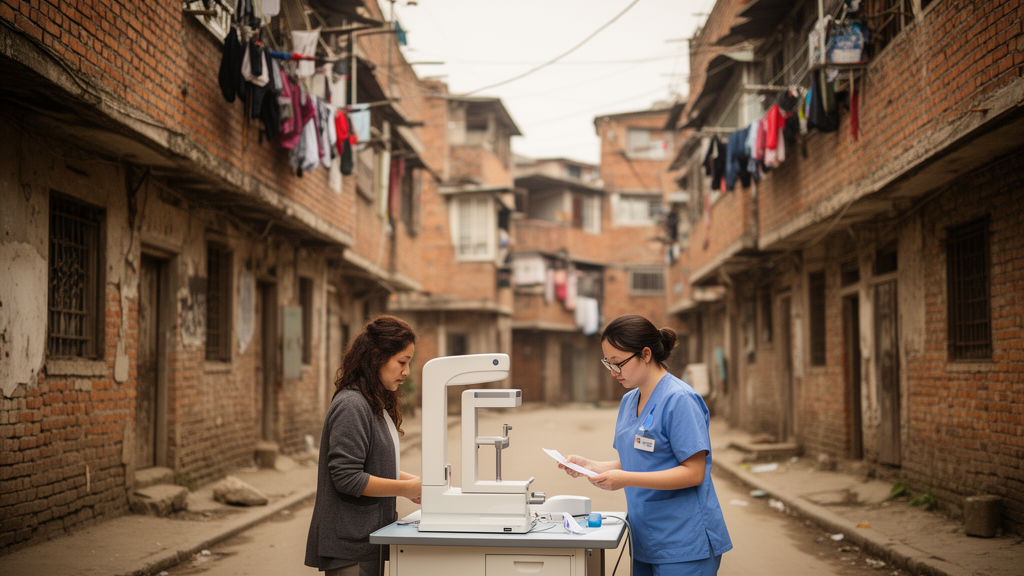
A descriptive public health field investigation in an informal urban settlement in Badalona, Spain, found that community-based outreach screening identified three new active tuberculosis cases among 81 people screened between October 2024 and February 2025. The target population was an estimated 150 residents and non-resident community members connected to a former school building that had been occupied for five years. Overall, 11 tuberculosis cases were epidemiologically linked to the settlement: 10 were bacteriologically confirmed and one was clinically diagnosed.
The investigation followed the detection in late 2023 of a small cluster of tuberculosis cases among men of sub-Saharan origin living in Badalona. Several cases were linked to the occupied building, and another resident was subsequently hospitalized with disseminated tuberculosis and died during admission. The field investigation was coordinated by the Epidemiological Surveillance Service of Barcelonès Nord and Maresme with primary care, hospital and community teams, and was designed to identify undiagnosed active disease and assess the feasibility of outreach screening in a structurally vulnerable population.
Conditions in the building included overcrowding, poor ventilation, makeshift partitions, and limited access to water and electricity. In addition to people residing there, the building served as a social, religious and community gathering place, so the eligible population included regular non-resident users. Population estimates were uncertain and changed between visits; women and children were initially not known to be present, while people who used cannabis and alcohol were present in both sections of the building.
Three sequential on-site interventions combined health education, symptom-based screening and clinical assessment. Recruitment involved posters, word of mouth, visits by community health workers and support from trusted community representatives. The symptom questionnaire covered unexplained cough, unexplained fever lasting more than three weeks, night sweats, dyspnea, chest pain, unintentional weight loss and unexplained fatigue. People reporting symptoms and close contacts of cases were assessed clinically, while asymptomatic close contacts were referred for chest radiography. Referrals for suspected tuberculosis included chest radiography, sputum smear microscopy, culture and Xpert MTB/RIF Ultra testing under national protocols. Transportation cards and community-worker support were provided to facilitate access.
Across the three visits, 81 people were screened, equivalent to 54% of the estimated eligible population. Forty-five completed symptom questionnaires and clinical examinations, among whom 12 were classified as presumptive tuberculosis cases, a positivity of 27%. All 12 completed diagnostic evaluation, producing 100% retention in testing. Three were diagnosed with tuberculosis, giving a number needed to screen of 27 and a number needed to test of 4. Two began treatment, completed it and were cured; the third, a probable lymph node tuberculosis case, never started treatment and was lost to follow-up. Treatment outcomes were assessed through April 2026.
The October 2024 intervention reached 55 male participants, of whom 19 completed full clinical assessments. Two new smear-positive pulmonary tuberculosis cases were diagnosed after all seven people evaluated for suspected disease had received radiography, with one evaluated at primary care after missing a hospital appointment. The November intervention included 25 participants and 13 asymptomatic close contacts, resulting in one additional probable lymph node tuberculosis diagnosis. A February 2025 outreach effort identified 12 women and seven children linked to the settlement, but only one woman attended evaluation; no children were screened. She had previously received tuberculosis treatment and had a normal chest X-ray.
Beyond the three cases detected through screening, surveillance and hospital records identified six additional linked cases, bringing the total to 11. These included the index case, the fatal disseminated case, the two pulmonary cases found in the first intervention, the probable lymph node case found in the second, and six additional cases. During the ascertainment period, another 66 residents who had not been screened for tuberculosis and had no previous public health system record registered with and attended the Sant Roc Primary Care Center following community engagement and referral activities. Three children were also linked to pediatric primary care for health needs unrelated to tuberculosis screening.
Participation was limited by population mobility, incomplete enumeration, institutional mistrust, weak coordination with social services and limited transport and accompaniment support. Women and children were markedly underrepresented, and field professionals informally reported concerns that some women feared contact with public health services could draw the attention of social services. Site identification was delayed by six months after the initial reported cases, and incomplete mapping required another four months before the first intervention. An eviction notice issued during the campaign prompted residents to leave or relocate, contributing to loss to follow-up and unscreened people.
The investigation was descriptive and limited to one occupied building and its connected community. It did not include on-site chest radiography, so symptomatic participants and close contacts were referred to healthcare facilities, although all 12 presumptive cases completed diagnostic evaluation. The estimated eligible population remained uncertain, coverage differed across the three visits, and the findings cannot establish the effectiveness or cost-effectiveness of screening in comparable settlements. The authors nevertheless observed that coordinated community outreach detected active disease and linked residents with healthcare services, while concluding that such screening remains operationally fragile in the presence of housing instability, mobility, mistrust and limited institutional support.
Subject of Research: Descriptive field investigation of community tuberculosis screening in an informal urban settlement in Badalona, Spain.
Article Title: Tuberculosis transmission and community outreach screening in an informal urban settlement in a low-incidence European setting
Article References: Flamarich-Gol, C., Bosch-Arís, M., Blázquez, G., Garcia-Circuns, A., Thiaw, B. E., Essadek, H. O., Roure, S., Stojanovic, Z., Bellido-Calduch, S., Lovera, M., García-Delgado, A., Segura, A., Carreres-Molas, A., Guasch-Arriaga, I., Antuori, A., Llop, A., Pillado, P., Romero, Y., Antolín, O., … Vilaplana, C. (2026). Tuberculosis transmission and community outreach screening in an informal urban settlement in a low-incidence European setting. Frontiers in Public Health, 14, Article 1907926. https://doi.org/10.3389/fpubh.2026.1907926
Image Credits: AI Generated
DOI: 10.3389/fpubh.2026.1907926
Keywords: tuberculosis, community screening, active TB, outreach, informal housing, Badalona, public health surveillance, health inequalities, contact tracing, transmission, community, screening
News Source: Phoebe Ingram. (October 21, 2026). Descriptive field investigation finds three new tuberculosis cases after outreach screening at an informal settlement in Badalona, Spain. Scienmag.