• HOME
  • NEWS
  • EXPLORE
    • CAREER
      • Companies
      • Jobs
    • EVENTS
    • iGEM
      • News
      • Team
    • PHOTOS
    • VIDEO
    • WIKI
  • BLOG
  • COMMUNITY
    • FACEBOOK
    • INSTAGRAM
    • TWITTER
Monday, June 29, 2026
BIOENGINEER.ORG
No Result
View All Result
  • Login
  • HOME
  • NEWS
  • EXPLORE
    • CAREER
      • Companies
      • Jobs
        • Lecturer
        • PhD Studentship
        • Postdoc
        • Research Assistant
    • EVENTS
    • iGEM
      • News
      • Team
    • PHOTOS
    • VIDEO
    • WIKI
  • BLOG
  • COMMUNITY
    • FACEBOOK
    • INSTAGRAM
    • TWITTER
  • HOME
  • NEWS
  • EXPLORE
    • CAREER
      • Companies
      • Jobs
        • Lecturer
        • PhD Studentship
        • Postdoc
        • Research Assistant
    • EVENTS
    • iGEM
      • News
      • Team
    • PHOTOS
    • VIDEO
    • WIKI
  • BLOG
  • COMMUNITY
    • FACEBOOK
    • INSTAGRAM
    • TWITTER
No Result
View All Result
Bioengineer.org
No Result
View All Result
Home NEWS Science News Chemistry

Delmic licenses Cryo Workflow Tools developed together with Max Planck scientists

Bioengineer by Bioengineer
March 10, 2021
in Chemistry
Reading Time: 3 mins read
0
IMAGE
Share on FacebookShare on TwitterShare on LinkedinShare on RedditShare on Telegram

New product to be launched in March simplifies cryo electron tomography
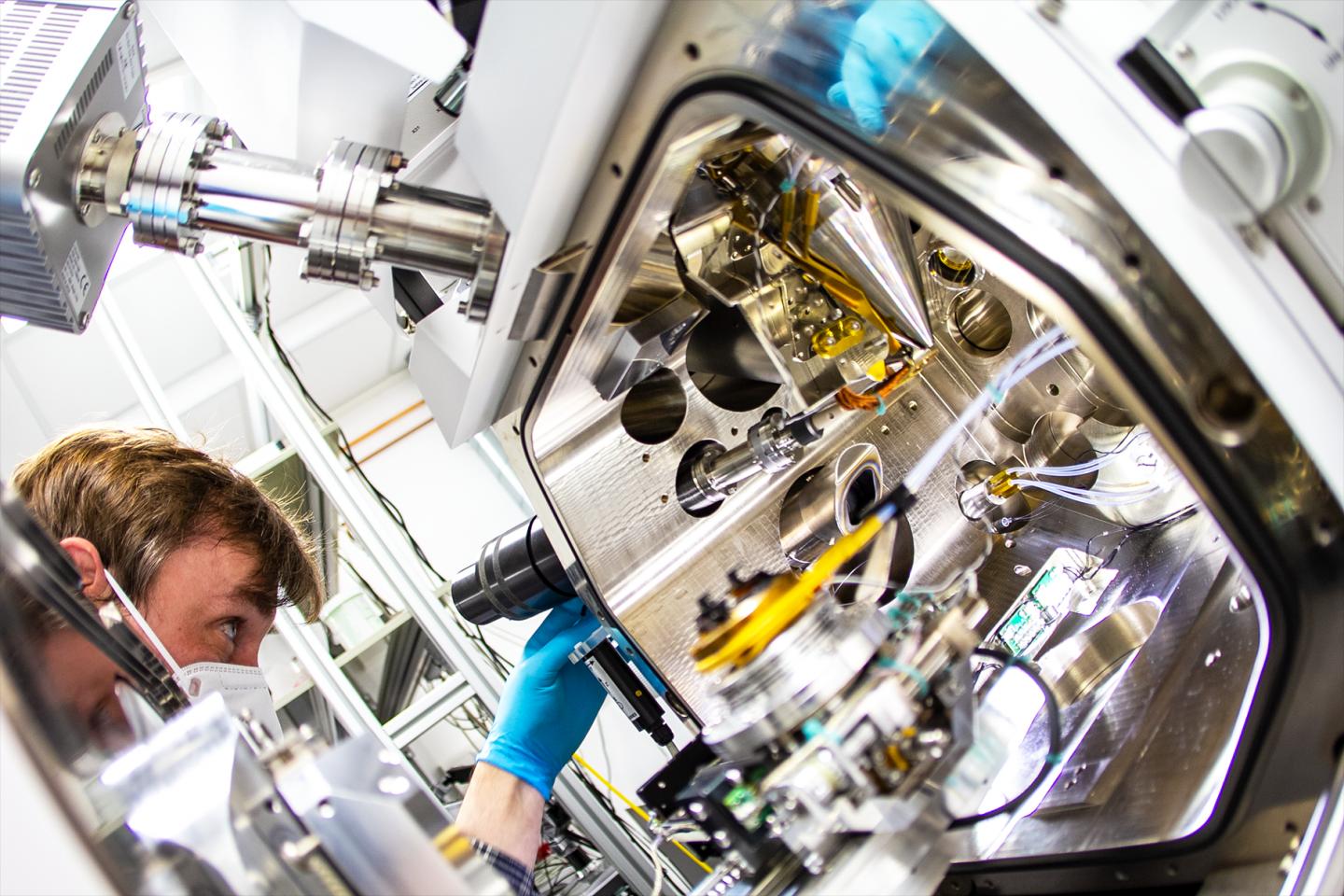
IMAGE

Credit: MPI of Molecular Physiology

In comparison to the conventional light microscopy, cryo electron tomography is a powerful tool that offers much deeper insights into the cell structure by unveiling high-resolution 3D views of biological samples such as large macromolecules. In the first step, samples are immobilized by high-speed freezing at extreme temperatures under ?150 °C. These cryogenic conditions make it possible to study samples without chemical fixation or dehydration, thereby preventing distortion or disruption of biological structures of the sample. However, the preparation and the handling of the samples are very complex, since the formation of crystalline ice can compromise the structural integrity of the specimen. Sebastian Tacke and colleagues from the MPI in Dortmund developed an innovative cryo-ET technology, which is now commercialized by the Dutch company Delmic, who specialize in offering solutions for light and electron microscopy. The new set of powerful cryo solutions is aimed to simplify and bring efficiency in the preparation phase involving cryo-ET samples.

The Cryo Workflow Tools will be known commercially as the CERES Ice Defence System. Used together or individually, the anti-contaminator, glove box and high vacuum cryo transfer (HVCT) are aimed to minimize ice contamination during lamella preparation. The Anti-contaminator (CERES Ice Shield) consists of a cryo shutter that is cooled by liquid nitrogen. It provides a colder surface within close proximity to the cryo sample and prevents any residual moisture in the chamber to condense on the sample and therefore drastically reduces undesirable ice formation on the sample. The glove box (CERES Clean Station) can be used to prepare the cryogenically frozen samples for cryo-FIB (Focused Ion Beam) and for cryo-TEM (Transmission Electron Microscopy) with minimal ice contamination thanks to a

“We are very excited to partner with the Max Planck Institute in Dortmund to make these innovative tools available to researchers in the cryo-EM field. The tools fit perfectly with our company mission, which is to make the world a healthier place by increasing the ease of obtaining powerful insight into the building blocks of life through cryo-ET”, says Dr. Katherine Lau, Business Unit Owner at Delmic Cryo.

“This fruitful collaboration of academia and industry is an example par excellence of how basic research can be transferred into the development of innovative technologies, improving the gain of new knowledge in life sciences and beyond. This technology transfer would not have been possible in this way without the important work of Max Planck Innovation,” says Prof. Dr. Stefan Raunser, director at the Max Planck Institute of Molecular Physiology.

“With Delmic, we have found an innovation-driven company that offers high-performance microscopy solutions for research. The invention of the MPI for Molecular Physiology fits in perfectly with Delmic’s product portfolio and will further simplify cryo-ET research to get a better understanding of organisms in the future. We are glad about the partnership and look forward to the product launch”, says Dr Ingrid Kapser-Fischer, patent- and licensing manager at Max Planck Innovation, the technology transfer organization of the Max Planck Society.

###

Media Contact
Johann
[email protected]

Original Source

https://www.mpi-dortmund.mpg.de/news/new-cryo-tools-enter-market

Tags: BiochemistryBiologyBiomedical/Environmental/Chemical EngineeringCell BiologyHealth CareMolecular BiologyOpticsPhysiology
Share12Tweet8Share2ShareShareShare2

Related Posts

AI and Physics Collaborate to Design Advanced Hydrogen Storage Materials

June 25, 2026

International Team Including Dresden Scientists Develops Novel Designer Proteins for Advanced Study of Living Tissue

June 25, 2026

New Study Uncovers Key Factors Driving Water Chemistry in Nanoscale Environments

June 25, 2026

Plasma Technology Extends Catalyst Lifespan in Hydrogen Production

June 24, 2026
Please login to join discussion

POPULAR NEWS

  • Saying Goodbye to PGY-6: Pediatric Fellowship Realities

    103 shares
    Share 41 Tweet 26
  • Multi-Hospital Study Reveals Long Covid Burden Is Twice as High as Current Estimates

    92 shares
    Share 36 Tweet 23
  • Detection of EDCs in Breast Milk and Infant Urine Up to Six Months Highlights Early Exposure Risks

    77 shares
    Share 31 Tweet 19
  • New Drug Candidate Developed at McMaster Shows Potential for Treating Brain Cancer

    58 shares
    Share 23 Tweet 15

About

We bring you the latest biotechnology news from best research centers and universities around the world. Check our website.

Follow us

Recent News

Tracking Lanthanide-Labeled Microplastics in Plants

POSTECH Researchers Slash Cost of Reconstituted Cell-Free Systems by 95%

AI and Physics Collaborate to Design Advanced Hydrogen Storage Materials

Subscribe to Blog via Email

Success! An email was just sent to confirm your subscription. Please find the email now and click 'Confirm' to start subscribing.

Join 82 other subscribers
  • Contact Us

Bioengineer.org © Copyright 2023 All Rights Reserved.

Welcome Back!

Login to your account below

Forgotten Password?

Retrieve your password

Please enter your username or email address to reset your password.

Log In
No Result
View All Result
  • Homepages
    • Home Page 1
    • Home Page 2
  • News
  • National
  • Business
  • Health
  • Lifestyle
  • Science

Bioengineer.org © Copyright 2023 All Rights Reserved.