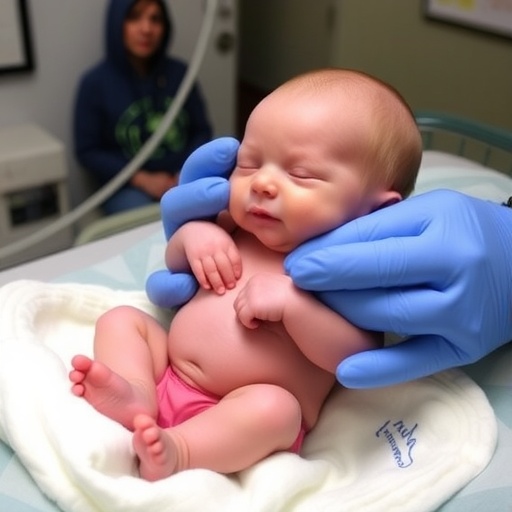
In a groundbreaking study published in the Journal of Perinatology, researchers have unveiled compelling evidence on the benefits of combining delayed cord clamping with immediate kangaroo mother care in moderate and late preterm infants. This pioneering investigation delves into the physiological impacts on oxygen saturation and heart rate, offering promising insights that could revolutionize neonatal care practices worldwide. The study’s robust analysis sheds light on how these interventions, strategically timed, can significantly influence the early stabilization of vulnerable preterm newborns.
Delayed cord clamping (DCC) — the practice of postponing the clamping of the umbilical cord for a specified duration after birth — has been increasingly recognized for its protective effects on newborn health. Traditionally, immediate clamping is performed to proceed quickly with neonatal resuscitation and care; however, recent evidence points to notable benefits of delaying this step. DCC allows for continued placental transfusion, thereby augmenting the infant’s blood volume and improving oxygen carrying capacity. This study extends this foundational understanding by examining how timed DCC, when paired with immediate kangaroo mother care (KMC), affects vital physiological parameters in infants born moderately or late preterm.
Kangaroo mother care, a well-established practice involving skin-to-skin contact between mother and infant, promotes thermal regulation, breastfeeding, and maternal-infant bonding. Immediate initiation of KMC after delivery, before transferring the infant to conventional neonatal care, has been hypothesized to bolster cardiovascular and respiratory stability in neonates. Yet, few investigations have methodically quantified its impact when integrated with delayed cord clamping, especially in the cohort of preterm infants who often face the steepest challenges in physiological adaptation at birth.
The research team conducted a thorough observational and interventional analysis involving a representative cohort of moderate and late preterm infants, defined as those born between 32 and 37 weeks gestational age. Careful monitoring of oxygen saturation (SpO2) levels and heart rate immediately after birth provided direct metrics to assess cardiopulmonary transitional physiology. The results indicated that infants who experienced both delayed cord clamping and immediate kangaroo mother care demonstrated a statistically significant improvement in oxygen saturation within the first critical minutes postpartum compared to those receiving immediate cord clamping and conventional care.
Importantly, heart rate measurements complemented these findings. Infants undergoing the combined intervention exhibited more stable and optimal heart rate ranges during the early adjustment period, suggesting enhanced autonomic regulation. This stability likely reflects the synergistic effects of sustained placental blood flow and the calming, thermoregulatory influence of maternal skin contact. Such physiological benefits bear crucial implications for reducing the incidence of hypoxia and related complications in this vulnerable population.
From a mechanistic standpoint, the study hypothesizes that the increased blood volume from delayed cord clamping facilitates improved preload and cardiac output, while the tactile stimulation and warmth from kangaroo care fine-tune autonomic balance. Together, these interventions appear to create a more favorable hemodynamic environment that supports oxygen delivery and utilization. The data further hint at potential downstream effects on neonatal morbidity, such as decreased reliance on supplemental oxygen and reduced episodes of bradycardia or desaturation, though extended follow-up studies are warranted.
The researchers emphasize that this dual intervention protocol is particularly significant in resource-limited settings where advanced neonatal care is often inaccessible. Immediate kangaroo mother care capitalizes on maternal proximity and physiological interplay, offering a low-cost, high-impact strategy to stabilize preterm infants. When combined with delayed cord clamping, it creates an integrated approach that optimizes initial adaptation with minimal technological dependency.
This study also aligns with a growing body of evidence advocating for a paradigm shift in neonatal resuscitation and stabilization—one that respects the natural perinatal transition processes while maximizing physiological advantages through non-invasive, supportive care methodologies. The findings challenge routine early cord clamping and delayed skin-to-skin contact practices, encouraging care teams to re-evaluate standard protocols for moderate to late preterm deliveries.
Clinical implications extend beyond immediate stabilization. Improved oxygen saturation and heart rate stability are closely tied to neurodevelopmental outcomes, as early hypoxic events can predispose infants to long-term cognitive and motor impairments. By facilitating a gentler transition, the combined delayed cord clamping and kangaroo care approach may contribute to improved developmental trajectories, a hypothesis meriting rigorous longitudinal assessment.
Healthcare providers are urged to consider the practical aspects of implementing such protocols. Training, workflow adjustment, and parental involvement assume central roles in operationalizing this care model. Collaborative efforts between obstetric and neonatal teams are essential to synchronize timing and ensure infants receive uninterrupted skin-to-skin contact while still benefiting from maternal placental support.
Additionally, the study calls attention to the potential challenges and contraindications. Situations involving compromised maternal or neonatal status may limit feasibility. The identification of clinical criteria and decision algorithms to select appropriate candidates for this approach will be important for safe, effective application in diverse clinical environments.
The promise of this combined intervention further stimulates inquiry into the molecular and cellular mechanisms underpinning observed physiological improvements. Emerging research into epigenetic modulation, inflammatory responses, and microbiome establishment in the immediate postnatal period may connect these care practices to long-term health outcomes. Such multidimensional understanding could pave the way for precision neonatal care tailored to individual risk profiles.
In summary, the integration of delayed cord clamping and immediate kangaroo mother care represents a significant advance in neonatal medicine, particularly for moderate and late preterm infants who occupy a delicate physiological niche between full-term robustness and extreme prematurity vulnerability. This evidence-based approach offers an accessible means to enhance vital sign stability, potentially transforming perinatal care paradigms across varied healthcare settings globally.
As the neonatal community assimilates these findings, ongoing research and clinical quality improvement initiatives will be critical to refine protocols and optimize implementation. Policymaking bodies and professional guidelines may soon incorporate these recommendations, fostering broader acceptance and standardization. Ultimately, the convergence of placental physiology and maternal-infant bonding interventions offers a natural, patient-centered method to support life’s earliest moments effectively.
The impact of delayed cord clamping coupled with immediate kangaroo mother care extends beyond survival and stabilization to touch on the holistic well-being of preterm infants. This innovative strategy exemplifies how blending traditional wisdom with contemporary science can yield transformative outcomes, illuminating new pathways for enhancing neonatal resilience and long-term health.
Subject of Research: The physiological impact of delayed cord clamping combined with immediate kangaroo mother care on oxygen saturation and heart rate in moderate and late preterm infants.
Article Title: Impact of delayed cord clamping and immediate kangaroo mother care on oxygen saturation and heart rate in moderate and late preterm infants.
Article References:
Valles-Murcia, N., Aguar, M., Pinilla-González, A. et al. “Impact of delayed cord clamping and immediate kangaroo mother care on oxygen saturation and heart rate in moderate and late preterm infants”. J Perinatol (2026). https://doi.org/10.1038/s41372-026-02652-7
Image Credits: AI Generated
DOI: 04 May 2026