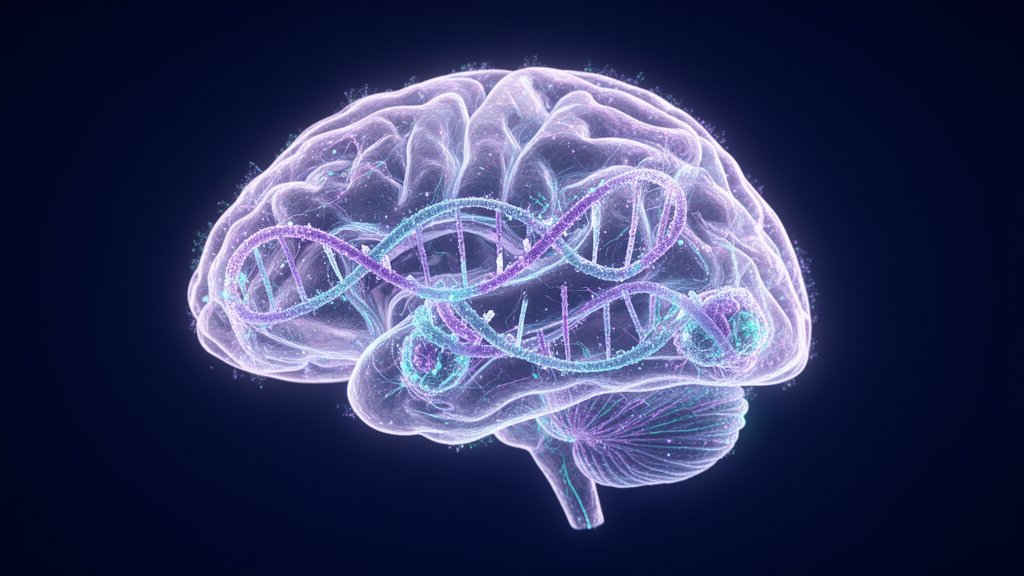
Researchers have developed DefunCNV, a deep learning framework designed to systematically predict the pathogenicity of functional noncoding copy number variations associated with brain disorders.
Studies indicate that a substantial fraction of copy number variations linked to brain disorders are situated in noncoding regions of the genome. While existing deep learning architectures effectively resolve short-range regulatory elements, they encounter major computational challenges when modeling the global characteristics of long-range chromatin interactions that extend across tens to hundreds of kilobases, leaving the pathogenicity of noncoding variations difficult to assess accurately.
To overcome the limitations of linear-sequence paradigms, DefunCNV reshapes 100-kilobase DNA sequences into two-dimensional feature matrices. This architectural strategy reorganizes extended genomic sequences into a two-dimensional layout that, combined with windowed attention mechanisms, captures long-range regulatory synergies that purely sequential analytical views fragment, enabling the precise annotation of 552 brain-related chromatin features.
Using these regulatory feature annotations, the research team constructed two specialized evaluation datasets by calculating log2 ratio differences across the 552 chromatin features between reference and variant genomic sequences. These benchmarks comprise a mixed coding and noncoding copy number variation dataset containing 2,638 entries alongside a dedicated noncoding copy number variation dataset containing 673 entries.
Experimental results demonstrated that DefunCNV outperforms existing computational tools in predicting the pathogenicity of copy number variations associated with brain disorders. By accurately modeling long-range sequence epigenetic regulation, the framework provides an established computational basis for both mechanistic interpretation and clinical evaluation of noncoding structural variants.
The operational scope of the framework is defined by its fixed window of approximately 100 kilobases, corresponding to exactly 98,304 base pairs. Because DefunCNV is specifically engineered for variations occurring within this defined length scale, the authors note that the model does not directly evaluate very large recurrent genomic rearrangements.
Subject of Research: Pathogenicity prediction of noncoding copy number variations in brain disorders using deep learning
Article Title: DefunCNV: a deep learning framework for functional noncoding copy number variations prediction
Article References: Bai, Y., Pei, M., Yu, Z., Du, F., Song, L., Gao, Y., Kang, Y., & Shi, F. (2026). DefunCNV: a deep learning framework for functional noncoding copy number variations prediction. Frontiers in Bioinformatics, 6, 1954308. https://doi.org/10.3389/fbinf.2026.1954308
Image Credits: AI Generated
DOI: 10.3389/fbinf.2026.1954308
Keywords: DefunCNV, copy number variations, noncoding CNVs, brain disorders, pathogenicity prediction, deep learning framework, chromatin features, epigenetic regulation, long-range chromatin interactions, two-dimensional feature matrices, windowed attention, log2 ratio differences, sequence annotation, genomic analysis, functional noncoding variations, recurrent rearrangements
News Source: Cassandra Pierce. (November 26, 2026). DefunCNV Framework Predicts Pathogenicity of Functional Noncoding Brain Disorder Variations. Scienmag.