• HOME
  • NEWS
  • EXPLORE
    • CAREER
      • Companies
      • Jobs
    • EVENTS
    • iGEM
      • News
      • Team
    • PHOTOS
    • VIDEO
    • WIKI
  • BLOG
  • COMMUNITY
    • FACEBOOK
    • INSTAGRAM
    • TWITTER
Thursday, June 11, 2026
BIOENGINEER.ORG
No Result
View All Result
  • Login
  • HOME
  • NEWS
  • EXPLORE
    • CAREER
      • Companies
      • Jobs
        • Lecturer
        • PhD Studentship
        • Postdoc
        • Research Assistant
    • EVENTS
    • iGEM
      • News
      • Team
    • PHOTOS
    • VIDEO
    • WIKI
  • BLOG
  • COMMUNITY
    • FACEBOOK
    • INSTAGRAM
    • TWITTER
  • HOME
  • NEWS
  • EXPLORE
    • CAREER
      • Companies
      • Jobs
        • Lecturer
        • PhD Studentship
        • Postdoc
        • Research Assistant
    • EVENTS
    • iGEM
      • News
      • Team
    • PHOTOS
    • VIDEO
    • WIKI
  • BLOG
  • COMMUNITY
    • FACEBOOK
    • INSTAGRAM
    • TWITTER
No Result
View All Result
Bioengineer.org
No Result
View All Result
Home NEWS Science News Biology

Defects in the ‘Swiss-army knife’ of gene expression may contribute to neuronal diseases like Alzheimer’s

Bioengineer by Bioengineer
May 1, 2020
in Biology
Reading Time: 3 mins read
0
IMAGE
Share on FacebookShare on TwitterShare on LinkedinShare on RedditShare on Telegram

IMAGE

Credit: Toshifumi Inada, Tohoku University

The growth, death, and diseases of complex organisms rely on the flow of information — from genes in DNA, through their transcription into RNA, and then translation of that transcript into proteins, which in turn build much of the living organism.

Proteins that control this whole process are themselves subject to this overarching information flow for survival. Researchers have now discovered a previously unknown function of a group of proteins, called the Ccr4-Not complex, that may shed light on the development of diseases like Alzheimer’s.

The findings were published in Science on 17-Apr-2020.

“The Ccr4-Not complex is involved in so many aspects of gene expression that we might as well call it the ‘Swiss Army Knife’ of protein production,” says Toshifumi Inada, a professor from the Graduate School of Pharmaceutical Sciences at Tohoku University, who led the research.

The best understood aspect of Ccr4-Not’s role is its involvement in the destruction of the messenger RNA (mRNA). The mRNA molecules are like instruction manuals that tell the ribosomes, the cell’s protein-making machinery, how to construct proteins.

The amount of proteins produced by the ribosomes is crucial, and so is the speed of that production. You don’t want too many or too few, too fast or too slow. In turn, these protein levels depend on the amount of mRNA. Thus control of mRNA destruction–especially when these instruction manuals have mistakes in them–is critical in controlling protein production.

“But until now, how Ccr4-Not did this has remained elusive,” Inada adds.

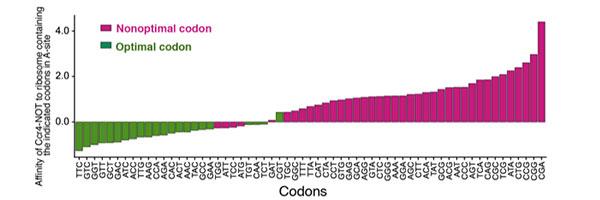
The mRNA instruction manuals are composed of multiple three-unit codes called ‘codons’ that tell the ribosomes which amino acids to use. Amino acids are the building blocks of proteins.

But even with this error-tolerant redundancy, there can still be a preference, or to use the formal term, bias, toward a particular synonym codon, because it speeds up the process. If an instruction manual for some reason doesn’t have this codon bias, the system is not working at the speed it should.

The researchers found that the Ccr4-Not complex is always on the hunt for slow-poke mRNA that don’t have this codon bias. They discovered that when the complex spots one, a part of it attaches itself to the ribosome, in turn triggering a degradation of the faulty mRNA.

But if the Ccr4-Not complex itself is faulty, missing the part that would attach to the ribosome reading the faulty mRNA, then the complex loses this crucial ability to sense and destroy these mRNA that are manufacturing proteins at the wrong speed.

Protein production that happens at the wrong speed can result in incorrect protein concentration, location or shape, all of which have been associated with a wide variety of diseases including Huntington’s and Alzheimer’s. The research offers insight into how Ccr4-Not abnormalities contribute to such illnesses via insufficient control of the rate of protein synthesis.

The researchers now want to investigate whether a normally functioning Ccr4-Not complex’s management of this rate also enables it to control protein folding and transport of proteins to their appropriate destination in the body.

###

Media Contact
Toshifumi Inada
[email protected]

Original Source

https://www.tohoku.ac.jp/en/press/gene_expression_may_contribute_to_neuronal_diseases.html

Related Journal Article

http://dx.doi.org/10.1126/science.aay6912

Tags: BiologyGenetics
Share12Tweet8Share2ShareShareShare2

Related Posts

Unlocking the Genome’s Power Source: Scientists Reveal How the Nucleus Generates Energy — Biology

Unlocking the Genome’s Power Source: Scientists Reveal How the Nucleus Generates Energy

June 11, 2026
Newly Identified TMEM63B Variant Drives Severe Respiratory Disorder Through Loss-of-Function Mutation — Biology

Newly Identified TMEM63B Variant Drives Severe Respiratory Disorder Through Loss-of-Function Mutation

June 10, 2026

New Insights into Brain Aneurysm Formation Could Improve Rupture Prediction

June 10, 2026

How Ambiguous Conservation Goals Are Letting Vulnerable Species Down

June 10, 2026
Please login to join discussion

POPULAR NEWS

  • ESMO 2025: mRNA COVID Vaccines Enhance Efficacy of Cancer Immunotherapy

    324 shares
    Share 130 Tweet 81
  • Saying Goodbye to PGY-6: Pediatric Fellowship Realities

    93 shares
    Share 37 Tweet 23
  • Multi-Hospital Study Reveals Long Covid Burden Is Twice as High as Current Estimates

    90 shares
    Share 36 Tweet 22
  • Common Food Preservatives Associated with Elevated Blood Pressure and Increased Heart Disease Risk

    58 shares
    Share 23 Tweet 15

About

BIOENGINEER.ORG

We bring you the latest biotechnology news from best research centers and universities around the world. Check our website.

Follow us

Recent News

IL11 Drives Lung Cancer Metastasis Through MMP12 Pathway

Human Brain Network Predicts Diffuse Midline Glioma

Digital Tools Boost Rural Myanmar Seniors’ Unity Amid War

Subscribe to Blog via Email

Enter your email address to subscribe to this blog and receive notifications of new posts by email.

Join 82 other subscribers
  • Contact Us

Bioengineer.org © Copyright 2023 All Rights Reserved.

Welcome Back!

Login to your account below

Forgotten Password?

Retrieve your password

Please enter your username or email address to reset your password.

Log In
No Result
View All Result
  • Homepages
    • Home Page 1
    • Home Page 2
  • News
  • National
  • Business
  • Health
  • Lifestyle
  • Science

Bioengineer.org © Copyright 2023 All Rights Reserved.