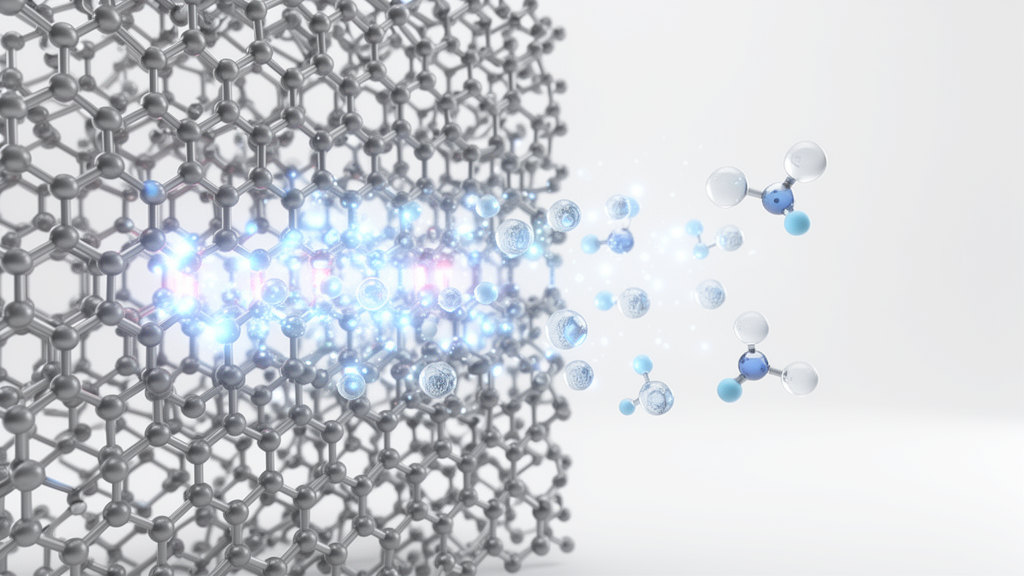
Researchers from Xinjiang University have developed a metal-organic framework catalyst that converts methane directly into acetic acid with high selectivity under mild conditions. The study, published in the Chinese Journal of Catalysis, demonstrates that introducing specific ligand defects into the UiO-66 framework creates unsaturated zirconium sites that facilitate the activation of methane C–H bonds and promote C–C coupling. This approach addresses a significant challenge in green chemistry: the direct synthesis of higher-value C2 products from methane, a process that currently relies on energy-intensive indirect methods involving methane reforming, methanol synthesis, and methanol carboxylation.
The team, led by Prof. Haibao Huang, Dr. Hao Guo, and Dr. Di Hu, designed a catalyst variant designated UiO-66-XT. This material was synthesized using the competitive complexation effect of trifluoroacetic acid, a method that results in a higher specific surface area and a greater number of defect sites compared to standard UiO-66. These structural modifications are crucial because the deficient sites expose unsaturated Zr4+ centers, which serve as the active locations for catalytic reaction. The research highlights the potential of metal-organic frameworks as a platform for precise control over the microenvironment surrounding active sites, allowing for regulated methane activation and selective conversion.
The mechanism of action involves the efficient adsorption of both methane and hydrogen peroxide at the exposed unsaturated Zr4+ sites. The study indicates that the d-band center of the Zr 3d orbital in these sites shifts upward, promoting decomposition and C–C coupling. Efficient charge transfer at these defect sites enables the activation of the strong C–H bond in methane, while defect-stabilized intermediates guide the subsequent coupling steps to form acetic acid. This mechanistic insight provides a novel perspective on material defect engineering and extends the current understanding of partial methane oxidation processes.
Experimental results showed that the catalyst achieved an acetic acid selectivity of 84% under optimal conditions at 150 °C. The yield was reported as 1,691 μmol·gcat.-1, indicating a high level of productivity per unit mass of catalyst. The research team observed a volcano-shaped correlation between the degree of ligand defects in the UiO-66 structure and the selectivity for acetic acid. The catalyst also exhibited exceptional stability.
The direct conversion of methane to acetic acid is considered essential for the green and efficient conversion of clean energy. Traditional industrial processes for producing acetic acid from methane are indirect and consume enormous amounts of energy due to the multi-step nature of the synthesis. Direct synthesis of C2 products from methane often presents challenges in activating the C–H bond and controlling C–C coupling reactions. The UiO-66-XT catalyst addresses this by precisely regulating the microenvironment around the active sites, thereby enhancing the selectivity for the desired C2 product.
The study was conducted by a research team at Xinjiang University, with contributions from institutions in Urumqi and Guangzhou. The findings were published in the Chinese Journal of Catalysis, a monthly journal co-sponsored by the Dalian Institute of Chemical Physics, Chinese Academy of Sciences, and the Chinese Chemical Society. The journal is published by the Elsevier group and covers all areas of catalysis, including fundamental issues and practical applications.
The implications of this research extend beyond the specific reaction of methane to acetic acid. By tuning the structure and electronic properties of the catalyst, researchers can potentially optimize the conversion of methane to other C2 chemicals.
Subject of Research: Catalytic conversion of methane to acetic acid using defective metal-organic frameworks
Article Title: Highly selective oxidation of methane to acetic acid enabled by deficient UiO-66 under mild conditions
Article References: Highly selective oxidation of methane to acetic acid enabled by deficient UiO-66 under mild conditions. Original publication (Bibliographic details unavailable.)
Image Credits: AI Generated
DOI: Not provided
Keywords: methane oxidation, acetic acid synthesis, UiO-66, metal-organic frameworks, ligand defects, zirconium catalysts, C-H bond activation, C-C coupling, green chemistry, catalyst design, hydrogen peroxide, selective oxidation, defect engineering, Xinjiang University, Chinese Journal of Catalysis
News Source: Bethany Barker. (November 14, 2026). Defective UiO-66 Catalyst Converts Methane to Acetic Acid. Scienmag.