


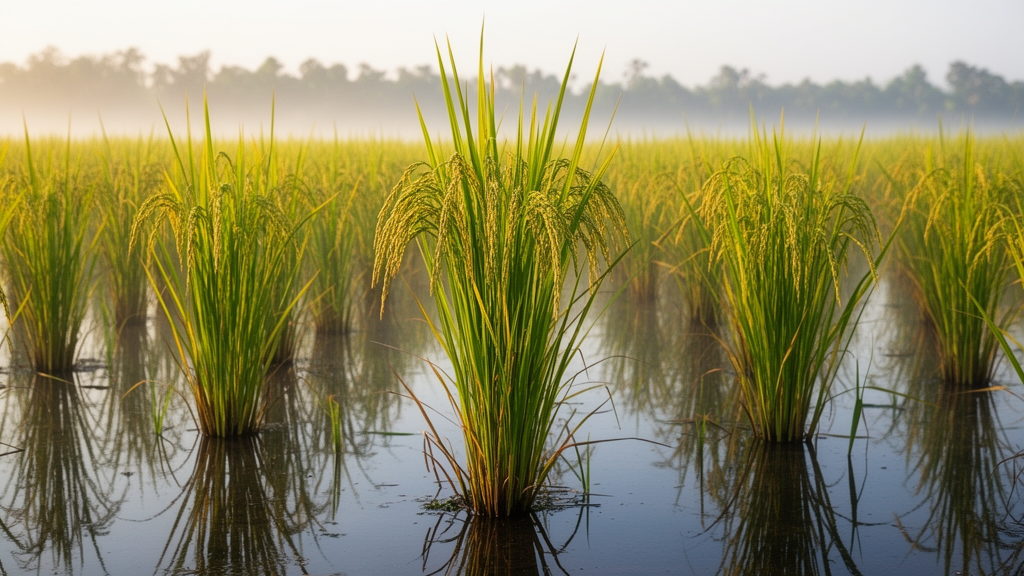
Researchers have produced a de novo whole-genome assembly of Pin Gaew 56, a deepwater rice cultivar described as a well-studied genetic resource with extensively documented physiological and molecular traits related to internode elongation under partial submergence. The new data note, published in BMC Genomic Data, describes a de novo whole-genome assembly built specifically for this variety, giving researchers a cultivar-specific reference where broad reference genomes previously fell short.
Deepwater rice survives flooding through what is known as the submergence escape response, a vital survival strategy in which the plant rapidly elongates its internodes to keep its upper portions above the water. Although this physiological process has been studied extensively in Pin Gaew 56, the authors note that current reference genomes lack sufficient genetic information to fully understand the molecular mechanisms behind it. The new assembly is intended to close that gap by providing genomic data matched to the cultivar in which the response has been so well documented.
The final assembly spans a total length of 407.7 megabases, distributed across 138 scaffolds with an N50 of 32.5 megabases. The assembly has a total length of 407.7 Mb, comprising 138 scaffolds with an N50 of 32.5 Mb.
Quality control for the assembly relied on several complementary measures. Genome completeness assessed by BUSCO showed 94.5% complete BUSCOs. Continuity in LTR-rich regions was supported by an LTR Assembly Index of 28.2.
Two further lines of evidence bolstered confidence in the assembly. Assembly quality was further supported by a k-mer-based quality assessment and whole-genome synteny alignment against the MH63 reference genome.
Pin Gaew 56 is described as a well-studied genetic resource with extensively documented physiological and molecular traits related to internode elongation under partial submergence. The new assembly supplies that missing piece.
The authors state that this study provides a cultivar-specific genomic resource for Pin Gaew 56 that can support further investigation of the genetic basis of the submergence escape response.
The authors position the dataset as a resource for investigating the genetic mechanisms underlying internode elongation and flooding adaptation in deepwater rice. As a data note, the publication focuses on describing the assembly and its quality rather than reporting new biological discoveries.
The submergence escape response is a complex physiological process, and understanding it at the molecular level requires both the phenotypic data that Pin Gaew 56 has long offered and a genomic reference that reflects the cultivar’s own sequence. The final assembly has a total length of 407.7 Mb, comprising 138 scaffolds with an N50 of 32.5 Mb, 94.5% complete BUSCOs, and an LTR Assembly Index of 28.2, providing a genomic resource for investigating the genetic mechanisms underlying internode elongation and flooding adaptation in deepwater rice.
Subject of Research: De novo whole-genome assembly of the deepwater rice cultivar Pin Gaew 56 as a resource for studying the submergence escape response
Article Title: De novo genome assembly of the deepwater rice (Oryza sativa) cultivar Pin Gaew 56
Article References: Seong, H. J., Huh, S. U., Lee, T.-H., & Choi, D. (2026). De novo genome assembly of the deepwater rice (Oryza sativa) cultivar Pin Gaew 56. BMC Genomic Data, 27(1), Article 64. https://doi.org/10.1186/s12863-026-01476-w
Image Credits: AI Generated
DOI: 10.1186/s12863-026-01476-w
Keywords: deepwater rice, genome assembly, Oryza sativa, Pin Gaew 56, submergence escape response, internode elongation, BUSCO, LTR Assembly Index, scaffolds, flood adaptation, genomic resource, BMC Genomic Data
News Source: Juliet Wilcox. (October 30, 2026). Deepwater rice cultivar Pin Gaew 56 gets its own genome assembly. Scienmag.



