


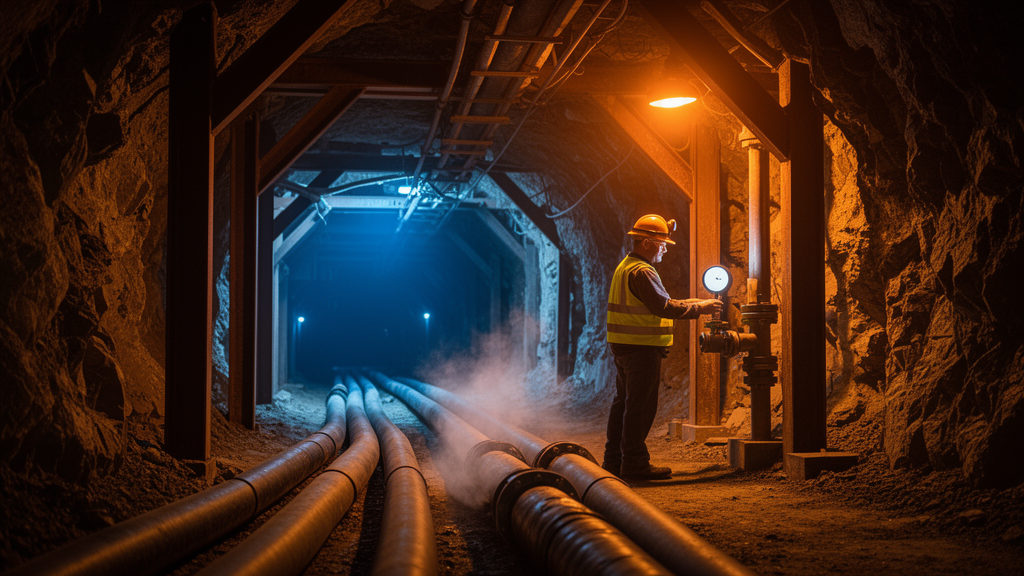
Deep mines around the world are getting hotter as they dig deeper, and a growing body of research argues that this underground heat should not be treated merely as a hazard to be ventilated away. A comprehensive review published in GeoEnergy Communications examines co-exploitation of mine-derived geothermal energy, or CMGE, an emerging approach that treats mineral extraction and geothermal utilization as a single, integrated enterprise. The review, authored by Dan Ma, Xuefeng Gao and Jixiong Zhang, synthesizes recent advances in the genesis mechanisms, resource assessment, extraction technologies, materials, artificial intelligence applications and sustainability challenges of the field, while identifying the knowledge gaps that still stand between laboratory concepts and industrial-scale deployment.
The basic premise rests on a striking convergence of two trends. As shallow mineral deposits are depleted, mining is pushing steadily downward. In China, coal mining has reached depths of up to 1,500 meters, with more than 50 mines exceeding 1,000 meters, and operations are progressing further underground at a rate of 10 to 15 meters per year. The review notes that in the next 10 to 15 years, 53 percent of China’s coal resources are expected to be extracted from depths below 1,000 meters, while non-coal mining has already exceeded 4,000 meters and roughly 32 Chinese metal mines now descend beyond 1,000 meters. At the same time, surrounding rock temperatures rise with depth. More than 80 mines worldwide deeper than 1,000 meters report surrounding rock temperatures of 50 to 70 degrees Celsius, and deep Chinese wells reach 40 to 45 degrees. Because the economically viable geothermal reservoir zone overlaps with these mining depths, the authors argue that the two resources can be explored, planned and developed collaboratively.
The scale of the underlying resource is substantial. The review cites estimates that approximately 140 million exajoules of geothermal energy exist within the upper 5 kilometers of the Earth’s crust, capable of supporting electricity generation, heating and other applications for around 17 percent of the global population. Global thermal content at 1 kilometer depth is estimated at 370,000 terawatt-hours thermal, rising to 40 million terawatt-hours thermal at 4 kilometers. For China specifically, Wang and colleagues calculated that geothermal reserves in the national coalfield areas amount to 1.12 x 10^19 kilojoules, equivalent to 379.539 billion tons of standard coal, with recoverable heat reserves of 1.71 x 10^18 kilojoules, or 56.931 billion tons of standard coal. These figures, the authors conclude, make CMGE feasible from the standpoint of resource occurrence.
Mine-derived geothermal resources exist in three forms: surrounding rock, groundwater, and gas around the mines. Their formation depends on heat sources such as radioactive decay within the Earth’s interior, mantle heat transfer and magma activity, on the thermal conductivity and heat capacity of different rock types, and on groundwater flow patterns that carry heat through the system. The review also highlights a mechanism unique to mines: heat accumulation from underground machinery. Because mine-derived resources are typically buried at shallow depths and remain below 80 degrees Celsius, conventional geothermal classification schemes fit them poorly; the authors describe a refined classification based on mining stage, geothermal medium, mining method and mineral type, spanning well construction, exploitation and abandonment phases.
Accurate resource assessment is a prerequisite for cost-effective development, and here the review identifies a methodological shortfall. Traditional approaches such as the volumetric method and reservoir simulation remain the standard tools for geothermal evaluation, but the volumetric method is designed for large regional scales and can produce significant errors when applied to individual mines. Zhang and colleagues proposed an integral geothermal reservoir volume method that accounts for thickness variation of the thermal reservoir, improving applicability. Numerical simulation, the most accurate approach when built on real three-dimensional geological models, struggles to capture water migration under intensive mining conditions, and mining damage zones alter effective specific heat capacity and thermal conductivity in ways that reduce reliability. The authors call for new high-fidelity numerical methods integrated with transparent mine geological models.
On the experimental front, the review documents a progression from millimeter-scale fracture seepage tests to meter-scale rigs, aided by 3D printing and fine engraving technologies that allow realistic, rough fracture surfaces to be prepared and replicated. Physical similarity experiments have examined how water injection parameters affect cooling and thermal recovery of mine roadways, and scaled-down mine models now serve as fundamental units for controlling mining activities and geothermal extraction. These studies support a three-phase heat transfer model comprising host rock, fracture fluid and pore fluid. However, the authors caution that most experiments were designed for conventional geothermal development and lack the high-intensity mining-induced stresses that characterize real CMGE environments. Numerical simulators including TOUGH, COMSOL Multiphysics, OpenGeoSys and newer programs such as GeothermalKits, StrataKing and MultiFracS are extending what can be modeled, though simultaneously solving the coupled multi-field problem of mineral and geothermal exploitation remains a key difficulty.
Four principal extraction technologies have emerged. Heat extraction by buried pipes in backfill embeds heat-conducting pipelines in mine backfill, forming a closed system that avoids groundwater pollution and subsidence; modeling studies show that the thermal parameters of the backfill material most strongly govern long-term performance, and that increasing pipe length raises total heat dissipation even as efficiency per unit length falls. Heat extraction by buried pipes in surrounding rock uses drilled boreholes and directional or coaxial heat exchangers, offering a stable heat source particularly valuable for winter heating in cold regions. Heat extraction from in-situ drilling taps high-temperature aquifers in mine floors through boreholes already established at the working face, sidestepping the high cost of surface drilling while reducing water inrush risk. Finally, heat extraction from water stored in goafs, the flooded voids left behind by mining, uses warm mine water as a heat storage medium, though sealing capacity and water retention in damaged goaf areas remain major obstacles.
Materials science and artificial intelligence are both being recruited to push these technologies toward commercialization. A phase-change heat-storage material based on coal-based solid waste increased thermal conductivity by 75.7 percent and specific heat capacity by 111.9 percent compared with conventional backfill, while nanofluids have demonstrated thermal conductivity gains of up to 13 percent in laboratory settings, though high cost still blocks commercial application. Graphite-enhanced cement can raise backfill thermal conductivity to 3.5 watts per meter-kelvin, and surface coatings on buried pipes improve heat transfer while preventing corrosion and scaling. On the data side, deep learning models now predict mine pressure evolution, localize microseismic events, identify water inrush sources and channels, and forecast geothermal production metrics such as flow rate, outlet temperature and thermal breakthrough distance. One multivariable LSTM model enabled early warning of high water inrush risk more than two days before actual events.
Because nearly all mine-derived geothermal temperatures fall below 100 degrees Celsius, with most under 50 degrees, the review advocates cascade utilization, in which the same heat serves successive applications: power generation first, then heating, then cooling and anti-freezing uses with lower temperature requirements. Optimization has advanced from single-parameter tuning to global parameter collaboration; one study increased the average coefficient of performance of a multi-level cascade system from 4.41 to 4.74 while cutting costs by 9.92 percent. Yet sustainability concerns temper the outlook. Backfill bodies can crack under long-term thermal cycling, releasing heavy metals into mine water; aquifer communication through in-situ drilling can cause uneven surface subsidence; and mine water chemistry, rich in iron, aluminum, manganese, sulfate or toxic metal ions depending on ore type, threatens both end users and geothermal pipelines. Long-term temperature and groundwater fluctuations may also reshape underground microbial communities. Meanwhile, mining-induced stress and temperature damage alter reservoir rock properties, and recent modeling suggests geothermal reinjection amplifies mining disturbances on fault stability, increasing shear sliding distance and cumulative seismic moment compared with single-mining scenarios.
The review concludes that CMGE has moved from concept toward a coherent technical framework, but that most technologies remain at the proof-of-concept stage. No regulations specifically targeting mine-derived geothermal energy have yet emerged, a policy vacuum the authors warn could undermine investment confidence and environmental protection alike. Their proposed path forward includes innovative laboratory measurement systems capable of capturing chemical, physical and biological feedbacks during simultaneous mining and heat extraction, data-driven physics-based modeling that fuses multi-source data, uncertainty quantification across the entire CMGE lifecycle, and more professional legal frameworks. If those gaps close, the deepening of the world’s mines, currently seen as a cost of resource hunger, could instead become an unexpected contribution to a low-carbon energy supply.
Subject of Research: Co-exploitation of mine-derived geothermal energy, combining mineral extraction with geothermal heat recovery in deep mines
Article Title: Co-exploitation of mine-derived geothermal energy: recent advances and emerging perspectives
Article References: Ma, D., Gao, X., & Zhang, J. (2025). Co-exploitation of mine-derived geothermal energy: recent advances and emerging perspectives. GeoEnergy Communications, 1(1), Article 12. https://doi.org/10.1007/s44421-025-00013-2
Image Credits: AI Generated
DOI: 10.1007/s44421-025-00013-2
Keywords: geothermal energy, deep mining, mine-derived geothermal, cascade utilization, heat extraction, backfill, numerical simulation, artificial intelligence, resource assessment, sustainability, fault stability, energy policy
News Source: Violet Maxwell. (October 29, 2026). Deep Mines Could Double as Geothermal Power Sources, Review Finds. Scienmag.



