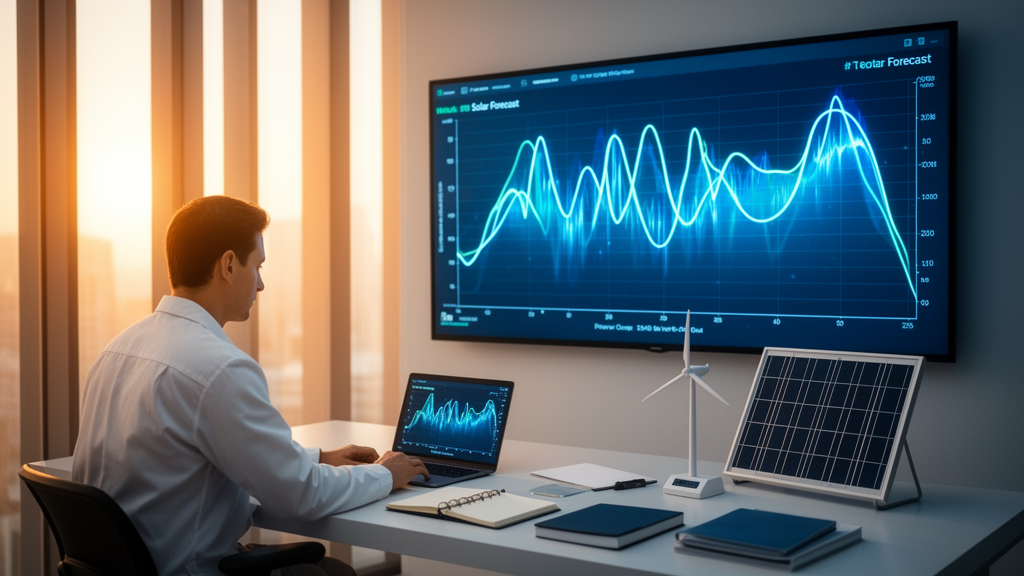
Accurate forecasting of renewable energy has become increasingly important for planning, managing and operating modern power systems as wind, solar and other renewable sources take up a growing share of electrical grids. A new systematic review published in Neural Computing and Applications examines how deep learning, one of the most prominent approaches in this field, is being used to predict renewable energy generation.
The review, authored by Anas Thamer Mustafa and Omar Sharaf Al-Deen Al-Yozbaky, argues that forecasting renewable output remains a complex and challenging task because the underlying data are heterogeneous, variable and often limited.
According to the authors, a wide range of methods has been proposed to improve forecasting accuracy and support reliable energy-system operation, spanning statistical techniques, artificial intelligence, hybrid approaches and other data-driven methods. Among these, deep learning stands out for its ability to automatically extract hierarchical representations, capture nonlinear patterns, model temporal and spatial dependencies, and adapt to changing renewable-energy generation conditions.
The article provides what the authors describe as a comprehensive and systematic review of deep-learning-based renewable-energy prediction methods and related neural-network-based or hybrid intelligent forecasting models. The catalogue is broad: artificial neural networks, convolutional neural networks, recurrent neural networks, restricted Boltzmann machines, autoencoders, deep belief networks and generative adversarial networks are all covered, alongside adaptive neuro-fuzzy inference systems, wavelet neural networks, radial basis neural networks and general regression neural networks.
The review also extends beyond pure deep architectures to extreme learning machines, ensemble learning, hybrid models and transfer learning, reflecting how researchers increasingly combine multiple techniques to squeeze out additional accuracy.
To make the study transparent and reproducible, the authors structured their selection process using a framework based on the Preferred Reporting Items for Systematic Reviews and Meta-Analyses, the widely used reporting standard known as PRISMA. This is intended to make clear which studies were included and why, a step that helps other researchers assess and extend the review.
The review discusses the methodological principles behind the models, their forecasting effectiveness, practical applications, the types of data they use, the forecasting horizons they target, the performance indicators used to evaluate them, and the limitations reported in the literature. It also identifies future research directions, including hybrid modeling, multi-source data integration, interpretability, computational requirements, data scarcity, and generalization across diverse geographical and climatic renewable-energy contexts.
Those open questions matter because a model that performs well in one climate or grid setting may not transfer cleanly to another. Better interpretability could help grid operators understand why a forecast is trustworthy, while improved handling of limited data could bring accurate forecasting to regions where historical records are sparse. As renewable penetration grows, the review suggests that combining deep learning with complementary techniques will remain central to keeping power systems reliable.
Subject of Research: Deep learning methods for forecasting renewable energy generation
Article Title: A review of cutting-edge methods for using deep learning to predict renewable energy
Article References: Mustafa, A. T., & Al-Yozbaky, O. S. A.-D. (2026). A review of cutting-edge methods for using deep learning to predict renewable energy. Neural Computing and Applications, 38(20), Article 844. https://doi.org/10.1007/s00521-026-12610-1
Image Credits: AI Generated
DOI: 10.1007/s00521-026-12610-1
Keywords: deep learning, renewable energy, forecasting, neural networks, systematic review, PRISMA, hybrid models, transfer learning, power systems, artificial intelligence, review, cutting-edge
News Source: Blake Davidson. (October 28, 2026). Deep learning review maps how AI forecasts renewable energy. Scienmag.