


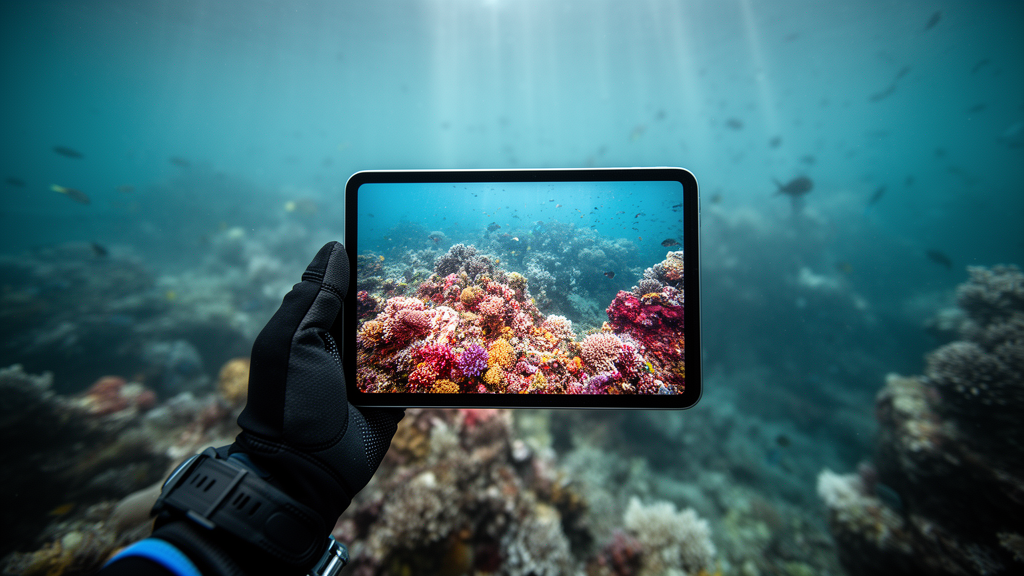
Underwater imaging has always been an unforgiving medium. Water absorbs light unevenly across the spectrum, scatters it through suspended particles, and strips photographs of the color and contrast that make scenes legible. Red, yellow, and green wavelengths vanish fastest with depth, leaving footage bathed in blue or green haze, while turbidity, motion blur, and artifacts such as ghosting and flickering compound the damage. A new systematic review published in the journal Discover Imaging maps how researchers have attacked these problems, tracing the field’s evolution from classical histogram tricks to generative adversarial networks, and concludes that deep learning now defines the state of the art, even as stubborn obstacles remain.
The review, authored by M. Thanjaivadivel and Rajasekaran Thangaraj, was published on 8 May 2026 as an open-access article in Volume 3 of the journal. The authors conducted a systematic literature review spanning the period from 2015 to 2023, searching databases including IEEE Xplore, Springer, Elsevier, and Google Scholar. Their screening pipeline began with 740 records, of which 560 came from database searches and 180 from other sources. After removing 285 duplicates, 455 records remained; screening by year and by title and abstract narrowed the pool further, and 94 full-text articles were ultimately included for qualitative synthesis, with 38 full-text candidates excluded for lacking information on process and performance.
The review organizes enhancement techniques into two broad classical families. Non-physical model-based methods manipulate images directly with standard processing tools, without attempting to simulate how light behaves underwater. Histogram-based techniques, among the most popular in this category, reshape the pixel intensity distribution to stretch contrast. Adaptive histogram equalization applies equalization locally to sub-regions of an image, and its contrast-limited variant, CLAHE, adds a cap that prevents noise from being exaggerated in homogeneous areas, a property the authors note is especially useful in turbid or murky water where noise runs high. Yet these methods do not correct color shifts, blurring, or the loss of detail in deeper regions of the water column, so they are typically combined with other approaches.
Retinex-based methods form the second major non-physical family. Rooted in a theory of human visual perception, they decompose an image into illumination and reflectance components, seeking to enhance reflectance while minimizing the influence of changing illumination. Multi-scale Retinex combines results computed at different resolutions to preserve both fine and coarse detail, and adaptive variants adjust parameters dynamically based on local texture and brightness. The review reports that Retinex techniques are useful for correcting color imbalance and sharpening images but are less effective against noise and turbidity artifacts, which is why they too are usually paired with complementary methods. Fusion-based approaches, a third non-physical strand, merge multiple images captured at different depths, illumination conditions, or angles, consolidating information from shallow and deeper regions of a scene. Their drawback is practical: they require several images of the same scene, which are not always available in dynamic, real-time environments.
Physical model-based methods take the opposite route, attempting to reverse the degradation by simulating the scattering, absorption, and reflection of light in water. Polarization-based methods exploit the fact that light transmitted through water or reflected from objects becomes partially polarized by scattering; polarization filters can suppress scattered light, and the review notes they have sharply boosted image sharpness in turbid or muddy conditions, finding use in object detection, navigation, and environmental monitoring. The Dark Channel Prior, adapted from atmospheric scattering models, estimates the transmission of light through water for every pixel and recovers details lost to absorption and dispersion. Integral imaging, meanwhile, records light from multiple angles and depths to reconstruct three-dimensional information, proving promising in turbid water where conventional two-dimensional approaches lose useful detail, with applications in underwater archaeology, marine biology, and structural inspection.
The review’s central verdict is that deep learning has overtaken these classical tools in demanding conditions. Convolutional neural networks learn spatial hierarchies of features and can map poor-quality images to high-quality ones, addressing color distortion, poor contrast, and blur. The authors divide CNN-based methods into two groups: non-physical networks that learn enhancement directly from large collections of labeled underwater images, and hybrid schemes that couple CNNs with physical models. In the hybrid approach, a CNN estimates parameters such as transmission maps, which a physical model then uses to restore the image, ensuring that both global and local distortions, including scattering, color shifts, and contrast loss, are addressed. The U-Net architecture, an encoder-decoder design originally developed for segmentation, is highlighted as one of the most popular non-physical CNN concepts for enhancement, capable of recovering fine-grained and global features lost to noise and distortion.
Generative adversarial networks add a different mechanism: a generator produces enhanced images while a discriminator judges whether they look authentic, and the two networks improve in competition with each other. Conditional GANs are conditioned on extra information, such as the low-light or low-contrast state of a scene, to transform degraded inputs into clear outputs. CycleGANs address one of the field’s most persistent bottlenecks, the scarcity of paired training data consisting of matching low-quality and high-quality images, by learning to translate between unpaired image domains. The review reports that CycleGAN-based approaches have succeeded across turbid water, low-light conditions, and high-scattering regions. GANs are also being turned to dataset creation itself, generating synthetic training data that can broaden a model’s generalization in a domain where collecting labeled images is time-consuming, costly, and difficult.
The evidence assembled in the review points to measurable superiority for the learned methods. In the authors’ own comparison, seven representative algorithms, CLAHE, MSRCR, FUSION, UDCP, UWCNN, UGAN, and FGAN, were evaluated on the U45 underwater dataset of degraded images exhibiting color casts, weak contrast, and haze-like effects. Assessment used objective metrics, chiefly UCIQE and NIQE, alongside subjective visual examination. The deep learning-based algorithms generally outperformed traditional methods in color fidelity, contrast enhancement, and overall image quality, shown by higher UCIQE and lower NIQE values. FGAN topped the field with the highest UCIQE and lowest NIQE scores, while UGAN and UWCNN also performed strongly. UGAN achieved the maximum UCIQE score in the haze and green scene cases. UDCP, FUSION, and MSRCR delivered moderate improvements but retained more noise and distortion, and the original images and CLAHE fared worst on both metrics.
Video enhancement emerges as the field’s hardest frontier, because moving footage adds a temporal dimension to every spatial problem. Beyond color bias, low contrast, and motion blur from camera and object movement, algorithms must maintain inter-frame consistency, suppressing flickering and discontinuous transitions so enhanced video does not visibly jump between frames. The review describes frame-by-frame approaches such as IMSRCP, which applies multi-scale Retinex to restore color balance and contrast, and UMCNN, which uses CNNs to learn multi-scale properties while preserving visual fidelity. For quality assessment of video, it catalogs metrics including MOVIE, VQM, and STMAD, which evaluate spatial and temporal distortion together. For still images, the no-reference metrics UCIQE and UIQM are singled out as essential where reference data is unavailable, and deep learning-based assessors such as NIMA and DIQA are reported to yield more precise results by aligning with human visual preference.
The review is candid about what still holds the field back. Deep learning models excel at enhancing single frames but struggle with problems spanning multiple frames, such as inter-frame consistency. Real-time processing remains difficult, with most models unable to handle large underwater video streams without significant delays, a critical limitation for autonomous underwater vehicles and live surveillance where low latency matters. High-quality labeled underwater video data is scarce, restricting generalization across diverse conditions, and computational expense remains high. The authors’ forward agenda calls for real-time enhancement models with low latency, multi-modal strategies that incorporate depth maps, multi-spectral images, and multi-view imaging, synthetic data generation through GANs and augmentation to expand training sets, and hybrid architectures that let deep networks learn abstract features while physical models handle environmental factors such as scattering and turbidity. If those threads come together, the review concludes, underwater imaging systems will become markedly more dependable for marine biology, archaeology, environmental monitoring, and autonomous navigation.
Subject of Research: A systematic review of conventional and deep learning-based methods for enhancing underwater images and videos
Article Title: Advances in underwater image and video enhancement systematic review of conventional and deep learning-based method
Article References: Thanjaivadivel, M., & Thangaraj, R. (2026). Advances in underwater image and video enhancement systematic review of conventional and deep learning-based method. Discover Imaging, 3(1), Article 4. https://doi.org/10.1007/s44352-025-00023-0
Image Credits: AI Generated
DOI: 10.1007/s44352-025-00023-0
Keywords: underwater imaging, image enhancement, deep learning, convolutional neural networks, generative adversarial networks, systematic review, CycleGAN, CLAHE, Retinex, video enhancement, UCIQE, marine robotics
News Source: Blake Davidson. (October 29, 2026). Deep Learning Reshapes Underwater Image and Video Enhancement, Review Finds. Scienmag.



