


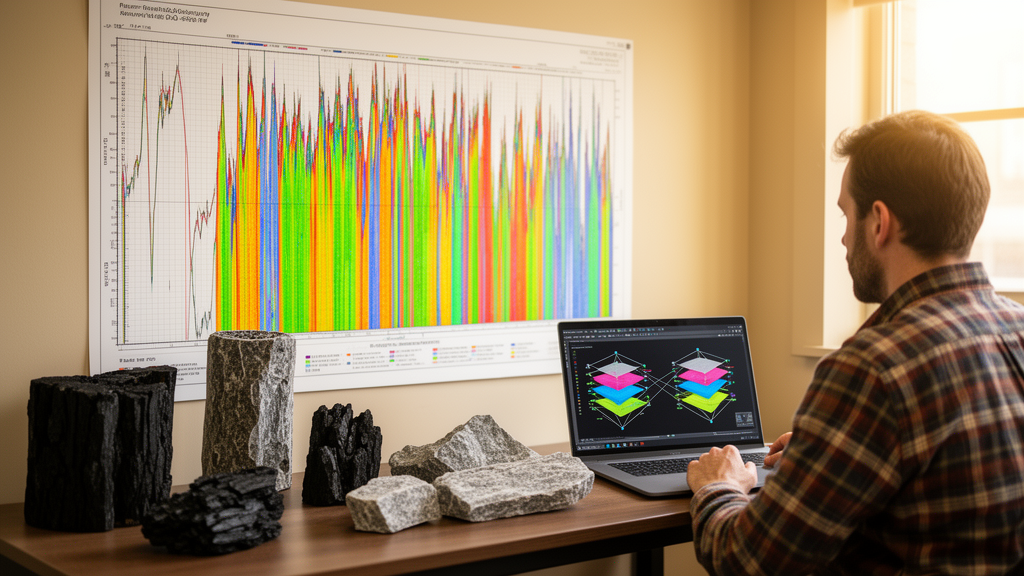
Identifying which rock type sits at which depth is one of the fundamental tasks of coalfield exploration, and a new study in Earth Science Informatics reports that a relatively simple convolutional neural network can do it better than more elaborate deep-learning architectures, at least on the dataset the researchers analyzed.
The study, published on 28 October 2026, combined microscopic rock characterization with machine learning to classify six lithologies common in coal-bearing strata: siltstone, fine-grained sandstone, medium-grained sandstone, coal, limestone, and sandy mudstone. The work was led by Feng Wang, with Tianyi Wang, Fanghao Lin, Wei Chen, Paraskevas Tsangaratos and Ioanna Ilia among the co-authors.
Before any algorithms were trained, the team characterized the pore structure of the six lithologies using three laboratory techniques: scanning electron microscopy (SEM), X-ray diffraction (XRD), and nuclear magnetic resonance (NMR). These methods reveal how pores are shaped, how they are distributed in size, and how minerals are arranged, all of which influence how rocks respond to downhole logging tools.
The microscopic results showed clear contrasts among the rock types. Medium-grained sandstone exhibited the most geometrically complex pore structure and the highest porosity, while limestone showed the simplest pore morphology and the lowest porosity. Coal displayed a complex multimodal pore-size distribution despite having a relatively low fractal dimension derived from the SEM images, a combination that underscores how deceptive single summary metrics can be when describing porous media.
According to the authors, these microscopic analyses provided the geological and petrophysical context needed to interpret the logging responses. Well-log curves reflect the physical properties of subsurface lithologies and are key data sources for stratigraphic interpretation, but their meaning depends on understanding what the rocks themselves look like at the pore scale.
For the classification task, the researchers used 37,227 logging records from two boreholes, based on four log types: density, natural gamma, spontaneous potential, and resistivity. After preprocessing and normalization, they built and compared six lithology-classification models: a support vector machine (SVM), a convolutional neural network (CNN), a long short-term memory network (LSTM), a Gray Wolf Optimization-tuned SVM (GWO-SVM), a CNN-LSTM-Attention hybrid, and a Zebra Optimization-CNN-multi-head attention-SVM model (ZOA-CNN-MATT-SVM).
The CNN achieved the highest overall performance, with an accuracy of 82.27%, recall of 85.0%, precision of 87.3%, and an F1-score of 85.99%. CNN-LSTM-Attention came second in overall accuracy at 75.67%, while GWO-SVM achieved the second-highest mean F1-score at 83.82% and outperformed the conventional SVM in accuracy. Notably, the most architecturally complex model tested did not top the rankings.
The authors draw a measured conclusion from this pattern: optimization can improve conventional classifiers in the present dataset, whereas increasing architectural complexity does not necessarily lead to better performance. In other words, adding attention layers and multi-model hybrids did not guarantee gains over a well-trained standard CNN on these logging data.
Not all rock types were equally easy to distinguish. Limestone and coal were identified most reliably, whereas siltstone and fine-grained sandstone proved more difficult to separate because of overlapping logging and geological characteristics, a reminder that classification accuracy depends as much on the physical distinguishability of the target classes as on the choice of algorithm.
The researchers position the CNN as an effective decision-support tool for lithology interpretation in the study area, but they are explicit about its limits. Predictions should be verified using core descriptions, drilling records, geological models, and adjacent-borehole information, particularly near thin beds, transitional boundaries, and intervals with uncertain or inconsistent log responses. The results come from two boreholes in a specific coal-bearing setting, so the reported accuracies describe this dataset rather than a universal benchmark for lithology identification.
Subject of Research: Microscopic pore-structure characterization and deep-learning-based lithology identification in coal-bearing strata
Article Title: Microscopic pore-structure characterization and deep learning based lithology identification in coal-bearing strata
Article References: Wang, F., Wang, T., Lin, F., Chen, W., Tsangaratos, P., & Ilia, I. (2026). Microscopic pore-structure characterization and deep learning based lithology identification in coal-bearing strata. Earth Science Informatics, 19(12), Article 231. https://doi.org/10.1007/s12145-026-02282-9
Image Credits: AI Generated
DOI: 10.1007/s12145-026-02282-9
Keywords: lithology identification, coal-bearing strata, well logs, convolutional neural network, pore structure, scanning electron microscopy, X-ray diffraction, nuclear magnetic resonance, support vector machine, GWO-SVM, porosity, machine learning
News Source: Blake Davidson. (October 29, 2026). Deep learning reads well logs to map coal-bearing rock types, with simple CNN outperforming complex models. Scienmag.



