


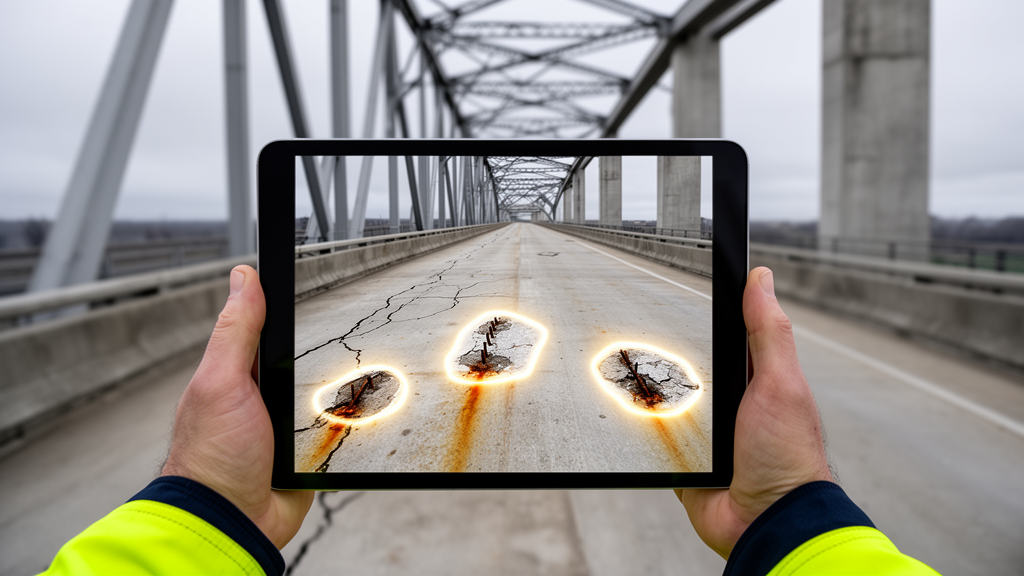
Concrete bridges quietly accumulate damage throughout their service lives, and the cracks, spalling, exposed reinforcement bars, efflorescence, and corrosion stains that mark this deterioration often appear together on the same surface. A new study published in AI in Civil Engineering presents a computer vision framework built for exactly this reality: a multi-label classification model that can recognize several co-occurring defect types within a single photograph, rather than forcing each image into one category. On a held-out test set drawn from the CODEBRIM benchmark, the best-performing configuration achieved a subset accuracy of 84.0 percent and a micro-averaged F1-score of 85.2 percent, meaning that for roughly five out of six test images the model identified every present defect correctly while missing none.
The work, carried out by Jamiu Lateef and Xiong Yu, addresses a persistent shortcoming in automated infrastructure inspection. Most prior CNN-based defect recognition research has framed the problem as single-label classification, an approach that breaks down in the field where cracks may co-occur with efflorescence and corrosion stains on the same pier or girder. The authors argue that a practical classifier must capture these combinatorial label sets to generate consistent and comprehensive digital inspection records, and their multi-label formulation predicts a set of labels jointly characterizing each image.
The study leaned on the Concrete Defect Bridge Image Dataset, or CODEBRIM, assembled from images collected at 30 distinct bridges exhibiting varying degrees of deterioration. The dataset provides image-level annotations for six categories: Crack, Spalling, Exposed Bars, Efflorescence, Corrosion Stain, and a non-defective Background class, with class frequencies of 2,507 images for Crack, 1,898 for Spalling, 1,559 for Corrosion Stain, 1,507 for Exposed Bars, 833 for Efflorescence, and 2,506 for Background. Each image carries a CSV record listing all applicable labels, permitting multiple defect types to be associated with a single photograph.
Before any training began, the researchers cleaned the data. Images of poor quality or low resolution were systematically identified through manual visual inspection combined with the Laplacian variance technique for blur detection; any image whose Laplacian variance fell below a threshold of 50 was flagged and removed. The final curated dataset consisted of 7,729 high-quality images, resized to 128 by 128 pixels to standardize inputs and keep training computationally tractable, then partitioned into training, validation, and test subsets in a 70:20:10 stratified split.
Three ImageNet-pretrained backbone architectures were evaluated, chosen to span a spectrum of design philosophies: VGG16, a classic stack of 13 convolutional layers with 3 by 3 filters; ResNet50, which uses residual blocks with shortcut connections to keep gradients flowing through 50 layers; and EfficientNetB0, a compact architecture built from Mobile Inverted Bottleneck Convolution units with Squeeze-and-Excitation mechanisms and compound scaling of depth, width, and resolution. Each backbone was paired with a shared classification head ending in six sigmoid units, one per defect class, allowing independent probability estimation for each label.
Two training configurations were systematically compared. In the frozen-backbone setup, the pretrained feature extractor was held fixed and only the classifier head was trained. In the fine-tuned setup, the head plus selected late backbone stages were unfrozen and optimized at a lower learning rate. Hyperparameters, including the number of unfrozen stages, learning rate, optimizer, and dropout rate, were selected through Bayesian Optimization implemented in the Keras Tuner framework, with 60 trials per architecture and identical search spaces across all three models to avoid selection bias. Training used binary cross-entropy loss, early stopping, and a reduce-on-plateau learning-rate scheduler, run on an NVIDIA A100 GPU in the cloud.
The results delivered a clear verdict on transfer learning strategy. Fine-tuning yielded substantial and consistent improvements over frozen backbones across all architectures and all evaluated metrics, which included subset accuracy, precision, recall, F1-score, Hamming Loss, label ranking average precision, and coverage error. Among the fine-tuned models, VGG16 led on the primary classification metrics, achieving the 84.0 percent subset accuracy and 85.2 percent F1-score, while ResNet50 showed the most reliable probability ranking, with an LRAP of 0.942, a coverage error of 1.630, and the lowest label-wise error at a Hamming Loss of 0.057. EfficientNetB0 remained competitive while carrying a substantially smaller model footprint, making it an attractive option for resource-constrained deployment.
Class-wise analysis revealed a consistent difficulty ordering across all three backbones. Crack and Exposed Bars, both visually salient defect types, were recognized with high F1-scores and balanced precision-recall profiles. Spalling showed intermediate performance with a discernible precision-recall tradeoff, as rough concrete surfaces could be misconstrued as spalled regions. Efflorescence and Corrosion Stain proved hardest: efflorescence displayed high precision but diminished recall, a conservative pattern consistent with its lower label support of 833 images and its visually diffuse appearance, while corrosion stain yielded the lowest F1-scores overall, possibly because it frequently co-occurs with more visually dominant defects such as spalling and exposed bars.
To probe generalization under domain shift, the team generated a synthetic evaluation dataset of 1,885 images using StyleGAN2-ADA, training a separate generative model for each defect class and retaining only images passing a Fréchet Inception Distance quality threshold below 50. Performance dropped for every model on the synthetic images, confirming a real-to-synthetic domain gap, though VGG16 still achieved the highest subset accuracy at 73.2 percent and ResNet50 the highest F1-score at 73.5 percent with recall of 78.2 percent. Interpretability checks using Grad-CAM heatmaps showed the fine-tuned VGG16 model localizing discriminative defect features, and a comparison against previously reported CODEBRIM results placed the proposed model at competitive or superior performance under the study’s evaluation protocol.
The authors are candid about limitations: the dataset is limited in size and class-imbalanced, field imagery is inherently variable, and the synthetic test set cannot capture all real-world sources of variation. Future work, they write, should evaluate cross-bridge and cross-site generalization, incorporate class balancing, apply threshold calibration and uncertainty estimation for decision support, and extend the framework to joint localization and classification for defect quantification. Such advances could feed structured inspection records and probability-aware bridge digital twins for longitudinal defect tracking and optimized maintenance planning. For now, the study demonstrates that adapting pretrained networks to the specific visual language of bridge deterioration, rather than relying on generic ImageNet features alone, is the decisive step toward automating a task that has long depended on subjective human judgment.
Subject of Research: Multi-label deep learning classification of concrete bridge surface defects using the CODEBRIM dataset.
Article Title: Novel computer vision algorithm for accurate multi-label classification of concrete bridge defects
Article References: Lateef, J., & Yu, X. (2026). Novel computer vision algorithm for accurate multi-label classification of concrete bridge defects. AI in Civil Engineering, 5(1), Article 10. https://doi.org/10.1007/s43503-026-00095-9
Image Credits: AI Generated
DOI: 10.1007/s43503-026-00095-9
Keywords: deep learning, computer vision, bridge inspection, multi-label classification, concrete defects, CODEBRIM, transfer learning, VGG16, StyleGAN2-ADA, structural health monitoring, CNN, Grad-CAM
News Source: Blake Davidson. (October 30, 2026). Deep Learning Model Reads Concrete Bridge Photos and Flags Multiple Defects at Once. Scienmag.



