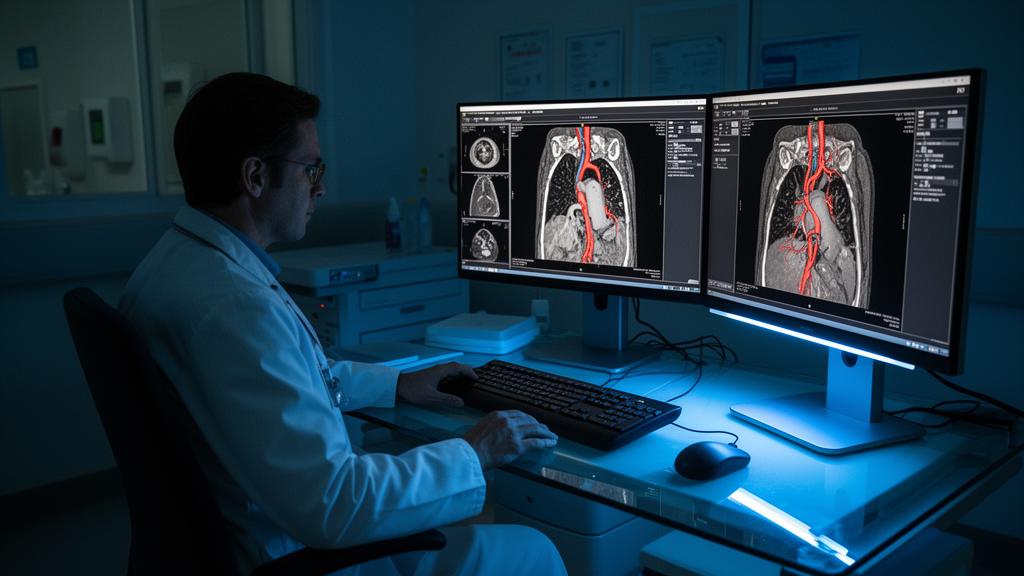
A multicenter clinical validation study has demonstrated that an artificial intelligence model based on deep learning can rapidly and accurately diagnose and classify aortic dissection using computed tomography angiography scans.
Aortic dissection is recognized as a life-threatening cardiovascular emergency that requires prompt, decisive, and precise medical diagnosis to guide urgent patient management. To address the clinical demand for efficient diagnostic support, the research team designed this retrospective study to validate a deep learning model utilizing a VB-Net architecture specifically tailored for automated vessel segmentation, disease detection, and Stanford classification on routine aortic computed tomography angiography examinations.
The clinical validation was structured as a retrospective multicenter investigation involving a total cohort of 378 patients. All enrolled participants had undergone diagnostic aortic computed tomography angiography between September 2022 and July 2023 across three independent clinical centers.
To benchmark the algorithmic performance against an authoritative diagnostic reference, the ground truth gold standard was established through independent readings performed by two senior radiologists. Any diagnostic discrepancies that arose between the two primary readers were subsequently reviewed and adjudicated by a third expert radiologist who possessed 25 or more years of professional experience. Statistical assessment of baseline inter-reader agreement between the two senior radiologists revealed substantial consistency prior to third-reader adjudication, yielding a Cohen’s kappa of 0.96 for identifying the presence of aortic dissection and a kappa of 0.99 for determining Stanford classification.
The performance of the VB-Net deep learning model in diagnosing aortic dissection was rigorously quantified through area under the curve metrics, diagnostic sensitivity, diagnostic specificity, and Cohen’s kappa statistics. Across the three participating centers, the model exhibited excellent diagnostic agreement with expert consensus for detection. Specifically, Cohen’s kappa values reached 0.99 at Center 1, 0.98 at Center 2, and 0.96 at Center 3. Corresponding receiver operating characteristic areas under the curve were recorded at 1.00 with a 95 percent confidence interval of 0.98 to 1.00 for Center 1, 1.00 with a 95 percent confidence interval of 0.96 to 1.00 for Center 2, and 0.99 with a 95 percent confidence interval of 0.95 to 1.00 for Center 3.
The model maintained stable diagnostic accuracy across all institutional datasets, with the lower bounds of the 95 percent confidence intervals for sensitivity and specificity remaining at or above 89.31 percent and 88.46 percent, respectively, across all three study centers. In categorizing cases according to the clinical Stanford classification system, the artificial intelligence model produced Cohen’s kappa values ranging from 0.93 to 0.96. Furthermore, the model’s diagnostic sensitivity and specificity for Stanford classification consistently exceeded 82 percent throughout the evaluation.
In addition to diagnostic precision, the implementation of artificial intelligence reconstruction provided a substantial increase in processing speed compared with conventional manual methods. Manual case processing averaged 10 minutes and 18 seconds, whereas the automated deep learning reconstruction completed the task in 33.27 seconds per case, a time reduction that proved statistically significant with p less than 0.001. The investigators concluded that the VB-Net model enables rapid and precise detection and Stanford classification of aortic dissection on computed tomography angiography with high consistency across multiple centers, demonstrating strong clinical applicability.
Subject of Research: Deep learning model for automated diagnosis and classification of aortic dissection
Article Title: Multicenter clinical validation of a deep learning model for automated diagnosis and classification of aortic dissection
Article References: Song, H., Xu, H., Cao, G., Zhao, Y., Xu, J., Xin, E., Jiang, P., & Chen, W. (2026). Multicenter clinical validation of a deep learning model for automated diagnosis and classification of aortic dissection. BMC Medical Imaging. https://doi.org/10.1186/s12880-026-02979-9
Image Credits: AI Generated
DOI: 10.1186/s12880-026-02979-9
Keywords: aortic dissection, deep learning, computed tomography angiography, VB-Net, Stanford classification, multicenter validation, cardiovascular emergency, automated segmentation, retrospective cohort, senior radiologists, inter-reader agreement, Cohen's kappa, area under the curve, diagnostic sensitivity, diagnostic specificity, reconstruction time
News Source: Blake Davidson. (November 11, 2026). Deep Learning Model Rapidly Detects Aortic Dissection Across Three Clinical Centers. Scienmag.