Researchers from the University of Tsukuba discover a regulatory neuroendocrine system that coordinates growth and maturation in a developmental stage-specific manner
Credit: University of Tsukuba
Tsukuba, Japan – Development, growth and reproduction are highly regulated in all animals. One of the key components of these processes is the precise action of steroid hormones. In a new study, researchers from the University of Tsukuba uncovered a regulatory pathway that controls ecdysteroid biosynthesis, a steroid hormone in the fruit fly Drosophila melanogaster, to enable proper body size adjustment during development transition from growth to maturation.
Steroid hormones are key for growth and maturation during development. Because different developmental stages require variable amounts of steroid hormones, the central nervous system tightly regulates their synthesis. In Drosophila, one such control mechanism includes the production of prothoracicotropic hormone (PTTH), which is known to be important for maintaining low, or basal, ecdysteroid levels as well as to stimulate high levels of ecdysteroid production at particular time points to facilitate proper development.
“The amount of steroid hormone being produced determines its function,” says senior author of the study Professor Ryusuke Niwa. “Basal levels of ecdysteroid are important for inhibiting larva growth, while peak levels facilitate maturation later on. The goal of our study was to further our understanding of what mechanisms modulate PTTH activity for basal ecdysteroid biosynthesis.”
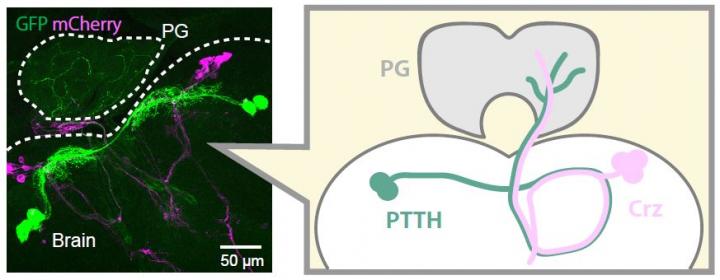
To achieve their goal, the researchers used fluorescence microscopy and found that neurons producing corazonin (Crz) physically contact with PTTH-producing neurons in Drosophila. Next, they used electron microscopy to investigate the connection between these neurons in more detail. They found that fusion sites of so-called dense core vesicles (DCVs), into which neuroactive peptides are known to be packaged, are present between Crz neurons and PTTH neurons — which suggests that they communicate with each other. Deactivating Crz neurons resulted in increased pupal body size, but did not affect the timing in the larva-to-pupa transition. Interestingly, larvae with inhibited Crz neuronal activity grew faster during the L3 stage, which is the final instar larval stage in Drosophila.
“These findings show how Crz neurons control growth during the L3 stage,” says first author of the study, Eisuke Imura. “Using liquid chromatography/mass spectrometry analyses of 20-hydroxyecdysone, the active form of ecdysteroid, we also found that Crz neurons control the timing of basal ecdysteroid biosynthesis. We wanted to know what happens at the molecular level during the mid-L3 stage and how Crz neurons themselves are regulated.”
Using fluorescence microscopy, the researchers investigated downstream molecules of Crz signaling and found that Crz receptors on PTTH neurons are present at higher levels during the mid-L3 stage, the feeding stage of larvae, than during the late-L3 stage, the wandering stage of larvae. By imaging calcium levels, which represent Crz receptor-mediated signaling, the researchers further confirmed that Crz neurons affect PTTH neurons only during the mid-L3 stage. In a search for molecules that regulate Crz signaling, the researchers found that the absence of octopamine, a neurotransmitter, replicated the effects of deactivating Crz neurons.
“These are striking results that show how Crz is a key molecule for the body size adjustment during the larval stage” says Professor Shimada-Niwa, a corresponding author of this study. “Our findings provide new insights into a neuronal axis that regulates growth and maturation during development.”
###
Media Contact
Naoko Yamashina
[email protected]
Related Journal Article
http://dx.