• HOME
  • NEWS
  • EXPLORE
    • CAREER
      • Companies
      • Jobs
    • EVENTS
    • iGEM
      • News
      • Team
    • PHOTOS
    • VIDEO
    • WIKI
  • BLOG
  • COMMUNITY
    • FACEBOOK
    • INSTAGRAM
    • TWITTER
Wednesday, September 2, 2026
BIOENGINEER.ORG
No Result
View All Result
  • Login
  • HOME
  • NEWS
  • EXPLORE
    • CAREER
      • Companies
      • Jobs
        • Lecturer
        • PhD Studentship
        • Postdoc
        • Research Assistant
    • EVENTS
    • iGEM
      • News
      • Team
    • PHOTOS
    • VIDEO
    • WIKI
  • BLOG
  • COMMUNITY
    • FACEBOOK
    • INSTAGRAM
    • TWITTER
  • HOME
  • NEWS
  • EXPLORE
    • CAREER
      • Companies
      • Jobs
        • Lecturer
        • PhD Studentship
        • Postdoc
        • Research Assistant
    • EVENTS
    • iGEM
      • News
      • Team
    • PHOTOS
    • VIDEO
    • WIKI
  • BLOG
  • COMMUNITY
    • FACEBOOK
    • INSTAGRAM
    • TWITTER
No Result
View All Result
Bioengineer.org
No Result
View All Result
Home NEWS Science News Health

Deciphering progesterone’s mechanisms of action in breast cancer

Bioengineer by Bioengineer
July 10, 2023
in Health
Reading Time: 3 mins read
0
Figure 1
Share on FacebookShare on TwitterShare on LinkedinShare on RedditShare on Telegram

“The mechanisms underlying the observed effects of progesterone on breast cancer outcomes are unclear.”
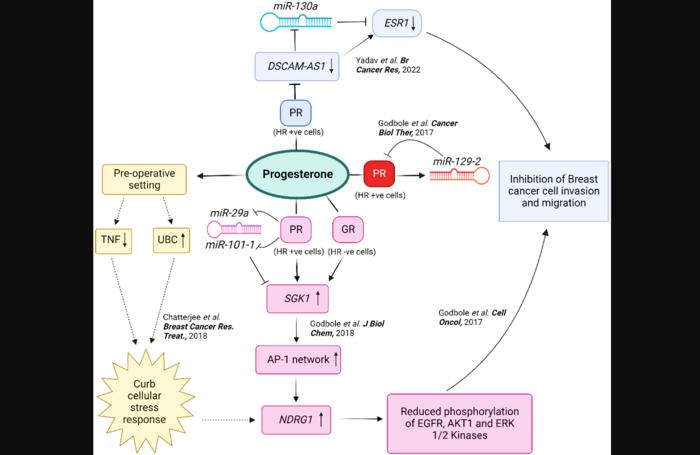
Figure 1

Credit: 2023 Chakravorty et al.

“The mechanisms underlying the observed effects of progesterone on breast cancer outcomes are unclear.”

BUFFALO, NY- July 10, 2023 – A new research perspective was published in Oncotarget’s Volume 14 on July 1, 2023, entitled, “Deciphering the mechanisms of action of progesterone in breast cancer.”

A practice-changing, randomized, controlled clinical study established that preoperative hydroxyprogesterone administration improves disease-free and overall survival in patients with node-positive breast cancer. In this new perspective, researchers Gaurav Chakravorty, Suhail Ahmad, Mukul S. Godbole, Sudeep Gupta, Rajendra A. Badwe, and Amit Dutt from Tata Memorial Centre, Homi Bhabha National Institute and MIT World Peace University summarized evidence from their studies that preoperative hydroxyprogesterone administration may improve disease-free and overall survival in patients with node-positive breast cancer by modulating cellular stress response and negative regulation of inflammation. 

“This research perspective is aimed to highlight the multipronged roles of progesterone in breast cancer that underlie the associated clinical response. We also present our opinion on the role of progesterone in overcoming endocrine resistance in the patients, especially by countering the genomic effects of overexpression and mutation of ESR1 and its targets.”

Non-coding RNAs, particularly DSCAM-AS1, play a regulatory role in this process, along with the upregulation of the kinase gene SGK1 and activation of the SGK1/AP-1/NDRG1 axis. Progesterone-induced modification of the progesterone receptor and estrogen receptor genomic binding pattern is also involved in orchestrating estrogen signaling in breast cancer, preventing cell migration and invasion, and improving patient outcomes. The team continues on to highlight the role of progesterone in endocrine therapy resistance, which could lead to novel treatment options for patients with hormone receptor-positive breast cancer and for those who develop resistance to traditional endocrine therapies.

“Overall, while preoperative hydroxyprogesterone administration appears to be a promising strategy for improving the prognosis of patients with node-positive breast cancer, the investigation of the mechanism of actions of progesterone in breast cancer remains an important area of research that holds great promise for improving patient outcomes.”
 

Read the full paper: DOI: https://doi.org/10.18632/oncotarget.28455 

Correspondence to: Amit Dutt

Email: [email protected] 

Keywords: breast cancer, progesterone, DSCAM-AS1, endocrine therapy


About Oncotarget: Oncotarget (a primarily oncology-focused, peer-reviewed, open access journal) aims to maximize research impact through insightful peer-review; eliminate borders between specialties by linking different fields of oncology, cancer research and biomedical sciences; and foster application of basic and clinical science.

To learn more about Oncotarget, visit Oncotarget.com and connect with us on social media:

  • Twitter 
  • Facebook 
  • YouTube 
  • Instagram 
  • LinkedIn 
  • Pinterest 
  • LabTube
  • Soundcloud


Sign up for free Altmetric alerts about this article: https://oncotarget.altmetric.com/details/email_updates?id=10.18632%2Foncotarget.28455

Click here to subscribe to Oncotarget publication updates.

For media inquiries, please contact: [email protected].


Oncotarget Journal Office

6666 East Quaker Str., Suite 1A

Orchard Park, NY 14127

Phone: 1-800-922-0957 (option 2)

###


Journal

Oncotarget

DOI

10.18632/oncotarget.28455

Method of Research

Commentary/editorial

Subject of Research

People

Article Title

Deciphering the mechanisms of action of progesterone in breast cancer

Article Publication Date

1-Jul-2023

Share12Tweet8Share2ShareShareShare2

Related Posts

Wearable monitor improves diagnosis of heart rhythm disorders after fainting

August 31, 2026

Visualisation of magnetic field-induced nanoparticle clusters and mechanical property changes in a breast phantom for inductive moderate hyperthermia

August 31, 2026

Multidisciplinary intervention in frail elderly patients with cardiovascular diseases: a multicentre, single-blinded, randomised controlled trial

August 31, 2026

Machine Learning Model Development and Evaluation for Non-contact Lower Limb Injury Risk Prediction in Elite Male Rugby Union: A Multi-team, Multi-season Analysis

August 31, 2026

POPULAR NEWS

  • β-Sitosterol from Ipomoea carnea Jacq. As a promising anti-inflammatory agent: Evidence from in silico modeling and in vitro validation

    29 shares
    Share 12 Tweet 7
  • Design, fabrication and characterization of a wearable Fiber Bragg grating sensor for cardiorespiratory monitoring using finger plethysmography

    29 shares
    Share 12 Tweet 7
  • KAIST opens the era of industrial-scale microbial foods, proposing growth strategies for the next-generation protein market

    29 shares
    Share 12 Tweet 7
  • Virologist awarded $2 million NIH grant to investigate how virus-infected cells live and die

    29 shares
    Share 12 Tweet 7

About

We bring you the latest biotechnology news from best research centers and universities around the world. Check our website.

Follow us

Recent News

β-Sitosterol from Ipomoea carnea Jacq. As a promising anti-inflammatory agent: Evidence from in silico modeling and in vitro validation

Design, fabrication and characterization of a wearable Fiber Bragg grating sensor for cardiorespiratory monitoring using finger plethysmography

KAIST opens the era of industrial-scale microbial foods, proposing growth strategies for the next-generation protein market

Subscribe to Blog via Email

Success! An email was just sent to confirm your subscription. Please find the email now and click 'Confirm' to start subscribing.

Join 85 other subscribers
  • Contact Us

Bioengineer.org © Copyright 2023 All Rights Reserved.

Welcome Back!

Login to your account below

Forgotten Password?

Retrieve your password

Please enter your username or email address to reset your password.

Log In
No Result
View All Result
  • Homepages
    • Home Page 1
    • Home Page 2
  • News
  • National
  • Business
  • Health
  • Lifestyle
  • Science

Bioengineer.org © Copyright 2023 All Rights Reserved.