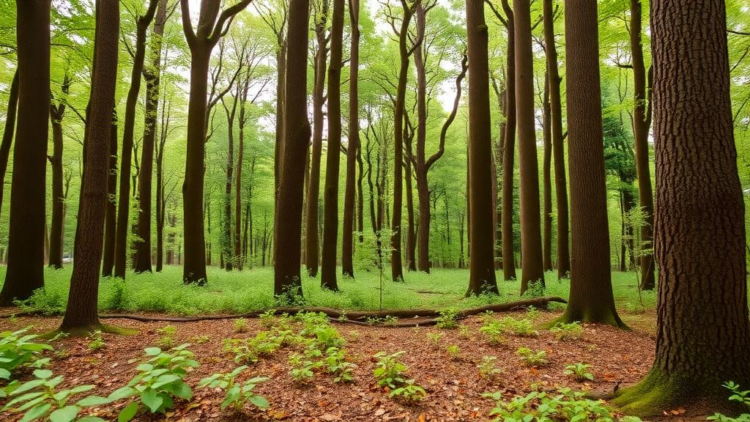
Deep in the Apennine mountains of central Italy, European beech forests that were carefully reshaped by conservationists a decade ago are now offering one of the most detailed portraits yet of how forest management can steer biodiversity. A large team of Italian researchers has published an open dataset that simultaneously documents forest structure and the diversity of three very different groups of organisms—vascular plants, epiphytic lichens, and saproxylic fungi—across nineteen sampling units within the Gran Sasso and Monti della Laga National Park. The work, published as a data paper in the journal Plant Biosystems, captures the state of these forests in July 2024, roughly ten years after conservation-oriented interventions were carried out there under the LIFE+ FAGUS project.
The significance of the study lies in its integrated design. European forests bear the imprint of centuries of human use, from timber harvesting to livestock grazing, and this long history has often homogenized stand structure, simplifying habitats and eroding the diversity of the biological communities they support. In recent decades, forest management has shifted toward imitating natural dynamics and promoting structural complexity, with the aim of sustaining both biodiversity and ecosystem services. Yet most previous studies have examined only trees or vascular plants, overlooking groups such as lichens, fungi, and invertebrates that may respond very differently to the same silvicultural choices. By sampling multiple taxonomic groups in the same plots at the same time, alongside detailed measurements of trees and deadwood, the new dataset directly addresses that gap.
The interventions themselves, performed in 2013 and 2014, were designed to increase structural complexity in beech-dominated stands. They included the creation of canopy gaps, thinning of dense regeneration, retention of deadwood, and the enhancement of habitat trees—features that collectively alter light availability, humidity, and substrate diversity within the forest. Similar sampling of the same taxonomic groups had been carried out at the same sites in 2013, before the interventions, which makes the new data a valuable temporal reference point for researchers seeking to quantify how forests change after management for conservation.
The fieldwork was conducted over four days in July 2024 by the Ecology, Lichenology and Mycology Group of the Società Botanica Italiana, spanning three sites: Prati di Tivo and Venaquaro, both belonging to the priority habitat type 9210* of Apennine beech forests with Taxus and Ilex, and Incodaro, representing habitat 9220*, the Apennine beech forests associated with silver fir. These habitat types, protected under the European Habitats Directive, are fragmented along the Apennine chain and are considered conservation priorities, making the park’s Natura 2000 designation an important backdrop for the work.
Each sampling unit followed a rigorous, nested protocol. Vascular plants were surveyed within circular plots of twenty meters radius, divided into four quadrants along the cardinal directions, with the cover of every species estimated separately in the herbaceous, shrub, and tree layers. Epiphytic lichens were recorded on the three suitable living beech trees nearest to each plot center, using standardized frames of five vertically arranged quadrats placed on each trunk at one meter height in the four cardinal directions—a method derived from the European guideline for mapping lichen diversity as an indicator of environmental stress. Saproxylic fungi, those that live on dead wood, were surveyed within a nested thirteen-meter-radius subunit, with every sporocarp larger than one millimeter recorded on all standing and lying deadwood fragments exceeding ten centimeters in diameter.
Forest structure was measured with equal care. Trees were inventoried within three concentric subunits with different diameter thresholds, and for each tree the researchers recorded species, diameter at breast height, height, vitality, regeneration origin, and social position within the canopy. Lying deadwood was classified as logs or stumps, measured for dimensions, and assigned to one of five decay classes ranging from freshly fallen wood with intact bark to soft, powdery remnants fully in contact with the ground. Across the dataset, tree diameters ranged from 2.5 to 112 centimeters with a median of 20 centimeters, while tree heights spanned 2 to 42 meters. Deadwood diameters reached up to 110 centimeters, and the longest log measured an impressive 18 meters.
The biological results reveal a clear hierarchy among the taxonomic groups. Vascular plants were by far the richest, with 191 entities belonging to 132 genera recorded across all plots, concentrated overwhelmingly in the understorey. Species richness was highest at Venaquaro with 133 species, followed closely by Prati di Tivo with 132, while Incodaro hosted 94. European beech dominated the tree and shrub layers, accompanied by silver fir, yew, and holly, while the herb layer featured widespread species such as Viola reichenbachiana, Rubus hirtus, Daphne laureola, Sanicula europaea, and the ghostly chlorophyll-free orchid Neottia nidus-avis. Epiphytic lichens came second, with 49 entities in 31 genera, peaking at Prati di Tivo with 34 species; the most frequent were Lecidella elaeochroma and Glaucomaria carpinea, found in every sampling unit. Saproxylic fungi contributed 46 entities in 33 genera, with Incodaro the richest site at 26 species, and wood-inhabiting ascomycetes such as Xylaria hypoxylon, Nemania serpens, and Biscogniauxia nummularia among the most common.
Notably, the three sites show contrasting deadwood profiles that hint at different management legacies. Logs outnumber stumps roughly two to one across the whole dataset, but the pattern varies sharply: Incodaro holds about five times as many logs as stumps, Prati di Tivo shows an even balance, and Venaquaro has roughly twice as many stumps as logs. Because saproxylic fungi depend entirely on dead wood for their life cycles, and lichens respond to bark texture, light, and humidity shaped by canopy structure, such structural differences are precisely the kind of variables that can explain why different groups flourish in different places. The dataset makes it possible to test these relationships quantitatively rather than anecdotally.
The authors are candid about the limitations of their design. July is not the optimal season for surveying saproxylic fungi in the Mediterranean region, since many fruiting bodies appear in autumn, but the choice preserved simultaneity with the plant and lichen sampling and reflected practical constraints of relocating the units in mountainous terrain. A small number of specimens across all three groups could not be identified to species level and are retained in the dataset as undetermined records at genus or family level, with the morphological reasoning for each decision documented. This transparency, the researchers argue, is essential for anyone hoping to reuse the data responsibly.
What elevates the work beyond a regional inventory is its commitment to open science and comparability. The full dataset is freely available on Zenodo, complete with example R scripts, and the sampling design adheres to a published European handbook for multi-taxon biodiversity studies in forests. The authors emphasize that sharing harmonized datasets and protocols is critical for advancing knowledge of how forest management affects biodiversity, for running comparative studies across space and time, and for closing persistent gaps in our understanding of the structure–biodiversity relationship. As European policy pushes forests toward multifunctionality—balancing carbon storage, timber production, and conservation—datasets like this one, born from a decade of patient stewardship in the Apennines, provide the empirical scaffolding needed to decide which silvicultural interventions genuinely deliver biodiversity gains, and for which organisms.
Subject of Research: Multi-taxon biodiversity and forest structure in conservation-managed Apennine beech forests
Article Title: Forest structure and multi-taxonomic diversity in Apennine beech forests subjected to conservation-oriented interventions
Article References: Legnaro Diamanti, M., Cangelmi, G., De Benedictis, L. L. M., Balducci, L., Benesperi, R., Bianchi, E., Carli, E., Ceci, A., Chianucci, F., Ciaschetti, G., De Simone, L., De Toma, A., Di Pietro, F., Fanfarillo, E., Fiaschi, T., Francioni, M., Girometta, C. E., Leonardi, M., Loppi, S., … Burrascano, S. (2026). Forest structure and multi-taxonomic diversity in Apennine beech forests subjected to conservation-oriented interventions. Plant Biosystems, 160(4), Article 224. https://doi.org/10.1007/s44473-026-00238-x
Image Credits: AI Generated
DOI: 10.1007/s44473-026-00238-x
Keywords: beech forests, forest structure, biodiversity, vascular plants, epiphytic lichens, saproxylic fungi, deadwood, forest management, Apennines, Gran Sasso, Natura 2000, open data
Cite Scienmag News
APA
MLA
Chicago
Margaret Porter. (October 4, 2026). Decade After Conservation Thinning, Italian Beech Forests Reveal Their Biodiversity Secrets. Scienmag. https://scienmag.com/decade-after-conservation-thinning-italian-beech-forests-reveal-their-biodiversity-secrets/
Margaret Porter. “Decade After Conservation Thinning, Italian Beech Forests Reveal Their Biodiversity Secrets.” Scienmag, 4 October 2026, https://scienmag.com/decade-after-conservation-thinning-italian-beech-forests-reveal-their-biodiversity-secrets/. Accessed 4 October 2026.
Margaret Porter. “Decade After Conservation Thinning, Italian Beech Forests Reveal Their Biodiversity Secrets.” Scienmag. October 4, 2026. https://scienmag.com/decade-after-conservation-thinning-italian-beech-forests-reveal-their-biodiversity-secrets/
Copy citation
Download RIS
Tags: and fungi data in forest studiesApennine mountain forests in ItalyApenninesbeech forestsbiodiversityBiodiversity assessment in European beech forestsConservation thinning impact on forest ecosystemsdeadwoodepiphytic lichensEuropean forest structure and species diversityForest habitat complexity and species richnessforest managementForest management strategies for biodiversity conservationforest structureGran SassoIntegration of plantlichenLIFE+ FAGUS project ecological outcomesLong-term effects of forest management on biodiversityMonitoring forest biodiversity after conservation interventionsNatura 2000open datarolesaproxylic fungiSaproxylic fungi and epiphytic lichens in managed forestsvascular plants