Data harvested from wearable devices and health apps could be valuable in public health research, according to a study. Vaccines can prevent SARS-CoV-2 infections and, in cases where the virus is able to break through, vaccination lowers the risks of severe disease, hospitalization, ICU admission, and death. Marc Wiedermann and colleagues used data from smartwatches and fitness trackers collected by the Corona Data Donation Project to investigate whether vaccination produces measurable changes in personal health and wellbeing. The Corona-Datenspende-App was launched in April 2020 and, as of April 2022, was still being used by 190,000 users in Germany, 120,000 of which were submitting daily data on resting heart rate, physical activity, and sleep duration. In addition, the app collects optional survey data on diagnostic test results and vaccination data. This data showed that COVID-19 infections correlated with elevated heart rate, reduced activity, and increased sleep. But vaccinated individuals had less extreme deviations from normal than unvaccinated individuals, suggesting that vaccinated people experienced less severe symptoms than unvaccinated people. In unvaccinated individuals who contracted the virus, average heart rate and activity levels did not return to normal for up to 11 weeks, compared to four weeks for vaccinated individuals with SARS-CoV-2 infections. According to the authors, the resting heart rate and step counts of unvaccinated COVID-19 positive individuals decreased in the week prior to taking a PCR test—suggesting a possible role for wearable devices and health trackers as an early warning indicator of an incipient illness.
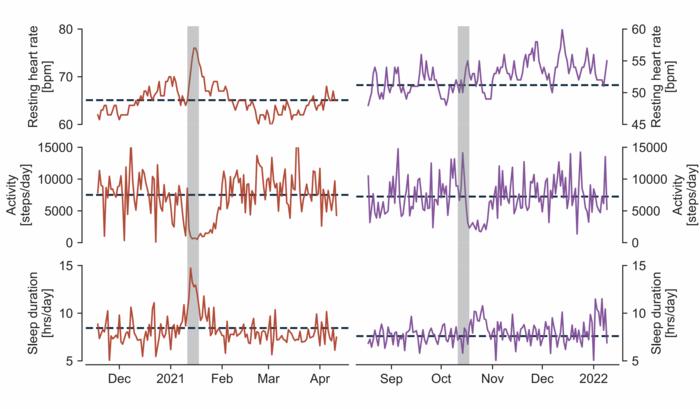
Credit: Wiedermann et al.
Data harvested from wearable devices and health apps could be valuable in public health research, according to a study. Vaccines can prevent SARS-CoV-2 infections and, in cases where the virus is able to break through, vaccination lowers the risks of severe disease, hospitalization, ICU admission, and death. Marc Wiedermann and colleagues used data from smartwatches and fitness trackers collected by the Corona Data Donation Project to investigate whether vaccination produces measurable changes in personal health and wellbeing. The Corona-Datenspende-App was launched in April 2020 and, as of April 2022, was still being used by 190,000 users in Germany, 120,000 of which were submitting daily data on resting heart rate, physical activity, and sleep duration. In addition, the app collects optional survey data on diagnostic test results and vaccination data. This data showed that COVID-19 infections correlated with elevated heart rate, reduced activity, and increased sleep. But vaccinated individuals had less extreme deviations from normal than unvaccinated individuals, suggesting that vaccinated people experienced less severe symptoms than unvaccinated people. In unvaccinated individuals who contracted the virus, average heart rate and activity levels did not return to normal for up to 11 weeks, compared to four weeks for vaccinated individuals with SARS-CoV-2 infections. According to the authors, the resting heart rate and step counts of unvaccinated COVID-19 positive individuals decreased in the week prior to taking a PCR test—suggesting a possible role for wearable devices and health trackers as an early warning indicator of an incipient illness.
Journal
PNAS Nexus
DOI
10.1093/pnasnexus/pgad223
Article Title
Evidence for positive long- and short-term effects of vaccinations against COVID-19 in wearable sensor metrics
Article Publication Date
25-Jul-2023