• HOME
  • NEWS
  • EXPLORE
    • CAREER
      • Companies
      • Jobs
    • EVENTS
    • iGEM
      • News
      • Team
    • PHOTOS
    • VIDEO
    • WIKI
  • BLOG
  • COMMUNITY
    • FACEBOOK
    • INSTAGRAM
    • TWITTER
Saturday, February 7, 2026
BIOENGINEER.ORG
No Result
View All Result
  • Login
  • HOME
  • NEWS
  • EXPLORE
    • CAREER
      • Companies
      • Jobs
        • Lecturer
        • PhD Studentship
        • Postdoc
        • Research Assistant
    • EVENTS
    • iGEM
      • News
      • Team
    • PHOTOS
    • VIDEO
    • WIKI
  • BLOG
  • COMMUNITY
    • FACEBOOK
    • INSTAGRAM
    • TWITTER
  • HOME
  • NEWS
  • EXPLORE
    • CAREER
      • Companies
      • Jobs
        • Lecturer
        • PhD Studentship
        • Postdoc
        • Research Assistant
    • EVENTS
    • iGEM
      • News
      • Team
    • PHOTOS
    • VIDEO
    • WIKI
  • BLOG
  • COMMUNITY
    • FACEBOOK
    • INSTAGRAM
    • TWITTER
No Result
View All Result
Bioengineer.org
No Result
View All Result
Home NEWS Science News Biology

Dams in the upper Mekong River modify nutrient bioavailability downstream

Bioengineer by Bioengineer
March 17, 2020
in Biology
Reading Time: 2 mins read
0
IMAGE
Share on FacebookShare on TwitterShare on LinkedinShare on RedditShare on Telegram

IMAGE

Credit: ©Science China Press


The number of hydropower dams has increased dramatically in the last 100 years for energy supply, climate change mitigation, and economic development. However, recent studies have overwhelmingly stressed the negative consequences of dam construction. Notably, it is commonly assumed that reservoirs retain nutrients, and this nutrient reduction significantly reduces primary productivity, fishery catches and food security downstream. Such perception largely hampers electricity supply and even sustainable socio-economic development in many developing regions such as Congo and lower Mekong basins.

However, solid scientific support for the widespread belief that dams retain nutrients is usually lacking, because monitoring programs gathering data to establish how nutrient fluxes and phytoplankton production have changed after dam construction are rare. A new article by Qiuwen Chen and his research group at Nanjing Hydraulic Research Institute, China, together with Prof. Jef Huisman from the University of Amsterdam and Prof. Stephen C Maberly from UK Centre for Ecology & Hydrology now provides extensive monitoring data for the upper Mekong River. Their data reveal some surprising new insights.

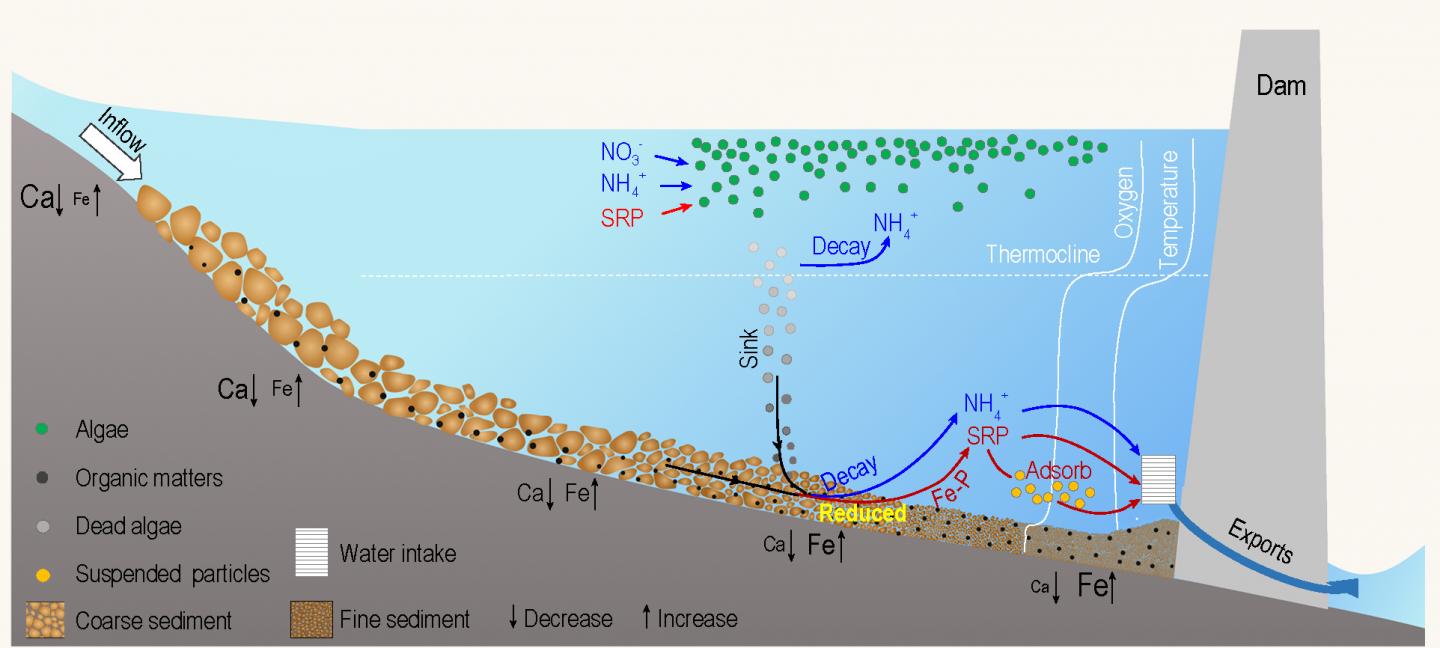
Contrary to expectation, their study shows that a cascade of reservoirs along the upper Mekong River increased downstream bioavailability of nitrogen and phosphorus. The core mechanism is the synergic effect of increased hydraulic residence time and the development of hypoxic conditions due to stratification and organic matter accumulation. The lack of oxygen results in release of nutrients from the sediment and subsequent accumulation of ammonium and phosphorus in the deeper water layers of the reservoir, which enhances the concentration of dissolved nutrients released downstream from the base of the reservoirs.

Moreover, the longer residence time in the reservoirs strongly increased phytoplankton production, with a shift in species composition from diatoms upstream to green algae in the downstream reservoirs.

Upstream dams are regularly blamed for nutrient retention and consequently the collapse of primary productivity and fisheries, and even human rights of subsistence in the lower Mekong River. This work implies that the fishery decline in the lower Mekong River might be caused by other factors such as over-fishing, habitat modification, disruption of fish migration by dam construction or water quality deterioration from local sources, rather than a reduction in nutrient availability or primary productivity induced by the cascade dams upstream.

This novel perspective on the globally important issue emphasizes the need for dedicated monitoring of the environmental impacts of hydropower dams on nutrient cycling and primary production. The findings are of great significance not only for science, but also for sustainable social-economic development along the Mekong River and other transboundary rivers worldwide.

###

See the article: Chen Q, Shi W, Huisman J, Maberly SC, Zhang J, Yu J, Chen Y, Tonina D, Yi Q, 2020. Hydropower reservoirs on the upper Mekong River modify nutrient bioavailability downstream. National Science Review, doi: 10.1093/nsr/nwaa026

Link: https://doi.org/10.1093/nsr/nwaa026

Media Contact
Qiuwen Chen
[email protected]

Related Journal Article

http://dx.doi.org/10.1093/nsr/nwaa026

Tags: Biology
Share12Tweet8Share2ShareShareShare2

Related Posts

Florida Cane Toad: Complex Spread and Selective Evolution

Florida Cane Toad: Complex Spread and Selective Evolution

February 7, 2026
New Study Uncovers Mechanism Behind Burn Pit Particulate Matter–Induced Lung Inflammation

New Study Uncovers Mechanism Behind Burn Pit Particulate Matter–Induced Lung Inflammation

February 6, 2026

DeepBlastoid: Advancing Automated and Efficient Evaluation of Human Blastoids with Deep Learning

February 6, 2026

Navigating the Gut: The Role of Formic Acid in the Microbiome

February 6, 2026
Please login to join discussion

POPULAR NEWS

  • Robotic Ureteral Reconstruction: A Novel Approach

    Robotic Ureteral Reconstruction: A Novel Approach

    82 shares
    Share 33 Tweet 21
  • Digital Privacy: Health Data Control in Incarceration

    63 shares
    Share 25 Tweet 16
  • Study Reveals Lipid Accumulation in ME/CFS Cells

    57 shares
    Share 23 Tweet 14
  • Breakthrough in RNA Research Accelerates Medical Innovations Timeline

    53 shares
    Share 21 Tweet 13

About

We bring you the latest biotechnology news from best research centers and universities around the world. Check our website.

Follow us

Recent News

Decoding Prostate Cancer Origins via snFLARE-seq, mxFRIZNGRND

Digital Health Perspectives from Baltic Sea Experts

Florida Cane Toad: Complex Spread and Selective Evolution

Subscribe to Blog via Email

Enter your email address to subscribe to this blog and receive notifications of new posts by email.

Join 73 other subscribers
  • Contact Us

Bioengineer.org © Copyright 2023 All Rights Reserved.

Welcome Back!

Login to your account below

Forgotten Password?

Retrieve your password

Please enter your username or email address to reset your password.

Log In
No Result
View All Result
  • Homepages
    • Home Page 1
    • Home Page 2
  • News
  • National
  • Business
  • Health
  • Lifestyle
  • Science

Bioengineer.org © Copyright 2023 All Rights Reserved.