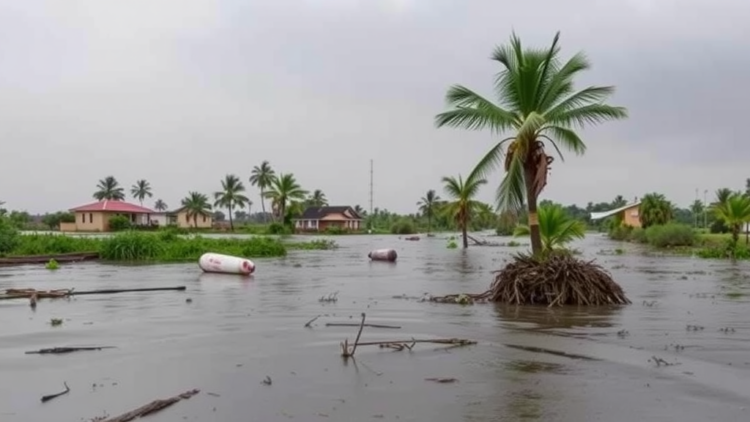
When Tropical Cyclone Ana swept across eastern Zimbabwe in January 2022, it was far less devastating than Cyclone Idai, which had killed 347 people and caused more than a billion dollars in losses three years earlier. Yet a new study argues that this smaller, often overlooked storm offers some of the clearest evidence yet of how Zimbabwe’s disaster risk management system performs under stress—and why recurrent, moderate cyclones may quietly inflict some of the most damaging cumulative losses in the region. Writing in the International Journal of Disaster Risk Science, researchers Decide Mabumbo and Nombulelo Kitsepile Ngulube examined how communities and institutions in Nyanga District prepared for, responded to, and began recovering from Cyclone Ana, and their findings reveal a system that remains largely reactive, centralized, and unevenly implemented.
The study focused on three wards in Nyanga District—Tangwena, Samanyika, and Kute—that were selected for their documented exposure to the storm and established vulnerability profiles. The researchers drew on eight focus group discussions, 27 in-depth interviews with affected households and key informants from the Department of Civil Protection, UNDP, the Zimbabwe Red Cross Society, and the Meteorological Services Department, alongside field observations and government documents. Conducted primarily in Shona and analyzed thematically using NVivo, the qualitative approach was designed to capture the social and institutional dynamics that quantitative damage assessments often miss. The result is a granular portrait of a disaster that struck households already struggling with poor roads, settlement on steep slopes and floodplains, and the lingering memory of Idai.
The physical impacts of Cyclone Ana were substantial for a moderate storm. Field assessments documented 126 affected houses, 70 of which were rendered uninhabitable, displacing families into temporary shelters and overcrowded public facilities. Flooding damaged boreholes and latrines, forcing some residents into open defecation and others into longer journeys for safe water; one female-headed household reported that daily water collection increased by roughly 3.5 kilometers, adding about two hours to caregiving duties. The Murozi footbridge, which provides access to nine villages and serves approximately 135 schoolchildren, was destroyed, while sections of the Troutbeck-Nyafaru road became impassable, delaying emergency assistance. Because the cyclone hit shortly before the main harvest, maize, bean, and vegetable fields were inundated, irrigation schemes and dip tanks were destroyed, and small livestock were lost during evacuations—triggering cascading effects that included food insecurity, school dropouts, and mounting psychological strain.
Perhaps the most striking finding concerns preparedness. Seventy-six percent of participants were unaware of any formal emergency preparedness plans, and roughly 64 percent said they had never been consulted during risk assessments or disaster plan development. Ward-level disaster risk management plans drafted in 2018 with external support were intended to guide local action until 2024, but document analysis showed they remained heavily response-oriented: only 18 percent of their content addressed preparedness, compared with 65 percent devoted to response. Capacity assessments of 45 disaster risk management committee members revealed deep deficits—35 lacked contingency planning experience, 40 had never been trained in post-disaster needs assessment, and about 70 percent reported no refresher training in the previous three years. Only 24 percent of the district’s committees met regularly, while nearly a third were largely inactive.
The researchers trace these weaknesses to structural and legal roots. At the time of Cyclone Ana, Zimbabwe’s disaster framework was still anchored in the Civil Protection Act of 1989, a hazard-focused, response-oriented law that gives limited weight to prevention and preparedness and specifies contingency planning mechanisms only vaguely. Donor funding cycles reinforce the imbalance, mobilizing resources after disasters strike rather than sustaining risk reduction between events. As one official told the researchers, communities ask politicians about new boreholes and clinics, not about disaster preparedness—until the cyclone hits. The result is a governance system in which decentralization exists on paper but budgets, technical support, and decision-making authority remain concentrated at levels far removed from the villages where floods and landslides actually occur.
Early warning performance during Ana was equally revealing. The Meteorological Services Department issued regular bulletins through print, broadcast, and social media in coordination with civil protection authorities, and around 70 percent of participants reported receiving some form of warning. But the messages were technical and generalized, referring broadly to thundery showers, downpours, and strong winds across several provinces without specifying local risks or recommended actions. Terms such as tropical depression and overland depression were poorly understood, particularly among older residents, and warnings rarely addressed secondary hazards like landslides or infrastructure failure. Roughly 30 percent of participants received no warning at all, hindered by unstable mobile networks, poor radio reception in mountainous terrain, and damaged roads that impeded door-to-door communication. Even where 31 evacuation centers had been designated, the district lacked clear evacuation protocols, transport plans, and pre-positioned supplies—so warnings did not consistently translate into protective action.
Social and cognitive factors compounded the problem. More than half of participants believed the storm would not directly affect them, often citing past forecasts they perceived as exaggerated. Others prioritized livestock and crops over personal safety, and some expressed skepticism toward government information. The researchers interpret these patterns through established frameworks such as Protective Action Decision Theory, noting that residents filtered official warnings through prior experience and local knowledge—so-called disaster scripts that normalized risk. One farmer recounted how traditional signs, from the behavior of birds to the color of the evening sky, prompted her family to move their goats to higher ground before dawn, even as the same knowledge could not save their maize crop. Indigenous early warning, the study suggests, is a genuine asset, but one with limits under extreme conditions and in need of integration with technical forecasting rather than substitution for it.
The response phase exposed both institutional fragility and remarkable community resilience. Detailed damage assessments in the worst-hit villages took nearly two weeks, hampered by impassable roads, fuel shortages, and limited vehicles; of the 7.3 million dollars allocated nationally for disaster risk management in 2022, only about 28 percent supported operational logistics. Residents were repeatedly surveyed by different agencies yet received little assistance, and coordination gaps produced fragmented vulnerability data. Meanwhile, only 20 of the 126 affected households received government-prefabricated shelters, with allocations that sometimes ignored household size—one family of more than 20 members received a single unit. In the vacuum, communities organized themselves: youth cleared debris from blocked paths, churches provided food, and families whose homes survived sheltered those who had lost everything. The authors argue these grassroots efforts were not merely a stopgap but a core, under-recognized component of community-based disaster risk management that formal systems should support, resource, and scale.
Recovery, supported in part by a crisis modifier under the Zimbabwe Resilience Building Fund and technical backing from UNDP, produced genuine gains alongside persistent inequities. Forty houses received reconstruction or rehabilitation support guided by Build Back Better principles, and a piped water supply installed at Dazi School and Clinic allowed services to resume—what the authors call a recovery surplus, improving conditions beyond pre-disaster baselines. Roads and footbridges along the Troutbeck-Dazi-Nyafaru corridor were rehabilitated, roughly 600 farmers received short-cycle seed inputs, and 126 local leaders and officials received disaster risk reduction training. Yet many households were left patching roofs with plastic sheeting and salvaged debris, and eligibility criteria excluded some affected farmers from livelihood support entirely. Short funding cycles and narrow targeting, the study concludes, can entrench the very vulnerabilities recovery is meant to reduce.
The broader significance of the Nyanga case lies in what it establishes as a baseline for reform. Since Cyclone Ana, Zimbabwe has pursued a new Disaster Risk Management and Civil Protection Bill, impact-based forecasting, anticipatory action frameworks, and strengthened contingency planning—developments the authors welcome as real progress. But their analysis identifies a critical implementation gap between policy commitments and local practice, visible in gaps of interpretation, coordination, financing, and first-mile communication. Closing it, they argue, requires aligning legislative reform, sustainable financing, and institutional capacity with genuinely community-centered approaches that embed local knowledge and participation across every stage of risk governance. As cyclones such as Freddy, Filipo, and Chido continue to test the region, the lesson from Nyanga is that effective disaster management depends not only on better forecasts and laws, but on sustained investment in the institutions, trust, and collective capacities of the communities who face the storm first.
Subject of Research: Disaster preparedness, response, and recovery from Tropical Cyclone Ana in Nyanga District, Zimbabwe
Article Title: Assessing Disaster Preparedness and Recovery from Tropical Cyclones in Zimbabwe: Insights from Cyclone Ana in Nyanga
Article References: Mabumbo, D., & Ngulube, N. K. (2026). Assessing Disaster Preparedness and Recovery from Tropical Cyclones in Zimbabwe: Insights from Cyclone Ana in Nyanga. International Journal of Disaster Risk Science. https://doi.org/10.1007/s13753-026-00759-1
Image Credits: AI Generated
DOI: 10.1007/s13753-026-00759-1
Keywords: tropical cyclones, Zimbabwe, Cyclone Ana, disaster risk management, early warning systems, community-based disaster risk management, Nyanga District, Cyclone Idai, build back better, anticipatory action, disaster recovery, impact-based forecasting
Cite Scienmag News
APA MLA Chicago
Denise Maddox. (September 13, 2026). Cyclone Ana Exposed Zimbabwe’s Disaster Readiness Gaps, Study Finds. Scienmag. https://scienmag.com/cyclone-ana-exposed-zimbabwes-disaster-readiness-gaps-study-finds/
Denise Maddox. “Cyclone Ana Exposed Zimbabwe’s Disaster Readiness Gaps, Study Finds.” Scienmag, 13 September 2026, https://scienmag.com/cyclone-ana-exposed-zimbabwes-disaster-readiness-gaps-study-finds/. Accessed 13 September 2026.
Denise Maddox. “Cyclone Ana Exposed Zimbabwe’s Disaster Readiness Gaps, Study Finds.” Scienmag. September 13, 2026. https://scienmag.com/cyclone-ana-exposed-zimbabwes-disaster-readiness-gaps-study-finds/
Copy citation Download RIS
Tags: anticipatory actionbuild back betterCentralized disaster response systems in ZimbabweClimate change and extreme weather events in ZimbabweCommunity resilience to cyclonescommunity-based disaster risk managementCumulative losses from recurrent cyclonesCyclone AnaCyclone Ana impact assessmentCyclone Idaidisaster recoverydisaster risk managementDisaster risk management in Zimbabweearly warning systemsEffectiveness of disaster recovery efforts in ZimbabweEvaluation of Zimbabwe’s disaster preparednessHumanitarian response to Cyclone Anaimpact-based forecastingNyanga DistrictRegional climate vulnerability and adaptation strategiesRole of government agencies in cyclone responsetropical cyclonesVulnerability of Nyanga District to tropical stormsZimbabwe