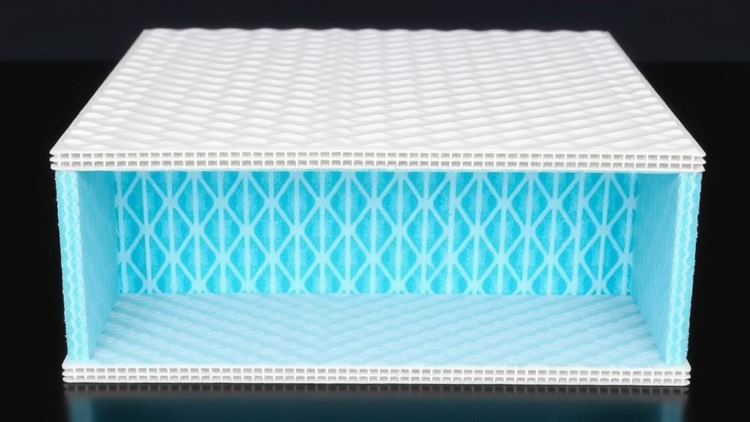
Engineers have long sought building materials that are light, strong, and kind to the planet, and a new study suggests that curved sandwich panels made from glass fiber-reinforced polymer face sheets and recycled polyethylene terephthalate foam cores could be a serious contender. Researchers report that embedding a lattice of thin glass fiber webs inside the foam core dramatically improves how these curved panels carry load, resist damage, and survive after initial failure. The work, published in Case Studies in Construction Materials, combines detailed laboratory bending tests with advanced computer simulations to map exactly how curvature, core design, and internal reinforcement shape structural performance.
Sandwich structures work much like an I-beam stretched into a panel: two stiff outer skins take bending stresses while a lightweight core holds them apart and resists shear. In civil engineering, this architecture promises high strength-to-weight ratios, built-in thermal insulation, and excellent energy absorption. Fiber-reinforced polymer face sheets add corrosion resistance, cutting maintenance and life-cycle costs compared with steel or reinforced concrete. Curved versions of these panels open additional design freedom for architecturally ambitious roofs and facades, yet their static bending behavior has remained surprisingly underexplored, with most prior research focused on vibration and aerospace applications.
The research team fabricated singly curved panels using vacuum infusion molding, a process that begins by cutting foam into an arc, wrapping it with a layer of ±45° glass-fiber fabric, and then sequentially assembling the bottom face sheet, internal web cores, and outer face sheet on a curved wooden mold before resin infusion. After eight hours of curing, the panels were demolded and trimmed. Three core configurations were compared: conventional polyurethane foam, grid-scored recycled PET foam, and recycled PET foam reinforced with a continuous lattice of glass fiber webs. Each panel had a span of 400 millimeters, a width of 200 millimeters, a 25-millimeter-thick core, and five ring webs spaced 200 millimeters apart horizontally.
Curvature proved to be a decisive variable. Panels were tested at three radii of 300, 580, and 1150 millimeters, corresponding to central angles of 60, 30, and 15 degrees. For the polyurethane foam series, the panel with the largest radius failed at 7.49 kilonewtons through brittle compressive fracture of the upper face sheet beneath the loading plate. Reducing the radius to 300 millimeters cut the ultimate load to 5.29 kilonewtons and the bending stiffness to 0.73 kilonewtons per millimeter, a 29.4 percent loss in capacity and a 26.3 percent loss in stiffness. Tighter curvature intensified membrane-bending coupling and radial compression, triggering premature debonding between face sheet and core before the panel could fully mobilize its bending resistance.
The grid-scored PET foam panels, in which load transfer relies on discontinuous resin-rich channels, fared worse under the same conditions. Their initial stiffness values of 0.66 and 0.77 kilonewtons per millimeter lagged well behind the lattice-reinforced equivalents, and stress concentrations at the resin columns, the foam-resin interface, and the face-core boundary interacted destructively during loading. At the smallest radius, interfacial delamination began at only 3.49 kilonewtons, and the panel ultimately failed at 4.37 kilonewtons before collapsing to 1.50 kilonewtons as shear cracks spread through the foam. The discrete grid could not bridge cracks or redistribute stress once local damage started, so degradation was rapid and brittle.
By contrast, the lattice-reinforced recycled PET foam panels delivered the best performance across every curvature. The largest-radius specimen reached an initial bending stiffness of 1.09 kilonewtons per millimeter and a peak load of 12.4 kilonewtons, while the moderate-radius panel achieved the highest ultimate load of the entire experimental campaign at 13.3 kilonewtons. Even the tightest-radius panel sustained 11.0 kilonewtons. Crucially, after the upper face sheet fractured in compression, the loads did not collapse entirely; they dropped only partially and then recovered, for example from 13.3 to 11.5 kilonewtons, because the continuous lattice webs acted as internal bridges that kept transferring load between the separated face sheets. Compared with the grid-scored design, ultimate loads rose by 71.5 to 151.7 percent.
Digital image correlation provided a strain-map view of these mechanisms in real time. In large-radius panels, strain concentrated in the upper face sheet under the loading plate, confirming compression-dominated failure. As radius shrank, shear strain localization migrated into the foam core near the load point and the face-core interface, signaling the shift toward debonding and core shear failure. The lattice-reinforced panels showed markedly more continuous strain distributions along the curved section than their grid-scored counterparts, evidence that the internal webs diffused stress, restrained local deformation, and delayed unstable crack propagation through the thickness of the core.
To go beyond what experiments alone could reveal, the team built a three-dimensional finite element model in ABAQUS incorporating Hashin damage criteria for the composite laminates, a crushable foam plasticity model with volumetric hardening for the PET core, and a bilinear cohesive zone model for the face-core interface. The simulations reproduced the measured stiffness and peak loads with errors below 10 percent, and predicted failure modes matched the laboratory observations, including interfacial debonding captured through cohesive damage variables. Deflection fields at a 4.0 kilonewton load level also agreed closely with the DIC measurements, validating the model as a trustworthy design tool.
The parametric study then isolated the levers that matter most. Raising the PET foam density from 80 to 150 kilograms per cubic meter increased ultimate load by 29.2 percent but bending stiffness by only 18.9 percent, because global stiffness is governed mainly by the axial stiffness and separation of the face sheets rather than the core. Fiber layup orientation strongly affected initial stiffness, with a (0°,90°) laminate reaching 2.15 kilonewtons per millimeter against 0.85 for an all ±45° stack, yet ultimate loads stayed within a narrow band around 13.7 to 14.1 kilonewtons. Lattice geometry emerged as the most powerful knob: thickening the longitudinal webs from 1.2 to 3.6 millimeters lifted ultimate load from 13.69 to 15.00 kilonewtons, and tightening longitudinal web spacing raised peak load to 16.43 kilonewtons, a gain of roughly half over the baseline configuration.
Across all variations, the dominant failure sequence remained interfacial delamination followed by compressive failure of the upper face sheet, but the lattice consistently delayed that sequence and preserved residual capacity afterward. The findings carry practical weight for sustainable construction: recycled PET foam diverts plastic waste, requires less production energy than traditional core materials, and adds thermal insulation, while GFRP skins resist corrosion and reduce reinforcement demands on existing structures. By demonstrating that a simple internal lattice transforms a recycled-core curved panel from brittle and debonding-prone into a progressively damage-tolerant structural element, the study offers designers a clear, simulation-backed recipe for lighter, greener, and more resilient civil infrastructure.
Subject of Research: Experimental and numerical investigation of the bending behavior, failure modes, and design parameters of curved GFRP sandwich panels with recycled PET foam cores and internal lattice reinforcement
Article Title: Bending behavior of curved sandwich panels comprising GFRP face sheets and recycled PET foam cores: Experimental investigation and numerical simulation
Article References: Xie, H., Man, J., Zhang, Z., Fang, H., Wang, Z., & He, P. (2026). Bending behavior of curved sandwich panels comprising GFRP face sheets and recycled PET foam cores: Experimental investigation and numerical simulation. Case Studies in Construction Materials, 25, Article e06525. https://doi.org/10.1016/j.cscm.2026.e06525
Image Credits: AI Generated
DOI: 10.1016/j.cscm.2026.e06525
Keywords: GFRP, recycled PET foam, curved sandwich panels, lattice reinforcement, bending behavior, face-core debonding, finite element simulation, Hashin damage criteria, digital image correlation, sustainable construction, foam core density, civil infrastructure
Cite Scienmag News
APA
MLA
Chicago
Denise Maddox. (September 22, 2026). Curved GFRP Sandwich Panels With Recycled PET Foam Cores Show Stronger Bending Under Lattice Reinforcement. Scienmag. https://scienmag.com/curved-gfrp-sandwich-panels-with-recycled-pet-foam-cores-show-stronger-bending-under-lattice-reinforcement/
Denise Maddox. “Curved GFRP Sandwich Panels With Recycled PET Foam Cores Show Stronger Bending Under Lattice Reinforcement.” Scienmag, 22 September 2026, https://scienmag.com/curved-gfrp-sandwich-panels-with-recycled-pet-foam-cores-show-stronger-bending-under-lattice-reinforcement/. Accessed 22 September 2026.
Denise Maddox. “Curved GFRP Sandwich Panels With Recycled PET Foam Cores Show Stronger Bending Under Lattice Reinforcement.” Scienmag. September 22, 2026. https://scienmag.com/curved-gfrp-sandwich-panels-with-recycled-pet-foam-cores-show-stronger-bending-under-lattice-reinforcement/
Copy citation
Download RIS
Tags: advanced simulation in civil engineeringbending behaviorbending strength of reinforced panelscivil infrastructurecorrosion-resistant fiber-reinforced compositescurved sandwich panelscurved structural building materialsdigital image correlationeco-friendly architectural materialsface-core debondingfinite element simulationfoam core densityGFRPGlass fiber-reinforced polymer sandwich panelsHashin damage criterialattice reinforcementlattice reinforcement in sandwich panelslightweight high-strength construction componentsrecycled PET foamrecycled PET foam coresstructural performance of curved panelssustainable constructionsustainable construction materialsthermally insulated building panels