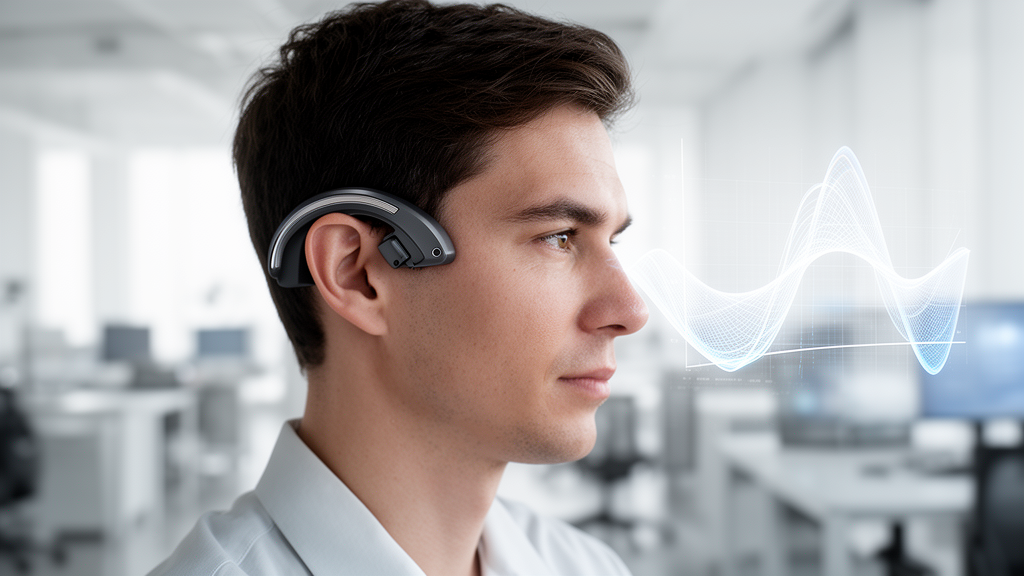
A research team at Kogakuin University has demonstrated that mathematical curve-fitting techniques can reliably predict the operational accuracy of ear-centered electroencephalogram brain-computer interfaces using only brief measurement trials, even when evaluated across entirely independent participant groups. Steady-state visual evoked potentials, known widely as SSVEP, represent rhythmic neural responses elicited in the visual cortex when an individual gazes directly at a flickering visual target. Because these neural signals exhibit high information transmission capacity, they serve as one of the primary input mechanisms for non-invasive brain-computer interfaces, commonly abbreviated as BCIs. By contrast, ear-EEG captures neural activity through electrodes positioned around the hairless outer ear, offering vastly superior user comfort, simplified self-placement, and improved skin contact impedance, which together make daily assistive operation significantly more viable for long-term real-world applications.
Despite these significant practical advantages, developing effective ear-EEG SSVEP interfaces presents severe engineering hurdles stemming directly from physical signal attenuation. Prior electrophysiological measurements indicate that the amplitude of SSVEP recorded at the ear is roughly twenty decibels lower than signals captured directly over the occipital scalp, leading to a markedly reduced signal-to-noise ratio and noticeably weaker high-frequency electrical responses. Furthermore, while high-performance conventional scalp interfaces can achieve information transfer rates reaching 267 bits per minute, documented ear-EEG SSVEP configurations have demonstrated comparatively modest speeds around 37.56 bits per minute. Designing an ear-based interface and empirically tuning its operational parameters has traditionally required exhausting, multi-subject laboratory evaluations where participants repeatedly fixate on flickering stimuli over many hours. To overcome this development bottleneck, the investigators previously formulated an evaluative metric termed the SSVEP ratio, which measures the proportional amplification of target visual frequencies over background non-target frequencies to forecast overall performance from minimal trial data.
To rigorously test whether this predictive approach could be expanded into a standardized, interactive design framework, the investigators formulated an experimental investigation evaluating prediction algorithms across diverse datasets. In their primary physical setup, visual stimulation was displayed using a twenty-five-inch liquid crystal display operating at a sixty-hertz refresh rate and a resolution of 1920 by 1080 pixels, positioned fifty centimeters from the subject. Because a standard screen can only render flicker frequencies that divide evenly into its fixed refresh rate, the team applied an established sinusoidal luminance modulation technique across individual video frames. This method allowed the display to smoothly present four distinct square stimuli measuring 300 by 300 pixels, labeled one through four and oscillating at precise frequencies of eight, nine, ten, and eleven hertz in one-hertz increments. Software written in MATLAB R2022b alongside Psychtoolbox-3 generated and managed the visual stimuli, normalizing luminance calculations between zero and 255 to maintain strictly controlled experimental conditions.
Data collection involved fifteen male and female university subjects aged twenty-one to twenty-five years who provided written informed consent under an institutional human research ethics approval granted by Kogakuin University. Electroencephalographic recordings were captured using a Nihon Kohden EEG1000 system sampling at one kilohertz and routed through a sixteen-bit National Instruments USB DAQ 6218 acquisition device. Electrodes were arranged according to the extended ten-twenty international layout across twenty-one scalp sites, including frontal ground at Fpz, bilateral ear reference contacts at A1 and A2, alongside parietal and occipital channels. Crucially, five outer-ear electrodes were attached along the pinna of both the left ear and right ear. The experimental protocol required each participant to complete thirty-six active recording trials, divided evenly into three operational sets where each of the four stimulus frequencies was fixated nine times. Each trial lasted ten seconds, accompanied by a three-second inter-stimulus rest interval, with visual and auditory cues signaling target selection and trial progression.
Signal processing relied on an advanced variant of canonical correlation analysis, an established multivariate statistical technique that calculates linear transformation parameters to maximize correlation between observed multi-channel EEG recordings and artificial reference sine-cosine waves. To substantially boost detection sensitivity, the researchers integrated a harmonic filter bank composed of zero-phase Chebyshev type I infinite impulse response filters. This filter bank decomposed the incoming neural signals into five overlapping sub-bands ranging from eight to ninety hertz, eighteen to ninety hertz, twenty-eight to ninety hertz, thirty-eight to ninety hertz, and forty-eight to ninety hertz, applying mathematically defined sub-band weights to generate a composite weighted correlation score. Because individual stimulus frequencies can generate uneven baseline correlation values, the authors implemented learning canonical correlation analysis, or LCCA. This method calculates baseline SSVEP values from non-target trials, establishing the SSVEP ratio by dividing mean target responses by mean non-target background responses to determine the exact frequency evoking maximal gaze focus.
Building on these foundational signal metrics, the investigators contrasted two distinct supervised learning paradigms to predict system accuracy across varying data lengths between one and ten seconds. The first approach utilized a k-nearest neighbors classification algorithm, dividing historical training data into ten discrete performance classes based on measured BCI accuracy and assigning incoming test ratios to their nearest class neighbors. The second approach implemented third-degree polynomial curve fitting, plotting calculated SSVEP ratios directly against operational BCI accuracy to generate a smooth mathematical transfer curve. Cross-validation was performed to test both algorithms against newly recorded experimental data, historical datasets from an earlier ten-subject cohort, and an external public occipital dataset. Accuracy was rigorously defined as the ratio of successful command selections—where detected frequencies matched the instructed target—divided by the total number of trial opportunities evaluated under identical test conditions.
The comparative analysis demonstrated that polynomial curve fitting delivered superior estimation precision when compared directly against the k-nearest neighbors classifier across the self-recorded ear-EEG data. Specifically, maximum prediction error for ear-EEG accuracy reached 7.12 percent under the k-nearest neighbors method, whereas curve fitting restricted maximum error to 5.16 percent. When applying curve models calibrated on historical experimental sessions, the peak accuracy prediction error dropped to just 3.36 percent at an analysis data length of six seconds, where actual system accuracy measured 79.16 percent, yielding an overall BCI accuracy discrepancy of only 4.24 percent. These quantitative outcomes confirmed that an appropriately fitted continuous curve captures the underlying non-linear relationship between neural frequency amplification and classification success far more effectively than discrete neighborhood clustering, providing a dependable mathematical foundation for rapid prototyping.
A critical inquiry of the research focused on determining whether prediction models suffered from subject dependency when applied to completely unfamiliar users. Prior investigations had not systematically decoupled subject-specific traits from predictive performance metrics. To resolve this question, the researchers evaluated their curve-fitting models against test datasets from entirely separate individuals who shared no overlap with the historical training population, while keeping the physical BCI architecture, electrode positions, and stimulus parameters perfectly uniform. The empirical curves relating SSVEP ratios to BCI accuracy showed near-perfect convergence across both distinct participant cohorts. These findings confirm that as long as the underlying hardware configuration, electrode montage, and stimulation mechanics remain constant, inter-subject neurological variations do not distort the functional transfer curve, enabling engineers to reliably calibrate predictive design tools using existing multi-subject reference databases without requiring extensive calibration from new participants.
In marked contrast to its robust resilience across different users, the predictive methodology revealed severe limitations when applied across divergent system architectures. To assess architectural generalizability, the team evaluated a widely recognized public benchmark dataset gathered by Nakanishi and colleagues, which recorded forty-target occipital scalp responses from a single subject across frequencies ranging from 8.0 to 15.8 hertz in fine 0.2-hertz increments. When the ear-EEG predictive models were tasked with estimating performance on this forty-target public setup, accuracy predictions broke down completely, exhibiting errors approaching fifty percent at short data durations of one second. Discrepancies also emerged when comparing the four-input ear recordings against four-input scalp recordings collected within the same laboratory sessions. In all comparative conditions, model transfer errors grew substantially whenever either the anatomical electrode placement or the total quantity of selectable visual targets was altered.
The authors also examined whether predicted BCI accuracy could be reliably converted into information transfer rates, measured in bits per minute, using standard information-theoretic equations that factor in target numbers, accuracy, and selection time intervals. This investigation revealed a notable vulnerability: because accuracy functions non-linearly inside logarithmic channel capacity formulas, modest errors in underlying accuracy predictions become significantly amplified when estimating final transmission speed. For instance, at a seven-second data length where the measured ear-EEG transmission speed was 9.58 bits per minute, the prediction error reached 1.08 bits per minute, representing an overall rate error of 11.27 percent. Because these discrepancies varied unpredictably across individual time windows, the researchers concluded that interface optimization cannot rely purely on derived information transfer estimates, recommending instead that developers tune systems to satisfy hard accuracy thresholds before running full-scale rate validations.
Despite these architectural constraints, the data revealed a crucial cross-platform invariant: across all examined datasets, whether recorded from the ear or scalp and spanning four or forty targets, classification accuracy consistently converged toward one hundred percent whenever the measured SSVEP ratio exceeded a value of two. Because practical assistive typing applications typically demand operational accuracy above eighty percent to achieve optimal communication rates, this threshold provides an immediate empirical benchmark for interface engineers. Looking forward, the researchers plan to establish explicit mathematical conversion functions capable of translating SSVEP ratios across different target configurations, analyzing extensive repository data covering eight, nine, sixteen, twenty-eight, and fifty visual inputs. Additionally, they aim to evaluate task-related component analysis to strengthen weak ear-level signals and eventually adapt these optimized wearable interfaces for clinical populations with severe communication impairments and motor hemiplegia.
Subject of Research: Ear-EEG steady-state visual evoked potential brain-computer interfaces and performance prediction modeling
Article Title: Interactive design and evaluation process for ear-EEG SSVEP-BCI
Article References: Kondo, S., & Tanaka, H. (2026). Interactive design and evaluation process for ear-EEG SSVEP-BCI. Artificial Life and Robotics, 31(1), 327-336. https://doi.org/10.1007/s10015-025-01105-2
Image Credits: AI Generated
DOI: 10.1007/s10015-025-01105-2
Keywords: brain-computer interfaces, ear-EEG, steady-state visual evoked potentials, SSVEP-BCI, canonical correlation analysis, learning CCA, filter bank analysis, information transfer rate, curve fitting, k-nearest neighbors, biomedical signal processing, neural engineering, assistive technology, neuroergonomics, visual cortex stimulation, electroencephalography
News Source: Cassandra Pierce. (November 26, 2026). Curve Fitting Predicts Ear Brain Computer Interface Accuracy Across Independent User Data. Scienmag.