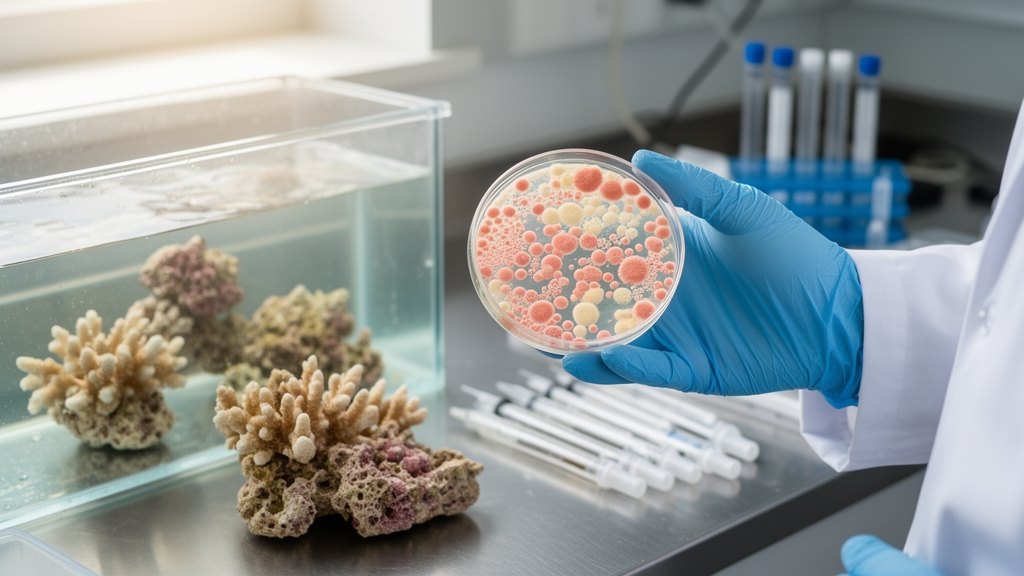
Researchers have grown and catalogued bacteria living in association with four coral species from the Mediterranean Sea, recovering 84 pure bacterial isolates whose initial genetic screening suggests that at least six may belong to previously undescribed taxa. The study, published open access in the journal Microbial Ecology by Rocío Mozo, Andrea Illa-Oviedo and Javier del Campo, targeted the corals Eunicella singularis, Cladocora caespitosa, Leptogorgia sarmentosa and Paramuricea clavata, and marks a deliberate return to classic microbiological methods in a field that has been dominated for the past decade by culture-independent molecular techniques.
Corals host diverse bacterial communities that are thought to facilitate their adaptation and sustain their health, a collective assemblage known as the coral holobiont. Molecular approaches such as metabarcoding have transformed understanding of these partnerships by revealing a high diversity of previously unrecognized bacterial symbionts, and microbiota characterization has relied heavily on such techniques. The authors argue, however, that relying solely on culture-independent methods does not provide a detailed understanding of the dynamics of the holobiont complex, because DNA-based surveys alone cannot reveal the physiology, metabolism or interactions of the organisms being detected.
To address that gap, the team set out to isolate and culture bacteria from the four Mediterranean coral species. Classifying the isolates based on the 16S rRNA gene, the standard marker for bacterial identification, revealed a diverse community of culturable coral-associated bacteria spanning four classes and 20 genera. Among the 84 isolates, six showed less than 97 percent 16S rRNA identity to their closest described species, the conventional threshold used to flag candidate novel taxa. These candidates fall within the genera Vibrio, Pseudoalteromonas, Alteromonas, Shewanella and Tritonibacter, a result the authors say underscores the value of culture-based studies even in well-surveyed environments.
Beyond taxonomy, the cultured diversity included taxa exhibiting traits potentially involved in host association, biofilm formation, surface colonization and the degradation of complex polysaccharides. Such functions suggest possible roles for these bacteria in coral colonization and in the maintenance of the holobiont, although the study reports these as traits of the isolates rather than as demonstrated effects on living coral hosts. Establishing what these bacteria actually do inside the symbiosis will require the kind of controlled experimentation that only cultured strains make possible.
That experimental path is precisely what the new collection is intended to enable. By banking 84 pure isolates with known identities, the researchers have created a foundation for detailed morphological and physiological characterization and for experimental ecology studies aimed at testing how individual bacterial strains interact with their coral hosts. The work, published on 26 October 2026 as a peer-reviewed accepted manuscript that is citable and carries a permanent DOI, positions culture-based microbiology as a complement rather than a rival to molecular surveys of the coral microbiome. The authors present the collection as a starting point for those investigations, with the six candidate novel taxa offering particularly promising subjects for future taxonomic description and functional study.
Subject of Research: Culturing and taxonomic identification of bacteria associated with Mediterranean coral species
Article Title: Culture and Isolation of Bacteria Associated with Mediterranean Corals
Article References: Mozo, R., Illa-Oviedo, A., & del Campo, J. (2026). Culture and Isolation of Bacteria Associated with Mediterranean Corals. Microbial Ecology. https://doi.org/10.1007/s00248-026-02919-8
Image Credits: AI Generated
DOI: 10.1007/s00248-026-02919-8
Keywords: coral microbiome, holobiont, Mediterranean corals, bacterial culture, 16S rRNA, novel taxa, Vibrio, Pseudoalteromonas, microbial ecology, symbiosis, Culture, Isolation
News Source: Morgan Morrow. (October 26, 2026). Culturing Mediterranean Coral Bacteria Reveals Potential New Species. Scienmag.