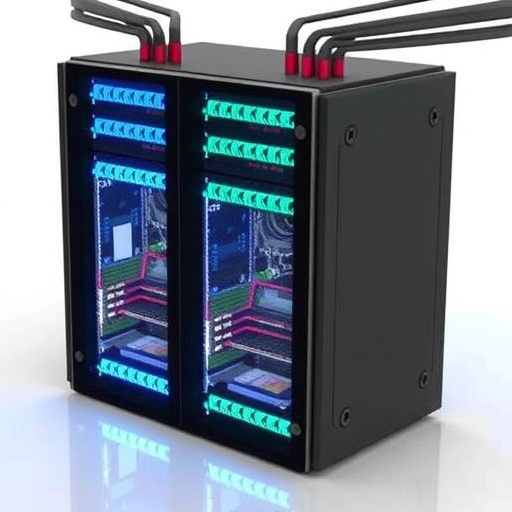
In a groundbreaking advancement poised to transform data transmission architectures for artificial intelligence (AI) systems, researchers at The Chinese University of Hong Kong (CUHK) have engineered an innovative all-optical signal processor (OSP) that operates entirely within the optical domain. This novel device is designed to address critical challenges in high-speed data communication between distributed data centers by performing real-time signal equalization without the need for optical-to-electrical conversion, thereby dramatically reducing latency and power consumption while enhancing throughput.
The crux of this development lies in the OSP’s integration onto a silicon photonic chip, which allows it to manipulate distorted optical signals instantaneously during transmission. Unlike traditional digital signal processing systems that necessitate conversion into electrical signals for processing—introducing delays and energy expenditure—the OSP processes the signal in its native light form. This capability is particularly crucial for modern AI infrastructures that demand ultra-fast, efficient interconnects to sustain extensive parallel operations across geographically dispersed GPU clusters and specialized accelerators engaged in synchronous AI model training.
Experimental validation revealed that the device could handle an aggregate data rate of 1.6 terabits per second, spanning eight wavelength channels each transmitting at 100 Gbaud PAM4 modulation. Remarkably, the OSP achieves this with a processing latency of less than 60 picoseconds—faster than a single clock cycle in many electronic systems—and maintains energy consumption at an astonishingly low scale of tens of femtojoules per bit. These results underscore its potential as a disruptive enabler for green AI supercomputing and next-generation high-bandwidth data center interconnects.
The exponential growth in AI capabilities has led to an unprecedented expansion of distributed computing resources, necessitating robust communication channels capable of handling massive data flows with minimal delay. Conventional optical fiber communication, while forming the backbone of modern data transmission, faces increasing challenges due to escalating transmission speeds that exacerbate signal impairments such as chromatic dispersion and nonlinear distortions. Conventional DSP methods struggle to keep pace, often incurring substantial latency and power inefficiencies detrimental to AI model training workflows.
Professor Huang Chaoran, leading the CUHK research team, emphasizes that traditional electronic processing introduces bottlenecks that impede scaling optical interconnects to meet the rigorous demands of next-generation AI systems. Addressing these constraints, the OSP represents a paradigm shift by leveraging optical computing principles inspired by neuromorphic architectures and machine learning algorithms. Through meticulous control of on-chip optical pathways, the OSP dynamically analyzes complex temporal signal features enabling precise compensation for diverse transmission impairments directly in the optical regime.
This programmable design equips the OSP to function as a nonlinear equalizer adaptable to a broad spectrum of channel conditions, including the effects of fiber chromatic dispersion, bandwidth limitations on transmitters and receivers, and nonlinear phenomena induced by intense optical loads. By maintaining the integrity of the complete optical field prior to any electrical conversion, the device attains a level of correction fidelity unattainable by pure DSP systems. Furthermore, its capacity to extend usable wavelength-division multiplexing (WDM) bandwidth nearly sevenfold heralds significant enhancements in per-fiber data capacity, a critical parameter for scaling inter-data center links.
The OSP’s design inherently supports configurability, enabling on-the-fly adjustment of compensation parameters to accommodate varying signal impairments, modulation formats, data rates, and wavelengths. This flexibility is crucial for deployment in heterogeneous network environments where transmission conditions can fluctuate rapidly. The experimental setup demonstrated simultaneous correction across multiple wavelength channels, highlighting the OSP’s scalability and suitability for complex multiplexed systems employed in state-of-the-art AI data centers.
The implications of this advance extend beyond immediate data center applications. It signals a pivotal evolution in optical communications, moving from passive transmission mediums to active photonic computing platforms capable of executing high-speed, low-latency signal processing functions intrinsically embedded within the transmission channel. This could pave the way for novel architectures merging communication and computation, achieving far greater efficiencies for distributed AI workloads and beyond.
Significantly, this work builds on a rich heritage in optical communications exemplified by Professor Charles K. Kao, whose pioneering research laid the groundwork for the low-loss optical fibers that underpin our modern internet infrastructure. The CUHK-led team’s breakthrough demonstrates how the core principle of employing photons for information transfer can be expanded to perform transformative in-line processing, unlocking unprecedented performance in future optical networks.
The collaborative research involved contributions from experts at CUHK, Huazhong University of Science and Technology, and Fudan University, meticulously combining expertise across photonics, electronics, and AI system requirements. Their findings not only showcase impressive experimental benchmarks but also provide a roadmap for integrating all-optical signal processors into practical, large-scale data center topologies, where ultra-high speed and energy efficiency are paramount.
By harnessing all-optical processing techniques, this OSP addresses the urgent need for sustainable, scalable, and rapid data movement infrastructures crucial for the continued evolution of AI technologies. As AI models grow larger and more distributed, such advances in optical signal processing will be indispensable in meeting the performance and energy efficiency demands of tomorrow’s intelligent computational ecosystems.
In conclusion, the introduction of this all-optical equalization technology marks a pivotal milestone toward next-generation optical interconnects, ushering in a new era where light not only transports but also processes information in real time. This breakthrough promises to accelerate the pace of AI development by overcoming the latency, distortion, and energy limitations that currently hinder high-speed optical communication networks critical to distributed AI supercomputing.
Article Title: An all-optical signal processor enabling terabit-per-second real-time equalization
News Publication Date: 11-Jun-2026
Web References: https://www.science.org/doi/10.1126/science.ady5344
References:
Huang Chaoran et al., “An all-optical signal processor enabling terabit-per-second real-time equalization,” Science, 11-Jun-2026, DOI: 10.1126/science.ady5344
Image Credits: The Chinese University of Hong Kong
Keywords
All-optical signal processing, high-speed data transmission, silicon photonics, AI supercomputing, optical equalization, low latency optical interconnects, wavelength-division multiplexing, nonlinear compensation, green computing, terabit-per-second communication
Tags: AI data center transmissionall-optical signal processordistributed GPU cluster communicationhigh-speed optical communicationlow-latency AI interconnectsoptical domain data processingPAM4 modulation optical signalspower-efficient data transmissionreal-time signal equalizationsilicon photonic chip technologysynchronous AI model trainingterabit per second data rate