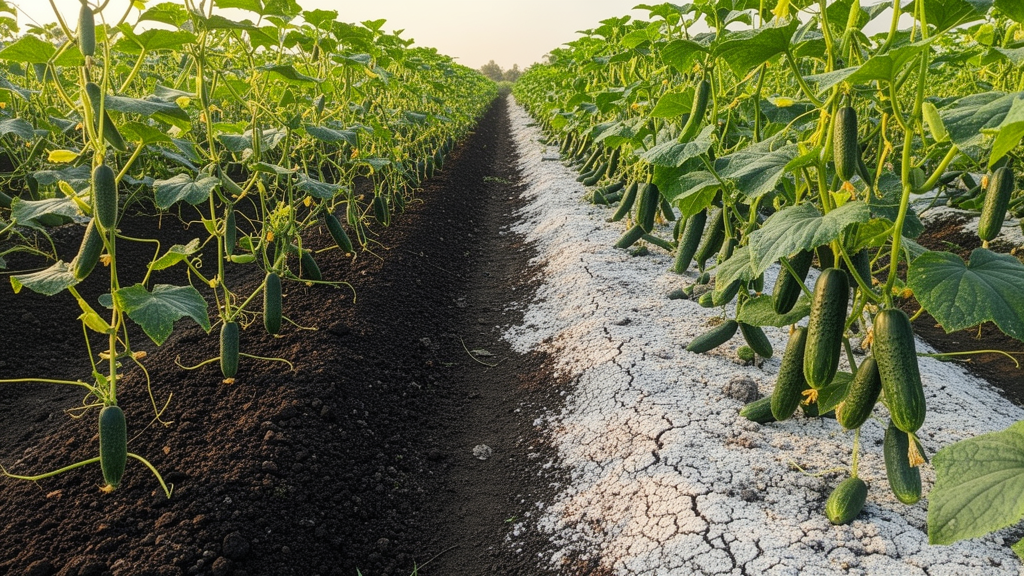
A four-trial, two-year field study in southwestern Nigeria found that the best cucumber management strategy depends on the product being targeted. CU 999 grown at 75 × 25 cm with 300 kg ha−1 of NPK 15-15-15 fertilizer ranked highest for per-hectare yield, while both CU 999 and Monalisa at the wider spacing of 75 × 75 cm with 300 kg ha−1 were strongest under a multi-criteria assessment of postharvest and nutritional quality. The experiment was conducted at the DUFARMS Research Farm of the Federal University of Agriculture, Abeokuta, during 2019 and 2020, with each year divided into trials planted at the onset of the main and late rainy seasons. Its results identify a practical yield-versus-nutrition trade-off, but they do not establish that either management route is the most profitable or environmentally sustainable option for smallholders.
The researchers evaluated two commercially cultivated cucumber varieties, CU 999 and Monalisa, at three plant spacings—75 × 25, 75 × 50 and 75 × 75 cm—and four NPK rates of 0, 100, 200 and 300 kg ha−1. The treatments were arranged in a split-split-plot randomized complete block design with three replications per trial. Each sub-subplot covered 6 m², with 0.5 m alleys between plots and 1 m between blocks. Fruit was harvested at commercial maturity, defined as 10–12 days after anthesis, with uniform dark-green skin and a length of 14–18 cm. Five randomly selected fruits from the middle two rows of each sub-subplot, excluding border plants, were taken for laboratory analysis.
CU 999 generally produced firmer fruit, while Monalisa consistently had greener skin. In the second 2019 trial, firmness averaged 1.35 kg for CU 999 compared with 1.15 kg for Monalisa; in the second 2020 trial, the corresponding values were 1.20 and 1.05 kg. Wider spacing also supported firmness, with fruits at 75 × 75 cm reaching 1.35 kg in the second 2019 trial compared with 1.07 kg at 75 × 25 cm. Fertilizer rate also affected firmness, but the response was not consistently linear: the highest mean occurred at 100 kg ha−1 in the first 2019 trial, at the unfertilized control in the second 2019 trial, and at 300 and 200 kg ha−1 in the two 2020 trials. In the first 2020 trial, the firmest treatment combination was CU 999 at 75 × 75 cm with 300 kg ha−1, at 1.46 kg.
Monalisa’s advantage in green coloration was more consistent than any fertilizer effect. Its CIELAB a* values were more negative than those of CU 999 in all four trials, indicating greener skin. In the second 2019 trial, the values were −12.13 for Monalisa and −10.54 for CU 999; in the first 2020 trial, they were −7.94 and −3.52, respectively. Spacing altered skin color significantly in every trial, although wider spacing produced greener fruit in only two trials. A rate of 200 kg ha−1 generally corresponded to greener skin than lower or higher rates, but this pattern was not uniform. Significant three-way interactions among variety, spacing and fertilizer were recorded for both firmness and color in all four trials, showing that the best combination depended on season and the trait under examination.
The clearest nutritional response was associated with the highest fertilizer rate. NPK at 300 kg ha−1 significantly increased vitamin A in every trial, reaching 35.93 µg/100 g in the second 2019 trial compared with 30.39 µg/100 g in the unfertilized control. It also produced the highest vitamin K values in all four trials, including 19.05 µg/100 g versus 15.84 µg/100 g under the control in the first 2019 trial. Vitamin C responded significantly to fertilizer rate in each trial, but not in a uniformly dose-dependent fashion: the highest mean occurred at 100 kg ha−1 in the first 2019 trial, 300 kg ha−1 in the second, and 200 and 300 kg ha−1 in the two 2020 trials. Monalisa generally had slightly more vitamin A than CU 999, while the varieties did not differ significantly in vitamin K in most trials.
Plant spacing was especially influential for vitamin K and vitamin C. The 75 × 75 cm treatment produced the highest vitamin K concentration in every trial, including 17.55 µg/100 g compared with 16.50 µg/100 g at 75 × 25 cm in the second 2019 trial. It also yielded the highest mean vitamin C concentration in the second 2019 trial and both 2020 trials, while the first 2019 trial instead favored 75 × 50 cm. These observations are consistent with the broader pattern in which reduced competition at wider spacing was associated with more concentrated fruit constituents. The relationship was not simply a matter of maximizing every vitamin at once: riboflavin, identified in the study as vitamin B2, remained uniformly low at 0.03–0.04 mg/100 g, and the 300 kg ha−1 fertilizer rate increased it significantly only in the two 2020 trials.
Fruit composition showed the same tension between output and concentration. The closest spacing maximized per-hectare yield, but its fruit contained less vitamin C in the study’s interpretation, consistent with nutrient dilution at high plant density. Wider spacing generally increased dry matter. NPK at 300 kg ha−1 gave the highest dry matter in three of four trials, including 5.27 g/100 g in the first 2020 trial, compared with 3.46 g/100 g in the control. The 75 × 75 cm treatment generally produced higher dry matter, while the 75 × 50 cm treatment sometimes gave the highest carbohydrate level. Fiber ranged from 0.25 to 0.50 g/100 g, with wider spacing and higher NPK rates generally associated with higher values. Fat remained low throughout, at 0.10–0.15 g/100 g, and did not differ significantly between varieties.
The multivariate analysis summarized the combined pattern. CU 999 at 75 × 75 cm with 300 kg ha−1 achieved the highest TOPSIS closeness coefficient, 0.768, indicating the strongest overall position across the measured postharvest and nutritional criteria. By contrast, CU 999 at 75 × 25 cm with the same fertilizer rate was the yield-maximizing recommendation. Principal component analysis placed vitamin content, dry matter and firmness together along the first component, while moisture and proximate fractions dominated the second. Treatments receiving 300 kg ha−1 consistently shifted toward higher scores on the first component. The moisture content was strongly inversely correlated with dry matter, with r = −0.93, and negatively associated with most vitamins. Firmness correlated positively with dry matter at r = 0.72 and with vitamin K at r = 0.68.
These results show why a single “best” treatment cannot summarize the experiment. The study analyzed each season independently because planting date, rainfall and soil conditions differed, and the four trials did not support a combined multi-environment analysis without explicit site-year covariates. ANOVA and Fisher’s least significant difference were used for treatment comparisons, while correlation, principal component analysis and TOPSIS were used to examine the combined profile. The 75 × 75 cm and 300 kg ha−1 combination should therefore be interpreted as a quality-oriented option rather than a definitive commercial recommendation. It uses fewer plants per unit area and requires a high fertilizer input, so profitability, fertilizer efficiency and environmental risk remain unresolved.
The findings nevertheless offer a clear experimental distinction for southwestern Nigerian cucumber production: close spacing favored volume, whereas wider spacing repeatedly favored dry matter and selected vitamins; CU 999 favored firmness, and Monalisa favored green skin color. The authors also identify limitations that constrain interpretation. Trials were conducted at one site over two years, economic feasibility was not tested, and vitamins A and K were quantified spectrophotometrically rather than by the more selective HPLC method. The study therefore demonstrates a management-linked trade-off in cucumber quality under tropical open-field conditions, while further location-based, economic and environmental studies are needed before the highest NPK rate can be presented as a broadly optimal production choice.
Subject of Research: Field study of cucumber variety, spacing and NPK effects on yield, postharvest quality and nutritional composition
Article Title: Variety, plant spacing, and NPK fertilizer rate influence postharvest quality and nutritional composition of cucumber fruits in Southwest Nigeria
Article References: Falaiye, O. O., Kasali, A. O., Adeyemi, N. O., Oni, O. E., Somoye, R. A., Falaiye, O. M., & Adekunle, E. A. (2026). Variety, plant spacing, and NPK fertilizer rate influence postharvest quality and nutritional composition of cucumber fruits in Southwest Nigeria. Discover Plants, 3(1), Article 473. https://doi.org/10.1007/s44372-026-00957-7
Image Credits: AI Generated
DOI: 10.1007/s44372-026-00957-7
Keywords: cucumber, crop management, plant spacing, NPK fertilizer, food nutrition, postharvest quality, Nigeria, yield trade-offs, CU 999, Monalisa, Variety, plant
News Source: Daisy Hatcher. (October 21, 2026). Cucumber spacing and fertilizer shift yield, nutrition trade-offs. Scienmag.