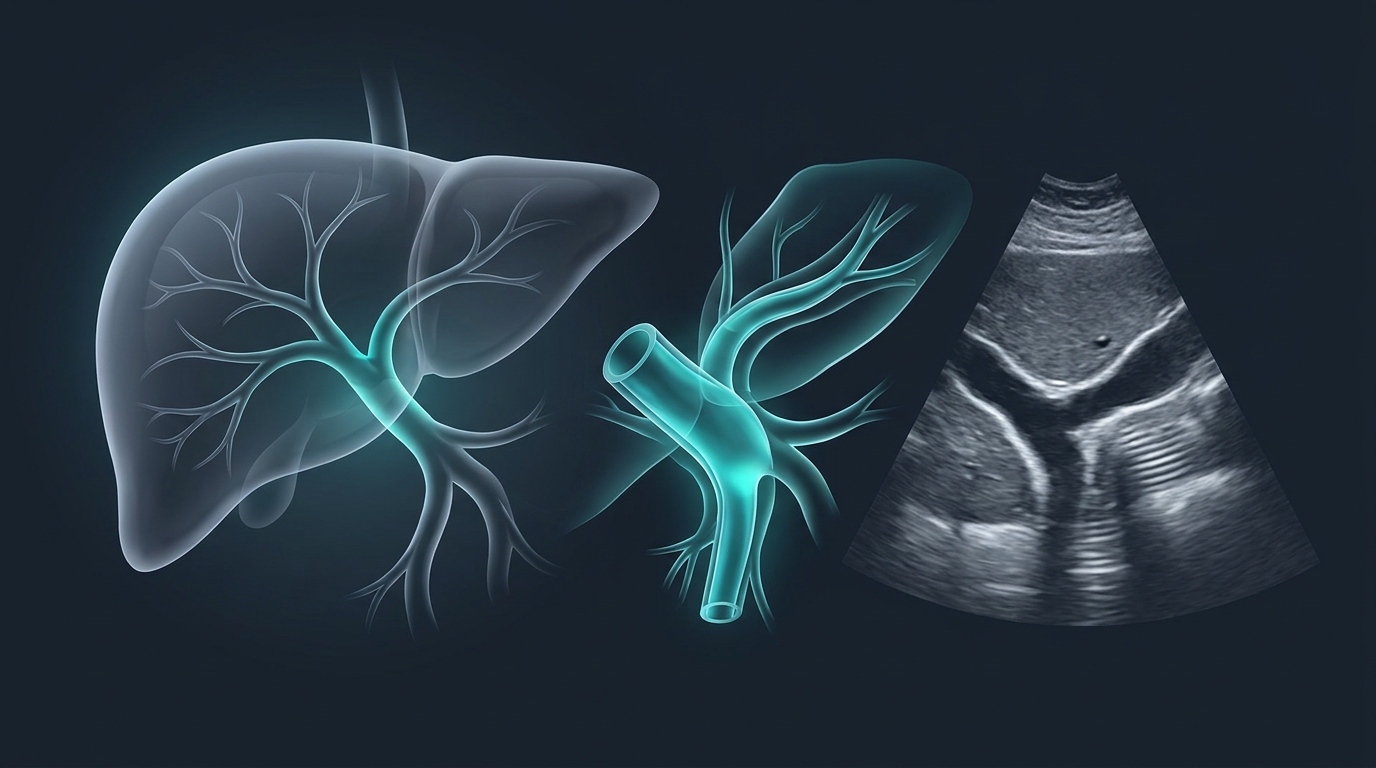
Radiologists who measure the portal vein in children with computed tomography have long had to rely on reference values borrowed from ultrasound, a technique that systematically reads the vessel as smaller than CT does. A new retrospective study of 1,101 children and adolescents now provides CT-specific normative data for the portal venous system, and it arrives with a practical warning: measurements taken with multiplanar reformation, which permits measurement perpendicular to the vessel’s long axis, consistently exceed standard axial measurements and should be compared against their own dedicated reference tables.
The study, published in Pediatric Radiology, was conducted at a single centre and drew on contrast-enhanced abdominal CT examinations performed between January 2018 and April 2026. After strict exclusion criteria were applied, the cohort spanned children from birth through 17 years of age. Two radiologists independently measured the diameters of the main portal vein in both axial and multiplanar reformation views, along with the right portal vein, the left portal vein and the splenic vein. Interobserver agreement was excellent across every parameter, with intraclass correlation coefficients ranging from 0.986 to 0.993.
The central technical finding concerns the gap between the two measurement methods. Multiplanar reformation measurements exceeded axial measurements in all 1,101 subjects, with a mean difference of 1.2 millimetres and a standard deviation of 0.9 millimetres. The discrepancy was not a fixed offset: proportional bias was present, with a correlation coefficient of 0.523 and a P value below 0.001, meaning the gap between the two techniques grew as the vessel itself grew larger. This effect was particularly pronounced in adolescents.
Why does the measurement plane matter? On a standard axial CT slice, a tubular structure such as the portal vein is often cut obliquely, so the displayed diameter depends on the angle of the cut. Multiplanar reformation allows the radiologist to reconstruct the image along a plane perpendicular to the vessel’s long axis. Because this perpendicular measurement is geometrically different from an axial one, the authors argue it cannot be judged against axial reference values, and tables generated specifically for MPR measurements should be used whenever that technique is employed.
Beyond the method comparison, the study mapped how portal venous dimensions scale with body size across childhood. Age showed the strongest correlation with main portal vein diameter, with a Spearman rank correlation of 0.894, making age the single best predictor of vessel calibre in this cohort. Reference values were therefore stratified by both age and body surface area, and the curves were generated using locally weighted scatterplot smoothing, a non-parametric technique that fits flexible curves to scattered data without imposing a rigid mathematical form.
Sex-based differences in vessel dimensions emerged only in the older portion of the cohort. Among subjects aged 13 years and above, differences between boys and girls were statistically significant across the measured parameters, with all corresponding P values at or below 0.006. In younger children, no such differences were detected.
One ratio proved remarkably stable across the entire paediatric age spectrum: the splenic-to-main portal vein diameter ratio varied with a coefficient of variation of just 8.2 percent. This relative constancy means that even as both vessels grow from infancy to adolescence, they do so in near lockstep, preserving a consistent proportional relationship that could serve as a useful internal check in clinical practice.
The clinical context is portal vein assessment in children, where vessel calibre helps radiologists evaluate suspected portal hypertension, thrombosis and other hepatobiliary conditions. The authors note that paediatric portal vein reference values have been derived almost exclusively from ultrasound, and that CT-specific normative data for children had previously been limited to a single study that lacked multiplanar reformation measurements, splenic vein data and comprehensive anthropometric analysis. The new dataset addresses all three gaps in a single cohort.
The study’s conclusion is direct: CT-based portal venous reference values in children differ substantially from ultrasound-derived reference values, and MPR-specific reference values should be used whenever MPR-based measurements are taken. As a single-centre retrospective study, the findings reflect the scanning protocols and population of one institution, and their generalisability to other populations will need confirmation in further work. Nevertheless, with 1,101 subjects, dual-reader verification and stratified tables spanning axial and reformatted views, the study gives paediatric radiology a comprehensive CT-native yardstick for the portal venous system.
Subject of Research: CT-based normative reference values for portal venous dimensions in children and adolescents
Article Title: Pediatric portal venous dimensions: a computed tomography-based normative study utilizing multiplanar reformation
Article References: Yasar, E., Unal Ozdemir, N. B., Agackaya, S. N., Agackaya, Y., & Yasar, Y. (2026). Pediatric portal venous dimensions: a computed tomography-based normative study utilizing multiplanar reformation. Pediatric Radiology. https://doi.org/10.1007/s00247-026-06828-3
Image Credits: AI Generated
DOI: 10.1007/s00247-026-06828-3
Keywords: pediatric radiology, portal vein, computed tomography, multiplanar reformation, reference values, splenic vein, body surface area, LOESS, interobserver agreement, adolescents, abdominal CT, normative data
News Source: Harold Sullivan. (November 4, 2026). CT scans reveal children’s portal veins measure larger than ultrasound suggests. Scienmag.